Recommended resources
The freely available resources this lesson will direct you to.
Welcome back. In our previous lesson, you learned how to record purchase transactions, distinguishing between short-term expenses (charges) and long-term investments (immobilisations). We specifically covered the journal entry for acquiring a fixed asset.
Today's lesson completes the lifecycle of a fixed asset, addressing the learning outcome: Record the acquisition and disposal of fixed assets (immobilisations). We will begin with a quick review of the acquisition process and then dedicate the majority of our time to mastering the accounting entries required when a company sells or discards an asset. Properly managing the disposal of assets is crucial for accurate financial reporting, as it directly impacts both the balance sheet and the income statement.
1. Review: Acquisition of a Fixed Asset
As a brief recap from our last session, when a company acquires a fixed asset, the journal entry recognizes the asset's cost (HT), the recoverable VAT, and the debt to the supplier.
The standard entry is:
| N° Compte | Intitulé du Compte | Débit | Crédit |
|---|---|---|---|
| 2xxx | Immobilisations... (e.g., Matériel de transport) | HT | |
| 34551 | État, TVA récupérable sur immobilisations | TVA | |
| 4481 | Fournisseurs d'immobilisations | TTC |
Remember, the key is to use a Class 2 account for the asset, the specific VAT account 34551, and the dedicated supplier account 4481.
To reinforce the critical distinction between an asset and an expense, examine the following image.
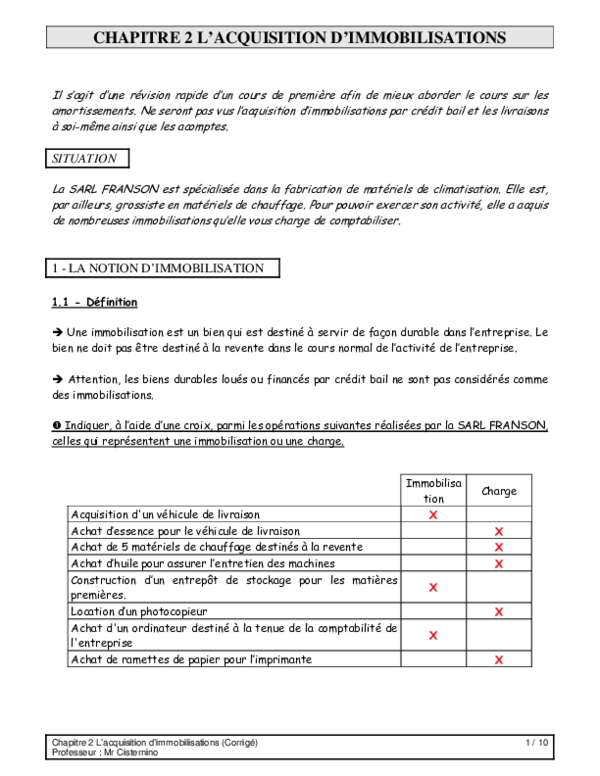
2. Prerequisite for Disposal: Understanding Depreciation
Before we can correctly account for the disposal of an asset, we must understand a fundamental concept: depreciation (amortissement). An asset like a vehicle or a computer loses value over time due to use, age, and technological obsolescence. Accounting records this gradual loss of value as an expense.
While we will cover the detailed calculation of depreciation in a future module, you need to be familiar with the core terminology to handle asset disposals.
The following document, 'Amortissements et Provisions', provides a clear introduction to depreciation. It defines the essential terms we will use throughout the rest of this lesson.
Please read section 1, 'Définition et terminologie'. Focus on understanding the definitions of 'Valeur d’origine (V.O)', 'dotation ou l’annuité d’amortissement', and 'valeur nette d’amortissement (VNA)'.
From your reading, here are the three key terms for our purpose:
- Valeur d'Origine (VO) / Original Cost: The total cost to acquire the asset (HT price + related costs like installation). This is the initial value recorded in the Class 2 account.
- Amortissement Cumulé / Accumulated Depreciation: The total depreciation expense recorded for the asset from the date of its acquisition until a specific point in time. This is tracked in a contra-asset account, typically
28xx. - Valeur Nette d'Amortissement (VNA) / Net Book Value (NBV): The remaining value of the asset on the company's books. It is the crucial figure needed for disposal and is calculated as:
The VNA represents the portion of the asset's cost that has not yet been expensed. When we sell the asset, we must remove this value from our books.
3. The 3-Step Process for Recording Asset Disposal
When a fixed asset is sold, you cannot simply remove it from the books. A specific three-step accounting process must be followed to ensure that the financial statements remain accurate. We will use the example of selling a company vehicle to illustrate this.
The following resource provides a detailed guide to this process. We will walk through it step-by-step.
We will now use the same 'Amortissements et Provisions' document to learn the accounting procedure for selling a fixed asset.
Refer to section 4.1, 'La cession des immobilisations amortissables - Le système linéaire'. We will follow the three steps outlined: 'La constatation de la dotation complémentaire', 'La constatation de la valeur nette d’amortissement', and 'La constatation du produit de cession'.
Let's break down the three essential journal entries.
Step 1: Record Complementary Depreciation (Dotation Complémentaire)
An asset depreciates for as long as you own and use it. If you sell it mid-year, you must first record the depreciation expense for the period from the beginning of the year until the date of sale.
- Purpose: To update the asset's accumulated depreciation and recognize the expense for the final period of use.
- Entry:
- Debit
619x - Dotations d'exploitation aux amortissements...(Depreciation Expense) - Credit
28xx - Amortissement de l'immobilisation...(Accumulated Depreciation)
- Debit
As shown in the resource's example (sale on 01/10/N+3), depreciation for the 9 months of use in year N+3 is calculated and recorded. This is a standard year-end adjustment that is simply performed earlier, at the date of disposal.
Step 2: Remove the Asset and Record its Net Book Value (VNA)
Now that depreciation is up to date, you can remove the asset from your books. This entry clears the asset's original cost and its total accumulated depreciation. The balancing figure is the asset's Net Book Value (VNA) at the time of sale, which is recorded as an expense.
- Purpose: To take the asset off the balance sheet and recognize its remaining book value as the cost of disposal.
- Entry:
- Debit
28xx - Amortissement de l'immobilisation...(with the total accumulated depreciation, including the complementary amount from Step 1). - Debit
6513 - VNA des immobilisations corporelles cédées(VNA of tangible assets sold). - Credit
2xxx - Immobilisation...(with the asset's original cost).
- Debit
This entry zeroes out the asset account (2xxx) and its related accumulated depreciation account (28xx). The VNA is now recorded in a Class 6 expense account.
Step 3: Record the Sale Proceeds (Produit de Cession)
Finally, you record the sale itself. This entry recognizes the payment received (or receivable) and the revenue generated from the sale, along with any VAT collected.
- Purpose: To record the cash inflow or receivable and the income from the sale.
- Entry:
- Debit
5141 - Banques(if paid by cheque) or4485 - Créances sur cessions d'immobilisations(if sold on credit). - Credit
7513 - Produits des cessions d'immobilisations corporelles(Proceeds from disposal of tangible assets). - Credit
4455 - État, TVA facturée(Collected VAT).
- Debit
The image below shows a clear example of this third entry.

The profit or loss on disposal is not recorded in a single account. It is the net result of the expense recorded in Step 2 (6513 - VNA) and the income recorded in Step 3 (7513 - Produit de cession).
- If
Produit de Cession (7513)>VNA (6513), the company made a profit (plus-value). - If
Produit de Cession (7513)<VNA (6513), the company incurred a loss (moins-value).
Test your understanding!
A Moroccan SME, "Bati-Pro SARL", sells a machine on September 30, N. Here are the details:
- Original Cost (VO): 150,000 MAD (acquired on Jan 1, N-2)
- Accumulated Depreciation at Dec 31, N-1: 60,000 MAD
- Annual Depreciation Rate: 20% (straight-line)
- Sale Price (HT): 70,000 MAD, received via bank transfer. The VAT rate is 20%.
Prepare the three required journal entries for the disposal on September 30, N.
Show answer
First, let's calculate the key figures:
- Complementary Depreciation (Step 1): The machine was used for 9 months in year N.
- Depreciation = 150,000 * 20% * (9/12) = 22,500 MAD
- Total Accumulated Depreciation:
- Depreciation at Dec 31, N-1 + Complementary Depreciation = 60,000 + 22,500 = 82,500 MAD
- VNA at Sept 30, N (Step 2):
- VNA = VO - Total Accumulated Depreciation = 150,000 - 82,500 = 67,500 MAD
- Sale Proceeds (Step 3):
- HT Price = 70,000 MAD
- VAT = 70,000 * 20% = 14,000 MAD
- TTC Price = 70,000 + 14,000 = 84,000 MAD
Journal Entries:
Step 1: Record Complementary Depreciation (Sept 30, N)
| N° Compte | Intitulé du Compte | Débit | Crédit |
|---|---|---|---|
| 6193 | DEA des immobilisations corporelles | 22,500 | |
| 2833 | Amort. des inst. tech., mat. & outillage | 22,500 | |
| Dotation complémentaire pour cession |
Step 2: Remove Asset and Record VNA (Sept 30, N)
| N° Compte | Intitulé du Compte | Débit | Crédit |
|---|---|---|---|
| 2833 | Amort. des inst. tech., mat. & outillage | 82,500 | |
| 6513 | VNA des immobilisations corporelles cédées | 67,500 | |
| 2332 | Matériel et outillage | 150,000 | |
| Sortie de la machine cédée |
Step 3: Record Sale Proceeds (Sept 30, N)
| N° Compte | Intitulé du Compte | Débit | Crédit |
|---|---|---|---|
| 5141 | Banques | 84,000 | |
| 7513 | Produits des cessions d'immob. corp. | 70,000 | |
| 4455 | État, TVA facturée | 14,000 | |
| Cession de la machine |
Result: The company generated a profit (plus-value) of 70,000 (Produit) - 67,500 (VNA) = 2,500 MAD.
4. Professional Practice and Common Mistakes
Professional Terminology
| Terme Professionnel (French) | Accounting English | Meaning |
|---|---|---|
| Cession d'immobilisation | Disposal of a fixed asset | The act of selling, scrapping, or otherwise removing a fixed asset from the company. |
| Dotation complémentaire | Complementary depreciation | The depreciation expense recorded for the partial period before an asset's disposal. |
| Valeur Nette d'Amort. (VNA) | Net Book Value (NBV) | The asset's original cost less its total accumulated depreciation. |
| Produit de Cession | Proceeds from Disposal | The income (HT) generated from selling an asset. |
| Plus-value / Moins-value | Gain / Loss on disposal | The profit or loss resulting from the sale of an asset. |
Frequent Mistakes to Avoid:
- Forgetting Step 1: Failing to record complementary depreciation understates the total depreciation, overstates the VNA, and miscalculates the profit/loss on disposal.
- Confusing VNA and Sale Price: The VNA (
6513) is an expense representing the book value consumed. The sale price (7513) is income. They are two separate concepts. - Incorrectly Calculating VNA: Using the wrong accumulated depreciation amount (e.g., forgetting the complementary portion) will lead to an incorrect VNA.
- Omitting VAT on the Sale: The sale of a used business asset is generally subject to VAT. Forgetting to credit
4455 - État, TVA facturéeis a common compliance error.
Conclusion
You have now covered the complete accounting cycle for a fixed asset, from its purchase to its final disposal. Mastering this three-step disposal process is a significant milestone, as it is a common yet complex transaction that many junior accountants struggle with.
Key Takeaways:
- Accounting for an asset disposal is a three-step process:
- Record complementary depreciation up to the date of sale.
- Remove the asset's cost and accumulated depreciation from the books, recording its VNA as an expense (
6513). - Record the sale proceeds (income account
7513) and the relatedTVA facturée.
- The profit or loss on the sale is the difference between the proceeds (
7513) and the Net Book Value (6513).
Preview of the Next Lesson:
Having recorded sales to customers and purchases from suppliers, we have created receivables (créances) and payables (dettes). The next logical step is to settle these accounts. In our next lesson, we will focus on recording cash receipts from customers and payments to suppliers, managing the lifeblood of the business: its cash flow.