Recommended resources
The freely available resources this lesson will direct you to.
Welcome back to Module 2. In our last session, we focused on sales transactions and established a crucial principle: the VAT you collect on sales (TVA facturée) is a liability—money you owe to the state.
This lesson addresses the other side of the coin, fulfilling the learning outcome: Record purchase transactions for services and goods, including the calculation and recording of deductible VAT (TVA Récupérable). Just as you collect VAT for the state when you sell, you pay VAT to your suppliers when you buy. The government allows you to deduct this VAT you've paid from the VAT you've collected.
This "right to deduct" is an economic benefit, and in accounting, economic benefits are assets. Today, you will learn how to correctly record your purchases and the corresponding VAT asset.
1. The Mechanism of Deductible VAT
When your company buys goods or services for its operations, the supplier's invoice will include VAT. This VAT is called TVA récupérable (Recoverable or Deductible VAT). Instead of being an expense, it is considered a receivable from the state. At the end of each declaration period (monthly or quarterly), you will calculate what you owe the state using a simple formula:
VAT to Pay = VAT Collected on Sales (TVA Facturée) - VAT Paid on Purchases (TVA Récupérable)
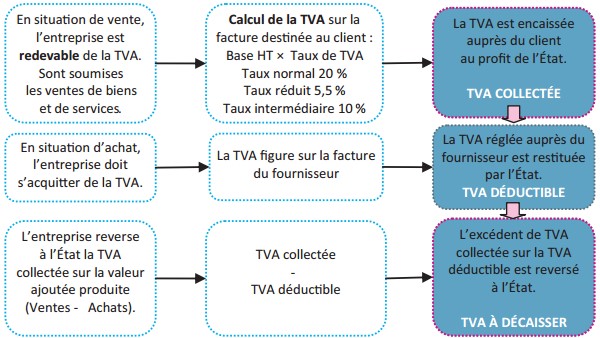
The flowchart below illustrates this dual mechanism. Our last lesson focused on the left side (TVA COLLECTÉE). Today, we focus on the right side (TVA DÉDUCTIBLE).
To understand the accounting for this asset, we'll start with a foundational resource.
The following resource from PlanComptable.ma introduces the key account for this lesson: 3455 - État, TVA récupérable. It explains its role and how it fits into the overall VAT mechanism.
Please read the initial sections titled '3455. Etat – TVA récupérable' and 'Le Mécanisme Fondamental de la TVA'. Focus on why this account is classified as an asset (actif circulant) and how it works as an 'intermediary' account.
As the reading highlights, Account 3455 - État, TVA récupérable accumulates all the VAT your company pays on its purchases. It's an asset (Class 3) because it represents a future economic benefit: the right to reduce your tax payment.
2. Recording Purchases of Services and Consumable Goods (Charges)
The most frequent purchases a business makes are for items consumed in the short term, such as office supplies, electricity, consulting services, or raw materials. In accounting, these are classified as charges (expenses) and recorded in Class 6 accounts.
Let's examine the journal entry to record such a purchase.
We'll continue with the same resource, '3455. Etat – TVA récupérable', which provides a clear, practical example of a purchase entry.
In the 'Exemple' section, focus only on '2. Enregistrement de la facture d’ACHAT'. Observe the three accounts used and how they are debited or credited. Note the use of account 6125 for the purchase, 3455 for the VAT, and 4411 for the supplier.
Based on this example, the standard structure for a purchase on credit is:
| N° Compte | Intitulé du Compte | Débit | Crédit |
|---|---|---|---|
| 6xxx | Achats / Services... | HT | |
| 3455 | État, TVA récupérable | TVA | |
| 4411 | Fournisseurs | TTC |
Let's break this down:
- Debit
6xxx - Charges: An expense account is increased with a debit. The expense for the company is only the pre-tax (HT) amount. - Debit
3455 - État, TVA récupérable: An asset account is increased with a debit. This reflects the growth of our claim against the state. - Credit
4411 - Fournisseurs: A liability account (Accounts Payable) is increased with a credit. This reflects the total amount (TTC) we owe to our supplier.
Notice the symmetry with a sales entry: Debits and Credits are reversed, and we use different accounts (Achats instead of Ventes, TVA récupérable instead of TVA facturée, Fournisseurs instead of Clients).
3. Distinguishing Between a Charge and a Fixed Asset
Not all purchases are immediate expenses. When a company buys a significant item that will be used for more than one year (like a vehicle, computer, or machinery), it's not a charge but an investment in an immobilisation (fixed asset). This distinction is fundamental.
The following resource explains this critical difference.
Comptabilité Marocaine : Comptabilisation des immobilisations
This article from NSE-MA clearly defines the difference between a charge and a fixed asset ('immobilisation') and why the distinction matters for tax purposes.
Read the sections 'Quelle est la différence entre une charge et une immobilisation ?' and 'Impact fiscal des charges et des immobilisations'. The key is to understand the criteria of durability and value.
In short:
- Charge (Expense): Consumed within the year. Directly reduces profit for the period. (e.g., stationery, rent).
- Immobilisation (Fixed Asset): Durable, used over several years. It's an asset (Class 2) and its cost is spread over its useful life via depreciation (a topic for a future lesson). (e.g., a delivery truck, a building).
4. Recording the Purchase of a Fixed Asset (Immobilisation)
Recording the acquisition of a fixed asset follows the same logic as a charge, but we use different accounts to reflect its long-term nature.
Let's see a concrete example.
Comptabilité Marocaine : Comptabilisation des immobilisations
We now turn to the section of the same article that shows the exact journal entry for acquiring a fixed asset.
Focus on the section 'Comptabilisation des acquisitions d’immobilisations' and study the example journal entry for the purchase of a 'matériel de transport'. Pay close attention to the account numbers used.
The journal entry to record a fixed asset purchase on credit is:
| N° Compte | Intitulé du Compte | Débit | Crédit |
|---|---|---|---|
| 2xxx | Immobilisations... | HT | |
| 34551 | État, TVA récupérable sur immobilisations | TVA | |
| 4481 | Fournisseurs d'immobilisations | TTC |
Key Differences to note:
- Asset Account (Debit): We debit a Class 2 account (e.g.,
2340 - Matériel de transport) instead of a Class 6 expense account. - VAT Account (Debit): We use a specific sub-account,
34551 - État, TVA récupérable sur immobilisations, to track VAT on fixed assets separately from VAT on charges (34552). This separation is a legal requirement in Morocco. - Supplier Account (Credit): We use
4481 - Fournisseurs d'immobilisationsto distinguish debts for long-term assets from debts for day-to-day supplies (4411).
Test your understanding!
Your Moroccan SME, "Alpha SARL," made two purchases on May 10. The VAT rate for both is 20%.
- Purchase 1: Bought office supplies from "BuroPlus" for 1,500 MAD HT on credit.
- Purchase 2: Bought a new computer for the office from "PC-Maroc" for 10,000 MAD HT on credit.
For each transaction:
a) Classify the purchase as either a charge or an immobilisation.
b) Calculate the VAT and the TTC amount.
c) Prepare the correct journal entry.
Show answer
1. Purchase 1: Office Supplies (Charge)
a) Classification: This is a charge, as supplies are consumed quickly.
b) Calculation:
* VAT = 1,500 * 20% = 300 MAD
* TTC = 1,500 + 300 = 1,800 MAD
c) Journal Entry:
| N° Compte | Intitulé du Compte | Débit | Crédit |
|---|---|---|---|
| 61221 | Achats de fournitures de bureau | 1,500 | |
| 34552 | État, TVA récupérable sur charges | 300 | |
| 4411 | Fournisseurs | 1,800 |
2. Purchase 2: Computer (Immobilisation)
a) Classification: A computer is a durable good used over several years, so it's an immobilisation.
b) Calculation:
* VAT = 10,000 * 20% = 2,000 MAD
* TTC = 10,000 + 2,000 = 12,000 MAD
c) Journal Entry:
| N° Compte | Intitulé du Compte | Débit | Crédit |
|---|---|---|---|
| 2355 | Matériel informatique | 10,000 | |
| 34551 | État, TVA récupérable sur immobilisations | 2,000 | |
| 4481 | Fournisseurs d'immobilisations | 12,000 |
5. Professional Terminology & Common Mistakes
Mastering the vocabulary is key to professional confidence.
| Terme Professionnel (French) | Accounting English | Meaning |
|---|---|---|
| TVA Récupérable | Deductible / Recoverable VAT | The VAT paid on purchases, which is an asset (a claim against the state). |
| Achats | Purchases | A general term for goods/services bought, typically referring to charges (Class 6). |
| Immobilisation | Fixed Asset / Non-current Asset | A long-term asset purchased for use in the business. |
| Fournisseurs | Suppliers / Accounts Payable | The liability account for money owed to regular suppliers of goods/services. |
| Fournisseurs d'immobilisations | Suppliers of fixed assets | The liability account specifically for money owed for fixed asset purchases. |
Frequent Mistakes to Avoid:
- Expensing a Fixed Asset: Recording the purchase of a computer or vehicle in a Class 6 account is a major error. It understates your assets and distorts your profit for the period.
- Recording TTC as the Cost: The cost of an asset or an expense is always the HT amount. The VAT is a separate asset (
TVA récupérable). - Using the Wrong VAT Account: Failing to distinguish between
TVA récupérable sur immobilisations(34551) andsur charges(34552) will cause problems during the VAT declaration.
Conclusion
You have now mastered the accounting for both sides of the VAT equation. You can record sales with collected VAT and purchases with deductible VAT, two of the most common activities in any business.
Key Takeaways:
- VAT paid on purchases (TVA Récupérable) is an asset, representing a claim against the state.
- The purchase of short-term goods/services is recorded as a charge (Class 6), while the purchase of long-term assets is an immobilisation (Class 2).
- A purchase journal entry involves three parts:
- A debit to a charge or immobilisation account for the HT amount.
- A debit to the appropriate
TVA Récupérableaccount (34551or34552) for the TVA amount. - A credit to a supplier account (
4411or4481) for the total TTC amount.
Preview of the Next Lesson:
We have now covered the acquisition of fixed assets. But assets don't stay with a company forever. In the next lesson, we will continue our focus on fixed assets by learning how to record their disposal—what happens when you sell or discard an old piece of equipment or a vehicle.