Recommended resources
The freely available resources this lesson will direct you to.
Welcome to Module 2: Recording Core Business Transactions with VAT.
In our first module, you built the essential mechanical skills of accounting—analyzing transactions, creating journal entries, and verifying your work with a trial balance. You've learned the fundamental language and structure of bookkeeping.
Now, we move from the abstract to the concrete. This module applies those skills to the daily operations of a Moroccan business. We begin with the most vital transaction for any company: making a sale.
This lesson is designed to help you master the learning outcome: Record sales transactions (cash and credit), including the calculation and recording of collected VAT (TVA Facturée). You will learn how to handle this common transaction correctly, integrating a key element of the Moroccan tax system from the very beginning.
1. Understanding VAT in Sales Transactions
In Morocco, most sales of goods and services are subject to a Value Added Tax, known as TVA (Taxe sur la Valeur Ajoutée). As an accountant, one of your primary roles is to correctly calculate, record, and declare this tax.
A crucial concept to grasp is that the VAT a company collects from its customers does not belong to the company. The company acts merely as a tax collector for the state (l'État). It is not revenue.
Let's break down the components of a sales invoice:
- Montant Hors Taxe (HT): This is the actual price of the good or service. This is the amount that constitutes the company's revenue.
- TVA: This is the tax calculated on the HT amount.
- Montant Toutes Taxes Comprises (TTC): This is the total amount the customer must pay (HT + TVA).
The following resource provides a brief but clear explanation of this mechanism and lists the standard VAT rates in Morocco.
This document, 'TAXE SUR LA VALEUR AJOUTEE' from mcours.net, explains the basic principle of VAT. We will focus on how the amounts are calculated and the different rates.
First, read the paragraph under 'A- Principe de La Taxe Sur la Valeur Ajoutée' to understand why VAT is neither a charge nor a product for the company. Then, review section 'B- Les taux de la TVA' to see the formulas for calculating the amounts and to familiarize yourself with the different rates. For our examples, we will primarily use the normal rate of 20%.
As you've read, the key formulas are:
TVA = HT × Taux de TVATTC = HT + TVAorTTC = HT × (1 + Taux de TVA)
For example, if a company sells a product for 1,000 MAD HT at a 20% VAT rate:
- TVA = 1,000 × 0.20 = 200 MAD
- TTC = 1,000 + 200 = 1,200 MAD
The company earns 1,000 MAD in revenue and has a liability of 200 MAD to pay to the state.
2. The Accounting Entry for a Sale with VAT
To record the VAT collected, we use a specific account from the Moroccan Chart of Accounts (Plan Comptable): 4455 - État, TVA facturée (State, VAT invoiced).
The following reading explains the nature of this account and shows exactly how to use it in a journal entry.
This page from PlanComptable.ma focuses entirely on account 4455. It clearly defines it as a liability and provides a perfect example of a sales journal entry.
Read sections '1. Nature et Rôle du Compte', '2. Ce qu’il enregistre', '3. La Contrepartie', and the 'Exemple' (Step 1 only). Focus on understanding why account 4455 is a liability (a debt to the state) and how the three-part journal entry is constructed.
Based on the reading, here is the standard structure for a credit sale (where the customer will pay later):
| N° Compte | Intitulé du Compte | Débit | Crédit |
|---|---|---|---|
| 3421 | Clients | TTC | |
| 7111 | Ventes de marchandises au Maroc | HT | |
| 4455 | État, TVA facturée | TVA |
Let's analyze this entry based on what you learned in Module 1:
- Debit
3421 - Clients: This is an asset account (Accounts Receivable). We debit it to increase the asset, reflecting the total amount (TTC) the customer owes us. - Credit
7111 - Ventes de marchandises: This is a revenue account. We credit it to increase our revenue, but only by the HT amount that we actually earned. - Credit
4455 - État, TVA facturée: This is a liability account. We credit it to increase our liability, reflecting the debt (the VAT amount) we now owe to the tax authorities.
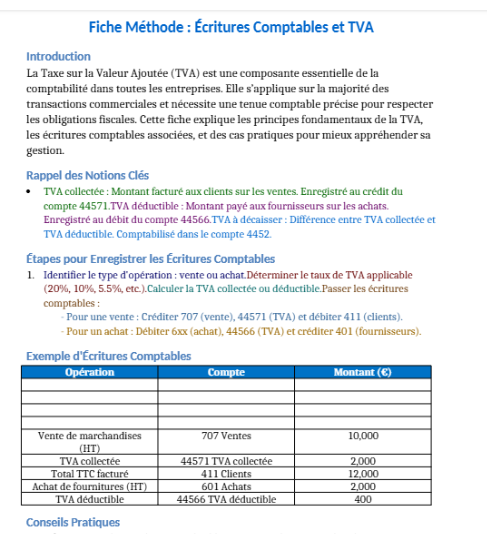
The image below summarizes this logic clearly.
3. Cash Sales vs. Credit Sales
The learning outcome requires you to handle both cash and credit sales. The accounting treatment is nearly identical, with one small but important difference: the account you debit.
- For a credit sale (vente à crédit): The customer owes you money. You debit
3421 - Clients. - For a cash sale (vente au comptant): The customer pays immediately. You debit the account where the money was received, typically
5141 - Banques(if by bank transfer/cheque) or5161 - Caisses(if in physical cash).
Example:
A company sells goods for 5,000 MAD HT with 20% VAT (1,000 MAD TVA, 6,000 MAD TTC).
Scenario A: Credit Sale
The customer will pay in 30 days.
| N° Compte | Intitulé du Compte | Débit | Crédit |
|---|---|---|---|
| 3421 | Clients | 6,000 | |
| 7111 | Ventes de marchandises | 5,000 | |
| 4455 | État, TVA facturée | 1,000 |
Scenario B: Cash Sale
The customer pays immediately by bank transfer.
| N° Compte | Intitulé du Compte | Débit | Crédit |
|---|---|---|---|
| 5141 | Banques | 6,000 | |
| 7111 | Ventes de marchandises | 5,000 | |
| 4455 | État, TVA facturée | 1,000 |
The revenue (credit to 7111) and the liability to the state (credit to 4455) are the same in both cases. The only change is which asset increases.
Test your understanding!
On March 15, your company, "TechSolutions SARL," sells IT services to a client for 10,000 MAD HT. The VAT rate is 20%.
- Calculate the VAT amount and the total TTC amount.
- Prepare the journal entry assuming the client will pay next month.
- Prepare the journal entry assuming the client paid immediately by cheque.
Show answer
-
VAT Amount: 10,000 MAD * 20% = 2,000 MAD
TTC Amount: 10,000 MAD + 2,000 MAD = 12,000 MAD -
Journal Entry for Credit Sale:
| N° Compte | Intitulé du Compte | Débit | Crédit |
|---|---|---|---|
| 3421 | Clients | 12,000 | |
| 7121 | Ventes de services produits | 10,000 | |
| 4455 | État, TVA facturée | 2,000 | |
| (Note: We use account 7121 for services instead of 7111 for goods) |
- Journal Entry for Cash Sale (via bank):
| N° Compte | Intitulé du Compte | Débit | Crédit |
|---|---|---|---|
| 5141 | Banques | 12,000 | |
| 7121 | Ventes de services produits | 10,000 | |
| 4455 | État, TVA facturée | 2,000 |
4. Sales Entries in Professional Software
In a real company, these entries are recorded in accounting software. The principles are exactly the same. The screenshot below shows a sales journal in a program like Sage, which is common in Moroccan SMEs.

Notice how the software enforces the double-entry rule. There is one debit to the client account for the full TTC amount, and two corresponding credits: one for the HT revenue and one for the TVA facturée.
Professional Terminology & Common Mistakes
| Terme Professionnel (French) | Accounting English | Meaning |
|---|---|---|
| TVA facturée | Collected VAT | The VAT charged on sales invoices, which is a liability to the state. |
| Ventes de marchandises / services | Sales of goods / services | The revenue accounts where the HT amount is recorded. |
| Clients | Accounts Receivable / Customers | The asset account representing money owed by customers. |
| Hors Taxe (HT) | Net of Tax / Before Tax | The amount of a transaction before VAT is added. |
| Toutes Taxes Comprises (TTC) | Gross / All Taxes Included | The total amount including VAT. |
Frequent Mistakes to Avoid:
- Recording TTC as Revenue: A very common error for beginners is to credit the Sales account for the full TTC amount. This overstates your revenue and is incorrect. Revenue is always the HT amount.
- Using the Wrong VAT Account:
4455 - État, TVA facturéeis used for sales. For purchases, you will use a different account, which we will cover in the next lesson. - Calculation Errors: Always double-check your VAT calculation. An error here will create problems not only in your accounting records but also in your tax declarations.
Conclusion
In this lesson, you have taken a major step into practical, real-world accounting. You've moved beyond basic mechanics to record a core business transaction that includes a crucial tax component.
Key Takeaways:
- VAT collected on sales (TVA facturée) is not company revenue; it is a debt to the state.
- This debt is recorded as a credit in the liability account
4455 - État, TVA facturée. - A sales journal entry always involves three key components:
- A debit to an asset (
ClientsorBanques) for the TTC amount. - A credit to a revenue account (
Ventes...) for the HT amount. - A credit to a liability account (
État, TVA facturée) for the TVA amount.
- A debit to an asset (
- The distinction between a cash and credit sale determines whether you debit the
Clientsaccount or a cash/bank account.
Preview of the Next Lesson:
Now that you understand how to account for VAT when you sell, the next logical step is to understand the other side: accounting for VAT when you buy. In our next lesson, we will focus on recording purchase transactions for goods and services, and you will be introduced to the concept of deductible VAT (TVA Récupérable).