Recommended resources
The freely available resources this lesson will direct you to.
Introduction
In our previous lesson, you built the foundation of your "Second Brain"—a personal knowledge management system in Obsidian designed to capture and connect your insights. Now, we will put that system to work on one of its most critical applications: documenting your value. Your work is more than a series of completed tasks; it's a collection of solved problems and delivered impact. This lesson is about creating a systematic record of that impact.
The learning outcome for this session is to maintain a structured 'brag document' that records weekly problems solved, contributions made, and impact delivered. This isn't about ego; it's a strategic tool that provides the evidence needed for performance reviews, promotions, and advocating for your career growth. We will transform the solutions you capture in your PKM into a compelling narrative of your professional contributions.
1. The Mindset Shift: From Hard Work to Visible Value
As a developer, it's easy to fall into the trap of believing that simply working hard and closing tickets will automatically lead to recognition and career progression. However, impact that isn't visible is often overlooked. The key to career growth isn't just working hard; it's working on the right things and ensuring that the value you create is understood by others.
The following video from a Principal Engineer at Amazon explains this critical distinction. He introduces the concept of finding "product-market fit" for your skills—aligning what you do with the expensive, painful problems your company needs to solve.
Why Hard Work Doesn’t Lead To Career Growth (And What Actually Does)
This video, "Why Hard Work Doesn’t Lead To Career Growth," provides the essential context for why a brag document is so powerful. It reframes career success as a function of creating visible value.
Watch these key sections to understand the core philosophy: First, watch the introduction explaining the problem of invisible work. Next, learn about product-market fit for your career. Pay close attention to the shift from asking "How can I improve my skills?" to "What expensive pain can I solve?". Finally, absorb the section on market research, which teaches you how to identify these valuable problems by talking to your manager.
Your brag document is the logbook of how you solve these "expensive pains." It's the story of your value creation, written in the language of problems and results.
2. The Brag Document: Your Career's Greatest Hits Mixtape
A brag document (also called a "hype doc" or "accomplishment log") is a private, running record of your professional achievements. It serves as the single source of truth for your contributions, ensuring you don't have to scramble to remember your accomplishments when performance review season arrives.
Let's watch another clip from the same engineer, where he introduces the brag document as a high-leverage career skill.
3 High-Leverage Career Skills (From a Principal At Amazon)
In this video, "3 High-Leverage Career Skills," the speaker details the "why" and "how" of starting and maintaining a brag document.
Watch these segments for a practical overview: From the introduction, understand why relying on memory is a failed strategy. Then, watch his step-by-step guide and personal example of a brag document entry. Finally, listen to the benefits and alternatives. Notice his point that this system is low-overhead compared to daily journals, making it more sustainable.
The core idea, as highlighted in Julia Evans' seminal blog post on the topic, is that your manager cannot possibly remember everything you did. Your brag document makes their job of advocating for you easier by providing concrete, detailed evidence.
Get your work recognized: write a brag document - Julia Evans
This blog post by Julia Evans is the classic text on brag documents. It clearly lays out the rationale and benefits.
Read the first few sections to solidify your understanding of the purpose: Start from the beginning and read through your manager doesn’t remember. Continue through the sections on sharing with your manager.
3. Anatomy of an Impactful Entry
A great brag document goes far beyond "Completed ticket DEV-123." A powerful entry connects your actions to business and technical impact. It should be structured to tell a miniature story: there was a problem, here's what I did, and here was the result.
The following table is an excellent example of a well-structured brag document, mapping projects to goals, results, and specific contributions.
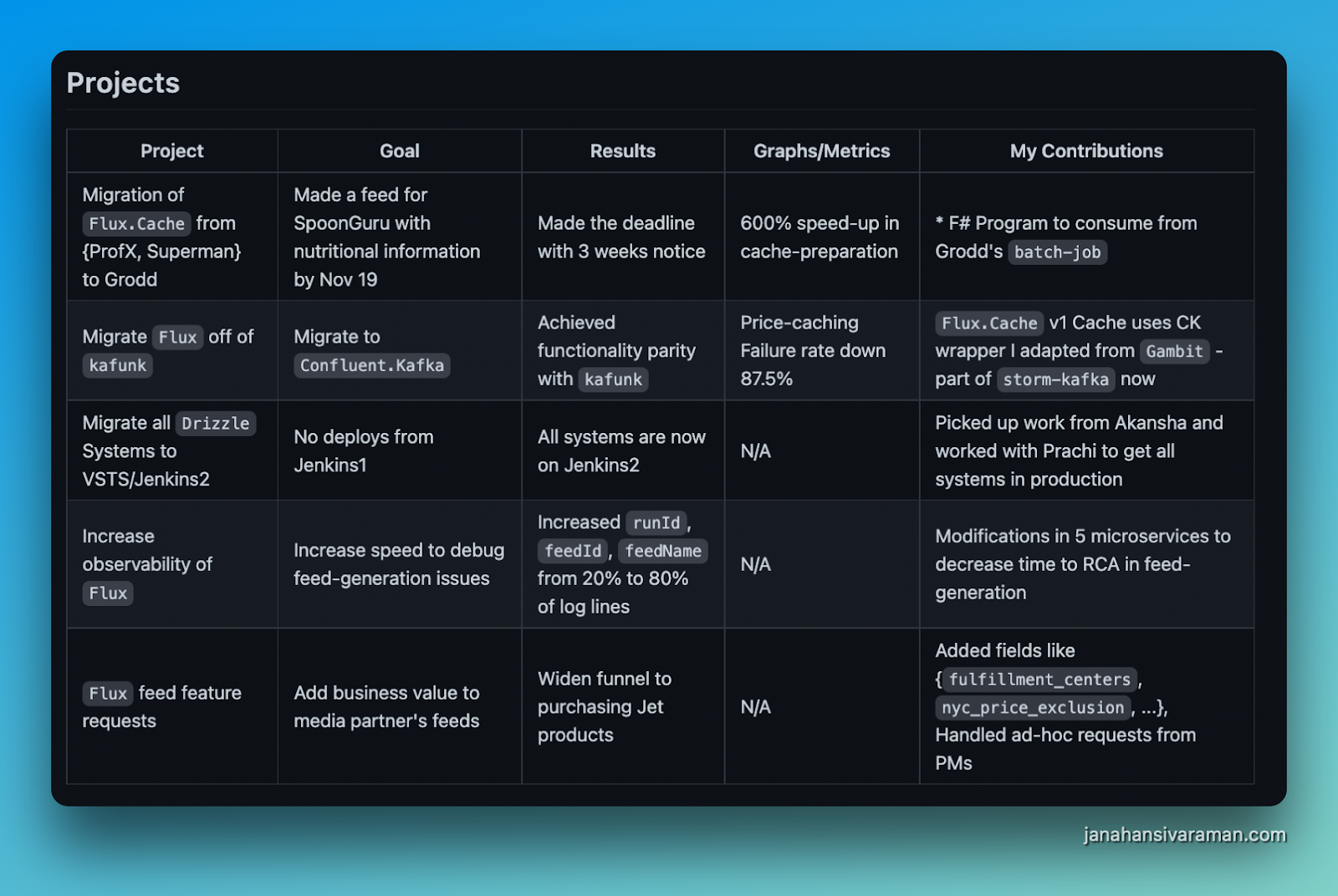
To build entries like this, focus on capturing these key categories of work.
Brag Document for Software Engineers: What to Track & How - Locu
This article from Locu is tailored specifically for software engineers and provides excellent, quantifiable examples of what to track.
Please read the sections What to Track and Example Entry. Pay close attention to the five categories and how the example entry quantifies impact (e.g., "81% improvement," "-$8k/month").
As you read, note these crucial categories:
- Shipped Features & Projects: What did you build? Who uses it? What was the outcome?
- Technical Wins: This is where your developer skills shine. Did you optimize a query, refactor a complex module, or fix a critical bug? Quantify the improvement (e.g., "Reduced P99 latency from 800ms to 120ms").
- Impact & Metrics: This is the language of business value. Always try to connect your work to metrics like time saved, money saved/earned, or error rate reductions.
- Leadership & Collaboration: This includes mentoring junior developers, leading design reviews, improving team processes, or writing excellent documentation. This "fuzzy work," as Julia Evans calls it, is often the hallmark of a senior contributor.
- Feedback & Recognition: Capture screenshots of positive Slack messages, emails from stakeholders, or shout-outs in team meetings. This is external validation of your impact.
Practical Application: Build Your Brag Document Template
Now, let's integrate this practice directly into the Obsidian vault you created in the last lesson. We'll create a new template specifically for your brag document entries.
1. Create Your Brag Doc Template (10 mins):
- In your Obsidian vault, navigate to your templates folder (e.g.,
04_Resources). - Create a new note named
T - Brag Entry.md. - Paste the following Markdown into the note. This template is a synthesis of the best practices from Julia Evans and the Locu blog post.
---
tags:
  - brag-entry
date: {{date}}
quarter: Q_
project:
related_tech:
  - Java
  - React
  - SQL
---


### 🚀 [Accomplishment Title]

**1. Problem & Context:**
*Describe the situation. What was the business need, user problem, or technical debt? What was the "expensive pain"?*


**2. My Actions & Contribution:**
*What specifically did I do? Be precise. Use "I" statements. (e.g., "I designed the new API endpoint," "I refactored the service to use the Strategy pattern," "I mentored the new hire on our deployment process.")*


**3. Impact & Results:**
*This is the most important section. Quantify the outcome whenever possible.*
- **Metrics:** (e.g., Reduced p99 latency by 70%, Decreased monthly cost by $X, Increased user engagement by Y%)
- **Feedback:** (e.g., "Received positive feedback from the product manager," "Link to Slack message from stakeholder")
- **Strategic Value:** (e.g., "This unblocked the mobile team," "Established a new best practice for the team")


**4. Skills Demonstrated:**
*List the key skills this work showcases.*
- (e.g., System Design, Java, Spring Boot, Mentorship, Cross-team Communication)

---
2. Log Your First Accomplishment (15 mins):
- Think of one thing you accomplished this past week. It doesn't have to be monumental. Perhaps you fixed a tricky bug, helped a teammate get unblocked, or finished a small feature.
- Create a new note in your
01_Inboxfolder. - Use the
Templaterhotkey to insert your new "Brag Entry" template. - Fill out the template for your accomplishment. Be as specific as you can. Even if you don't have hard metrics yet, write down what you think the impact will be. You can often go back and add metrics later.
- Once completed, you can move this note to a new folder,
05_Brag-Book, or simply rely on the#brag-entrytag to find all your entries later.
You have now created your first "paper trail of competence" entry. This is the raw data you will use to build promotion packets, update your resume, and prepare for performance reviews.
Conclusion
In this lesson, you've established a system for documenting your professional impact. You've moved beyond just doing the work to consciously recording the value you create. This is a fundamental habit of high-performing senior engineers and leaders.
Here are the key takeaways:
- A brag document is a strategic career tool for making your value visible and helping your manager advocate for you.
- Focus on impact, not just activity. Frame your accomplishments around the problems you solved and the results you delivered.
- Quantify your results with metrics whenever possible, but don't forget to include important "fuzzy" work like mentorship and process improvements.
- Integrating this practice into your existing PKM system with a dedicated template makes it a low-friction, sustainable habit.
You now have systems for managing your time (time blocking), your knowledge (PKM), and your accomplishments (brag document). In our next lesson, we will tie all of this together by establishing a weekly review protocol to plan and prioritize your technical and personal development goals. Updating your brag document will become a cornerstone of this powerful weekly ritual.