Recommended resources
The freely available resources this lesson will direct you to.
Introduction
Welcome to our next session. In the previous lesson, we developed a framework for cognitive reframing, learning to "refactor" self-limiting internal thoughts into growth-oriented ones. We focused on managing your inner monologue. Today, we build directly on that foundation by shifting our focus from our internal state to our external environment. It's not just about reframing thoughts, but also reframing problems.
This lesson is designed to help you achieve a crucial learning outcome: to shift from an external to an internal locus of control by identifying specific, actionable problems you can solve. We will dissect the psychological concept of "locus of control," understand how it manifests in a tech workplace, and develop a systematic approach to reclaim agency. This skill is a non-negotiable prerequisite for moving into senior and leadership roles, as it marks the transition from reacting to circumstances to proactively creating solutions.
1. The Core Engine: Agency and Locus of Control
The concept of "locus of control" (LoC) refers to the degree to which you believe you have control over the outcomes of events in your life. It exists on a spectrum between external and internal.
- An external locus of control is the belief that your life is primarily shaped by outside forces: luck, fate, other people's decisions, or the environment.
- An internal locus of control is the belief that you are the primary agent in your life, and your own actions, efforts, and decisions shape your outcomes.
This isn't an innate personality trait, but rather a mindset and a set of skills that can be cultivated. The infographic below provides a powerful visual summary of this distinction.

On the left, problems are attributed to external factors like the manager, the economy, or "others." On the right, those same life elements are pulled inside the circle of influence, reframed as learnable problems: a persuasion problem, a communication problem, an adaptability problem. This is the mental shift we are aiming for.
To explore this concept further and understand its profound impact on success and well-being, let's watch a segment from the "Therapy in a Nutshell" channel.
How to Build an Internal Locus of Control
This video clearly defines locus of control and highlights the different outcomes associated with each mindset.
Watch the section that defines the terms. Pay close attention to how an internal LoC is linked not just to success, but also to improved health and happiness.
2. Learned Helplessness in the Tech Workplace
While the concept of an internal LoC is empowering, it's important to acknowledge why an external LoC is so common, especially in large organizations. Tech workplaces can often feel like environments where you have very little control.
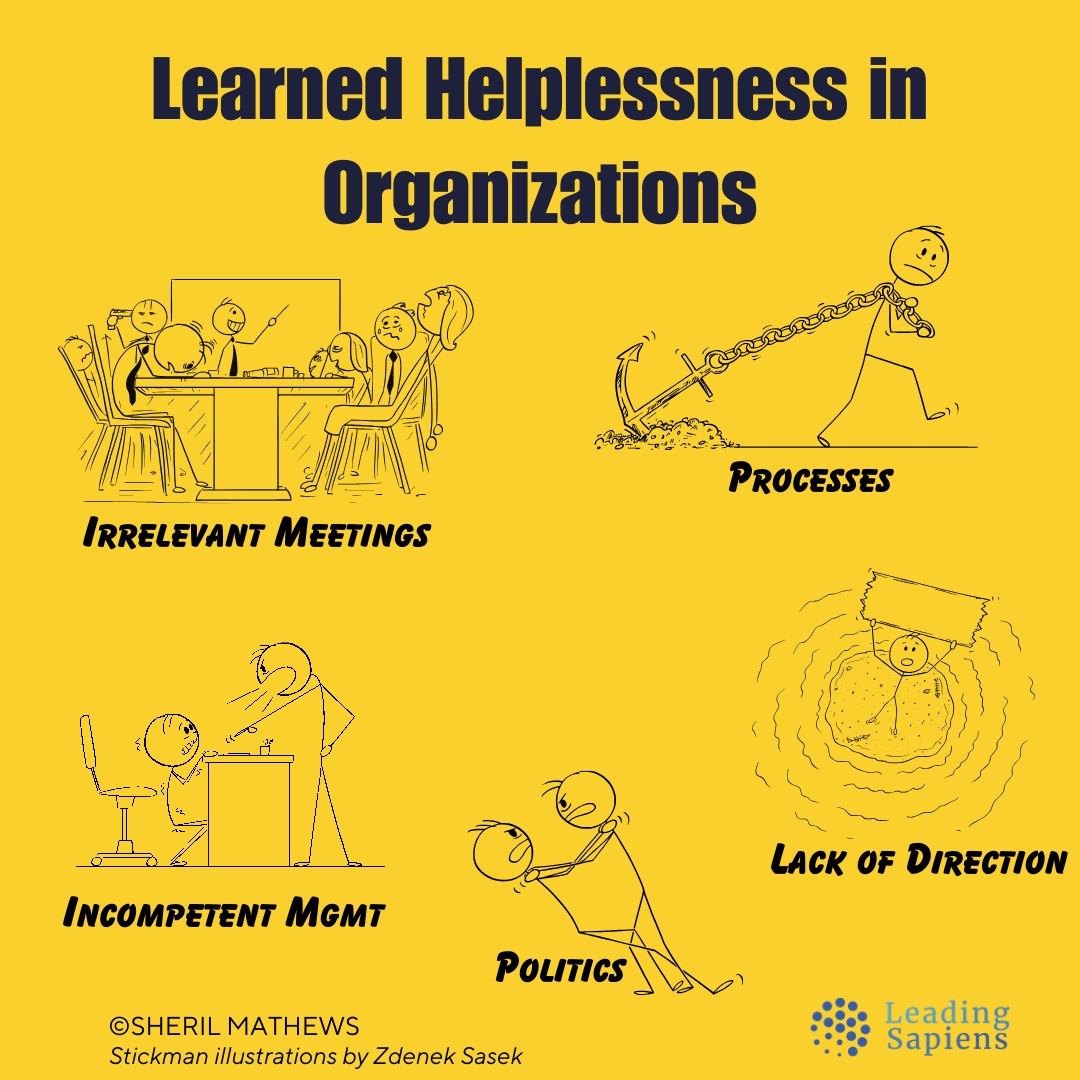
When faced with these systemic issues, it's easy to fall into a state of "learned helplessness," where you begin to believe your actions don't matter. This often manifests in two ways, which the "Therapy in a Nutshell" video calls the "helplessness wobble":
- Externalizing: Blaming outside forces for your problems. "I can't get promoted because of office politics." "This project is failing because management is clueless."
- Internalizing: Blaming a fixed, personal defect. "I'm just not smart enough to figure out this legacy system." "I'm too anxious to speak up in meetings."
While they seem different, both are forms of an external locus of control because they place the solution outside of your agency. The following segment of the video explains this dynamic in detail.
How to Build an Internal Locus of Control
This part of the video breaks down the concepts of externalizing and internalizing, providing clear examples for each.
Watch the segment from the discussion on this topic. As you watch, reflect on which of these patterns—externalizing or internalizing—you might see in yourself or your colleagues when faced with workplace frustrations.
3. A Framework for Shifting to Ownership
Recognizing these patterns is the first step. The next is to actively shift towards an internal locus of control using a deliberate framework. This is about moving from blame or self-pity to actionable problem-solving.
Step 1: Audit Your Language
The words you use, both in your head and out loud, reinforce your mindset. Shifting your language is a powerful first step in shifting your LoC.
Taking responsibility - The Modern Software Developer - Substack
This article from The Modern Software Developer offers direct, practical advice on how language shapes your sense of control.
Read the section under the heading "How do I take responsibility?". Focus on the distinction between 'Victim Language' (I have to, I must) and 'Responsibility Language' (I choose to, I want to). This simple reframing reinforces that your actions are choices.
Step 2: Separate What You Can and Cannot Control
This is the core tactical exercise. For any given problem, you must clearly distinguish between the elements you can influence and those you cannot.
How to Build an Internal Locus of Control
This segment introduces a simple yet powerful exercise for clarifying your locus of control.
Watch from this timestamp to see the "locus of control exercise" explained. It involves creating two columns: "Things I can control" and "Things I can't control." The goal is to focus your energy exclusively on the first column.
Step 3: Reframe the Problem and Take Ownership
Once you've identified what's in your control, you can take ownership. This doesn't mean taking the blame; it means taking responsibility for the response. A bug in production is a perfect case study for this. It's easy to blame external factors, but a senior mindset focuses on what could have been done differently.
Taking responsibility - The Modern Software Developer - Substack
This part of the article provides an excellent, developer-specific example of this principle in action.
Read the section titled How does taking responsibility help in software development?. Notice the list of potential external blames versus the list of internal actions. The key question is not "Whose fault is it?" but "How could I have improved the situation?"
This mindset of ownership is a recurring theme among effective senior engineers.
Career Advice I'd Give Every Software Engineer Right Now
In this clip from his channel "Beyond Coding," the speaker shares his personal philosophy on ownership.
Listen to his perspective from this timestamp. He makes a powerful point: by taking ownership, even if you don't believe the fault is yours, you convince yourself that you have agency and can influence the outcome next time.
4. From Symptom-Fixing to System-Solving
Applying an internal locus of control at work often means transitioning from fighting symptoms to solving root-cause problems. Someone with an external LoC accepts a recurring issue as "just the way things are," while someone with an internal LoC sees it as an unsolved problem and takes the initiative to investigate.
Your background in computer science has already trained you in this kind of thinking—you debug systems by looking for the root cause, not by patching symptoms. The same logic applies to workplace processes.
The following story is a perfect real-world example of this principle.
Career Advice I'd Give Every Software Engineer Right Now
Here, the speaker recounts an experience from his first job that perfectly illustrates the power of an internal locus of control.
Watch the anecdote about the order management system, from this segment. His colleagues accepted the daily manual fix as a fact of life (external LoC). He, however, reframed it as a solvable problem, took the initiative to speak with another team, and eliminated the issue at its source. This is what "identifying specific, actionable problems you can solve" looks like in practice.
Practical Application
Now it's your turn to apply this framework. This exercise is designed to help you generate a "paper trail of competence" by turning a source of frustration into a documented, solved problem.
Exercise (10 minutes):
- Identify a Frustration: Think of a recurring problem, process, or situation at your job that makes you feel stuck or powerless. (e.g., "Our deployment process is slow and manual," "I always get interrupted during my coding time," "The requirements for my tickets are always unclear.")
- Perform the Locus of Control Analysis: Create a two-column list for this specific problem.
- Things I Cannot Control: Be honest about the external realities. (e.g., Company policy requires a manual approval step; My manager's schedule is packed.)
- Things I Can Control: Brainstorm actions, no matter how small, that you have agency over. (e.g., I can script part of the deployment process; I can block 'focus time' on my calendar and communicate it; I can create a template for asking clarifying questions before starting a ticket.)
- Define One Actionable Step: Look at your "Things I Can Control" list. Choose one item and define a concrete, specific action you will take in the next week.
- Example: If your item is "I can script part of the deployment process," your action might be: "This week, I will write a small shell script to automate the database backup step and share it with my team."
This exercise moves you from a passive observer of problems to an active solver, which is the essence of seniority.
Conclusion
In this lesson, we have moved from reframing our thoughts to reframing our problems. You have learned how to consciously shift from an external to an internal locus of control, a mindset that is fundamental to career growth and personal satisfaction.
Here are your key takeaways:
- Locus of Control is a Choice: It is a learned skill, not a fixed trait. You can choose to adopt an internal locus of control.
- Beware the Helplessness Wobble: Recognize the patterns of externalizing (blaming others) and internalizing (self-blame) as two sides of the same disempowering coin.
- The Framework for Agency: Use the process of Auditing Language -> Separating Control -> Taking Ownership to transform frustrating situations into actionable challenges.
- Leaders Solve Systems, Not Symptoms: An internal locus of control drives you to look past daily annoyances to find and fix the root cause, demonstrating true leadership potential.
You've now learned how to identify what is within your power to change. In our next lesson, we will focus on creating the time and mental space to execute on those changes. We will cover how to implement time blocking with dedicated deep work sessions to minimize context switching and maximize focus, giving you the structure needed to act on your newfound agency.