Hello! Welcome to your next lesson in our "Engineering Workflow and System Design" module.
In our last session, you learned a systematic process for selecting materials by defining requirements and using performance indices to make trade-offs. Now that we know how to choose what our parts are made of, we need to figure out how to join them together reliably. This brings us to one of the most critical aspects of mechanical design: fasteners.
Today, you will learn to analyze and select appropriate fastener types for different loading conditions. This is a vital skill, as fastener-related issues are one of the most common causes of mechanical failure in industry. We'll go beyond simply identifying different bolts and screws and delve into the principles that ensure a bolted joint is strong, stiff, and durable.
1. The Core Principle of Bolted Joints: Preload
Before we can analyze any loading condition, we must understand the single most important concept in bolted joints: preload. A properly designed bolted joint doesn't just hold parts together; it acts as a powerful spring-loaded clamp. This clamping force, or preload, is intentionally induced in the fastener during assembly by tightening it.
This initial tension is what gives the joint its strength and resistance to vibration and fatigue. To get a clear picture of how this works, let's start with a foundational video.
The Incredible Strength of Bolted Joints
This video from The Efficient Engineer provides an excellent visualization of what preload is and why it's so fundamental to the performance of any bolted joint.
Please watch from the beginning to 01:46. Focus on how tightening a bolt stretches it, creating a clamping force (preload) on the joined members.
The importance of achieving correct preload cannot be overstated. A common misconception is that under-tightening a bolt is safer than over-tightening it. In reality, for dynamically loaded joints, the opposite is often true. An under-tightened bolt can lead to rapid fatigue failure.
To understand why, let's examine the consequences of under-tightening vs. over-tightening.
These notes from the University of Florida's Design & Manufacturing Lab contain a powerful example demonstrating how dramatically preload affects the fatigue life of a bolt.
Please read the section titled '7. Over-tightening vs. Under-tightening' on pages 13-14. Pay close attention to the example comparing a bolt torqued to 40% of its ultimate tensile strength (UTS) versus one torqued to 60%.
The key takeaway is that a higher preload reduces the stress amplitude the bolt experiences from external cyclic loads, drastically increasing its fatigue life.
2. Analyzing Loading Conditions
Fastener loads are generally categorized into two primary types: tension (axial) and shear (transverse). Real-world applications often involve a combination of both.
Tension Joints
A tension joint is one where the external load tries to pull the clamped parts apart, acting along the axis of the bolt. This is where preload truly shines. Because the parts are already clamped together under high compression, the external load must first overcome this clamping force before it can significantly increase the tension in the bolt itself.
The Incredible Strength of Bolted Joints
Let's return to 'The Incredible Strength of Bolted Joints' to see how preload works in a tension joint.
Watch the segment from 01:46 to 04:43. Notice the spring analogy—it explains how the stiffer joint members absorb most of the external load, shielding the bolt.
Shear Joints
A shear joint is one where the load acts perpendicular to the bolt's axis, trying to slide the parts relative to each other. Here, we must distinguish between two types of joints:
- Slip-Critical (or Friction-Type) Joints: This is the preferred design for most applications. The preload is high enough that the friction between the clamped parts is sufficient to resist the shear load. In this case, the bolt itself experiences no shear stress; it only maintains the clamping force.
- Bearing-Type Joints: In this case, the shear load is greater than the frictional force, causing the parts to slip until the side of the bolt shank "bears" against the inside of the hole. The bolt is now directly loaded in shear. This is generally avoided because it can lead to hole deformation, bolt failure, and loosening.
This video segment clearly illustrates the difference and the associated failure modes.
The Incredible Strength of Bolted Joints
This next segment explains the mechanics of both slip-critical and bearing-type shear joints.
Please watch from 04:43 to 08:32. Focus on the distinction between how the load is transferred in a slip-critical joint versus a bearing joint.
A critical design rule, stemming from this, is to never load the threaded portion of a fastener in shear. The reduced diameter and stress concentrations from the threads make it much weaker in shear and bearing than the smooth shank.
Combined Loading
In many mechanical systems, fasteners are subjected to both tension and shear simultaneously. The presence of a shear load reduces a fastener's capacity to handle tension, and vice-versa. This relationship is captured in a tension-shear interaction diagram.
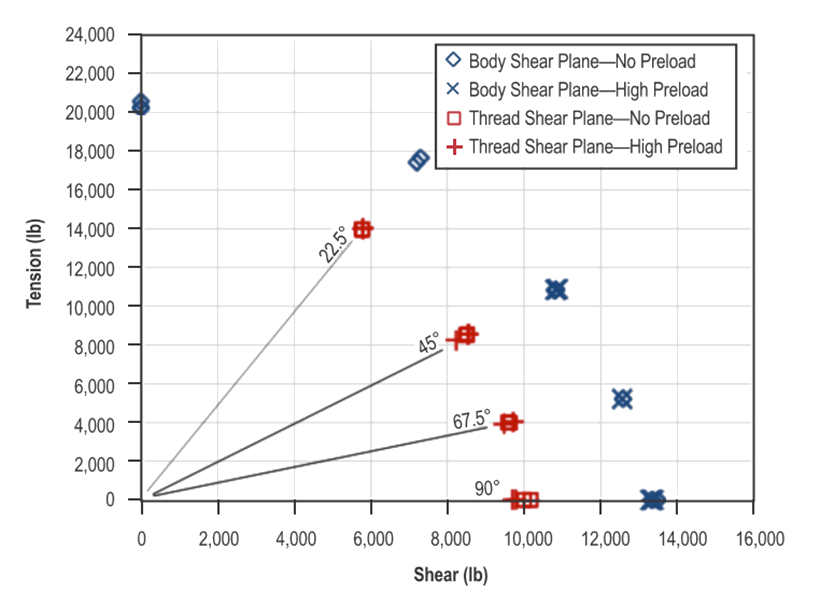
This chart visually confirms our principles:
- A fastener's capacity is a trade-off between tension and shear.
- Applying a high preload (the blue dots) allows the joint to resist a much larger external shear force before the bolt experiences direct shear, effectively expanding the safe operating envelope.
3. A Systematic Approach to Fastener Selection
Now that we can analyze the loads, how do we select the right fastener? A professional workflow involves considering several factors systematically.
When to Calculate vs. When to Use Rules of Thumb
Not every fastener requires a full engineering calculation. For non-critical applications like mounting covers or panels, experienced engineers often rely on rules of thumb. However, for safety-critical joints, dynamically loaded systems, or high-vibration environments, detailed calculations are mandatory. Your experience with FMEA will help you identify these critical joints where failure modes have severe consequences.
The video below offers excellent industry perspective on this decision-making process.
Complete Guide to Bolt Calculation- Size, Grade, Preload and Thumb rules
This video from 'Master Mechanical DESIGN' provides a practical guide to bolt calculations, bolt grades, and valuable rules of thumb used in industry.
Please watch the following three segments: When to Calculate: (00:00 - 04:07) Understand the difference between critical and non-critical applications. Bolt Grades: (26:18 - 30:54) Learn the ISO grading system (e.g., 8.8, 10.9) and how to choose the right grade. Thumb Rules: (42:01 - 46:14) Learn practical shortcuts for sizing bolts in non-critical situations.
Key Selection Criteria
When selecting a fastener for a specific loading condition, you will primarily decide on its:
- Material and Grade (Strength): As you just saw, grades like 8.8, 10.9, or 12.9 for metric bolts define their strength (yield and ultimate). Higher grades are stronger but may be more brittle or expensive. Grade 8.8 is a common default for general machinery.
- Size (Diameter): The required diameter is calculated based on the load it must carry, the bolt's material strength, and a suitable factor of safety. The calculation demonstrated in the video you just watched () is a direct application of the stress principles from your engineering studies.
- Thread Type (Coarse vs. Fine): The choice between coarse (e.g., UNC) and fine (e.g., UNF) threads is an important design decision. It depends on the materials being joined.
The document 'Fasteners' provides a clear, concise rule for choosing between fine and coarse threads.
Please read section '4. Fastener Thread Types' on pages 7-8. The core rule is explained in the first paragraph of that section.
The basic rule is:
- Use coarse threads when screwing into a weaker material (e.g., a steel bolt into an aluminum or cast iron part). The coarser, deeper threads provide more shear area for the weaker female material, preventing stripping.
- Use fine threads when the female material is strong (e.g., a steel bolt into a steel nut). The larger minor diameter of the fine-threaded bolt gives it a larger stress area, making the bolt itself stronger. Fine threads also offer better resistance to loosening from vibration.
Test your understanding!
You are designing a mounting bracket for your linear actuator project. You need to attach a steel guide rail support block to a base plate made of 6061-T6 aluminum. You will be using screws that thread directly into tapped holes in the aluminum plate.
Should you specify coarse or fine threaded screws? Why?
Show answer
You should specify coarse threads (e.g., M6x1.0 instead of M6x0.75, or 1/4"-20 UNC instead of 1/4"-28 UNF).
The reason is that the female material (aluminum) is significantly weaker than the male material (steel screw). The coarse threads have a larger thread depth, which engages more of the aluminum material and creates a larger shear area. This makes the threaded hole in the aluminum stronger and less likely to strip when the screw is tightened to the proper preload.
4. Application in CAD: Using Standard Content
You don't need to model every nut and bolt for your projects. Professional CAD software like Onshape includes libraries of standard fasteners that you can insert directly into your assemblies. This not only saves time but also ensures you are using components with correct, standardized dimensions.
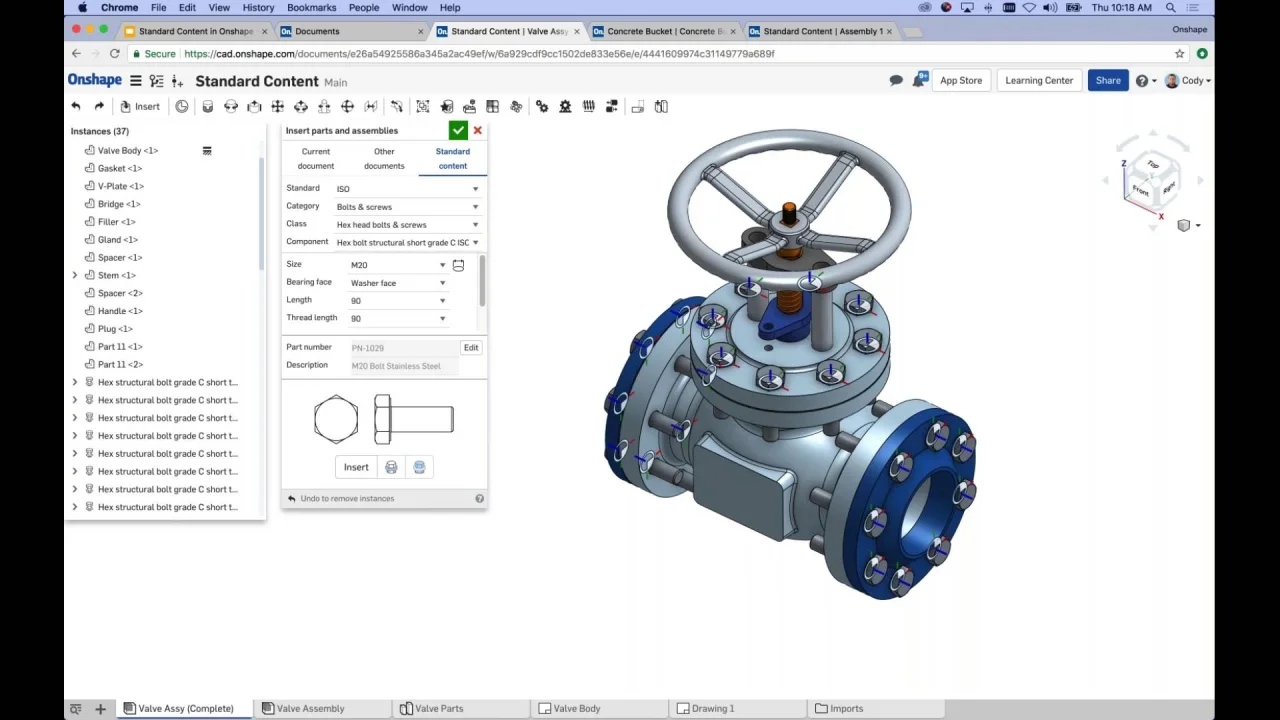
Conclusion
You now have a framework for analyzing and selecting one of the most fundamental components in mechanical design. By understanding the principles of preload and the trade-offs between different fastener characteristics, you can create joints that are safe, durable, and reliable.
Key Takeaways:
- Preload is the most critical factor in a bolted joint's performance. A properly preloaded bolt is a stiff spring that clamps parts together, increasing strength and fatigue life.
- Analyze the load path. For shear loads, design slip-critical joints where friction does the work. Avoid loading bolts in bearing, especially on the threaded section.
- Select fasteners systematically. Your choice of material (grade), size, and thread type should be a deliberate decision based on the loading conditions, materials being joined, and the criticality of the joint.
- Know when to calculate. Use rules of thumb for non-critical parts but perform detailed calculations for any joint where failure could have significant consequences.
In our next lesson, we will focus on how to structure a design review presentation. This will involve learning how to effectively communicate and justify the design decisions you've made—from mechanism type and materials to the fasteners we've discussed today—to an engineering audience.