Hello! Welcome back to the course.
In our last lesson, you created the final assembly drawing and Bill of Materials for your linear motion system. This is a significant milestone, as it represents a complete set of documentation for your design as it currently stands. In a professional engineering workflow, this is the point where we pause and critically assess the design for potential risks before committing to expensive prototyping or manufacturing.
Today, we will begin that risk assessment process. This lesson addresses the learning outcome: Apply basic FMEA methodology to identify potential failure modes in the linear motion system. Failure Mode and Effects Analysis (FMEA) is a cornerstone of robust engineering design, used to systematically identify, analyze, and mitigate potential problems. Your background in FMEA will be a great asset here, as we focus on the practical application of this methodology to your portfolio project.
1. What is FMEA?
FMEA is a structured, proactive method for evaluating a system, design, or process to identify where and how it might fail and to assess the relative impact of different failures. The goal is to identify and address potential issues early in the development cycle, when changes are least expensive.
There are different types of FMEA, but the two most common are:
- Design FMEA (DFMEA): Focuses on failures that could result from deficiencies in the design itself (e.g., wrong material, incorrect geometry, insufficient tolerances).
- Process FMEA (PFMEA): Focuses on failures that could result from the manufacturing or assembly process (e.g., incorrect machine setup, operator error, flawed inspection).
For this project, we will be conducting a DFMEA, as our focus is on ensuring the design of your linear motion system is robust.
To get a solid overview of the FMEA process and its role in risk management, please watch the beginning of the following video.
FMEA, the 10 Step Process to do an FMEA (PFMEA or DFMEA)
This video from CQE Academy provides an excellent introduction to what FMEA is, its purpose as a risk management tool, and the critical distinction between Design and Process FMEA.
Please watch the video from 01:35 to 05:41. Focus on understanding: The definition of FMEA as a systematic, proactive tool. How FMEA fits into the broader risk management process (assessment, control, review). The specific focus of DFMEA (design deficiencies) versus PFMEA (process failures).
2. The Core FMEA Methodology
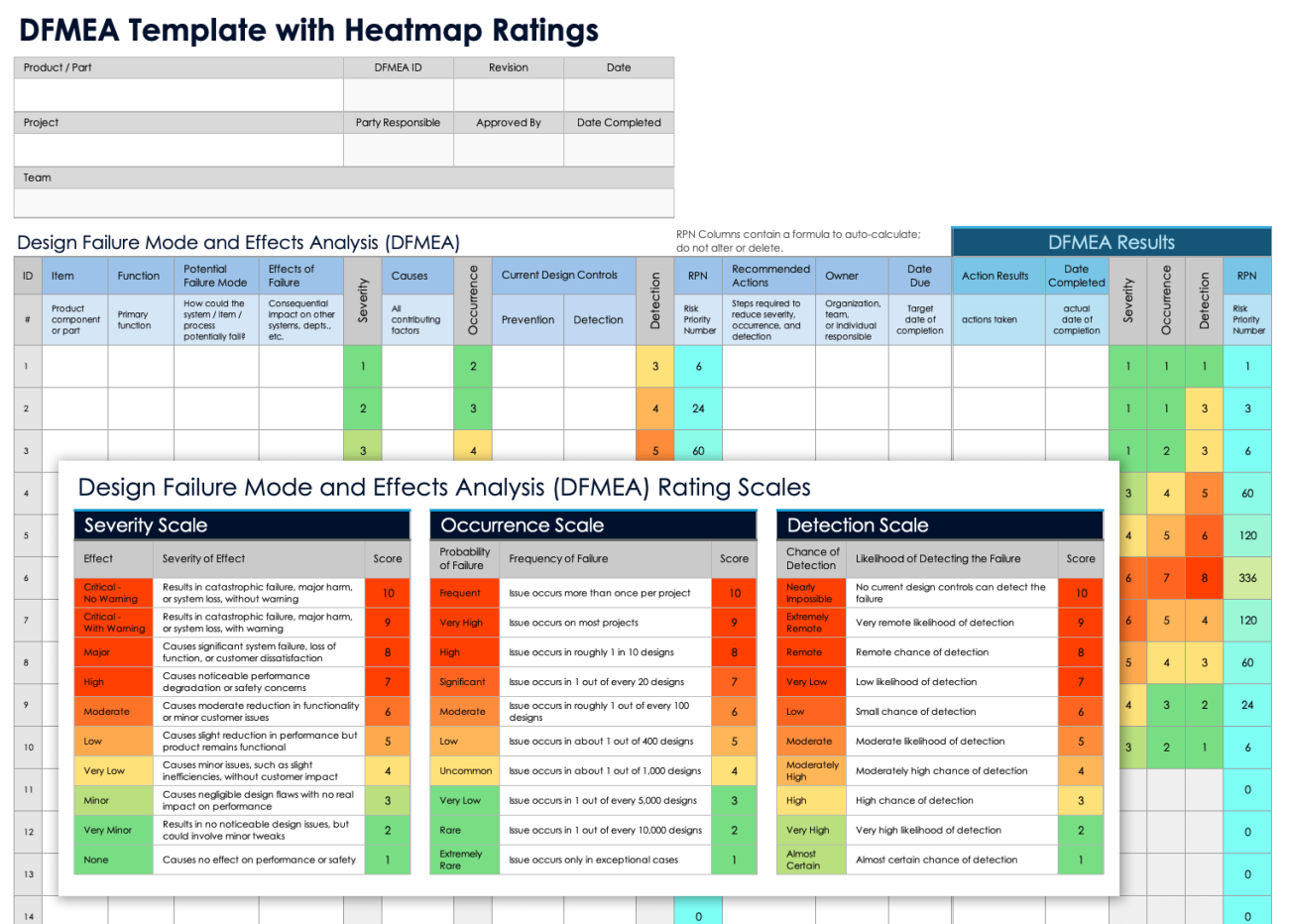
The FMEA process guides a team to brainstorm potential failures and then analyze them by answering a series of questions:
- Failure Mode: How could the component or system fail to perform its intended function?
- Effect: What is the consequence of that failure on the overall system or the end-user?
- Severity (S): How severe is that consequence? (Rated on a scale, typically 1-10)
- Cause: What is the root cause that could lead to the failure mode?
- Occurrence (O): How likely is that cause to occur? (Rated 1-10)
- Detection (D): How likely are we to detect the failure (or its cause) before the product reaches the customer? (Rated 1-10)
These three ratings are then multiplied to calculate the Risk Priority Number (RPN).
The RPN provides a quantitative way to prioritize risks. A high RPN indicates a critical failure mode that requires immediate attention. The goal is then to implement actions that reduce the RPN, typically by lowering the Occurrence or improving the Detection.
3. A Walkthrough of the FMEA Steps
Let's walk through the steps of conducting a DFMEA. The video we started earlier provides a comprehensive 10-step guide. We'll go through it in sections.
Step 0: Preparation
Before you even start listing failure modes, you need to establish the ground rules. This includes defining the rating scales for Severity, Occurrence, and Detection. These scales are not universal; they are tailored to the specific industry, product, and organization.
For our exercise, we'll refer to a set of industry-standard tables.
Booklet No. 14 Failure Mode and Effects Analysis FMEA
The Bosch Booklet No. 14 on FMEA is an excellent example of a real-world, industry-grade guide. We will use its rating tables as a reference for our analysis.
Please open this document and scroll to Appendix 1: Rating tables (page 41). Briefly review the tables for Severity (S), Occurrence (O), and Detection (D). You don't need to memorize them, but get a feel for what constitutes a high (e.g., 9-10) versus a low (e.g., 1-2) rating in each category.
Steps 1-10: The Analysis Process
Now, let's look at the full process, from scoping the analysis to implementing corrective actions.
FMEA, the 10 Step Process to do an FMEA (PFMEA or DFMEA)
Let's continue with the CQE Academy video. It systematically explains each step of the FMEA process, from identifying failure modes to calculating RPN and taking action.
Watch the video from 06:45 to 20:25. As you watch, pay attention to the flow: Preparation & Scoping (Step 0 & 1): Defining scales and system boundaries. Identifying Failures (Step 2 & 3): Brainstorming failure modes and their effects. Analysis (Steps 4-7): Finding root causes, identifying existing controls, and assigning S, O, D ratings. Prioritization & Action (Steps 8-10): Calculating RPN and implementing actions to reduce risk.
Test your understanding!
You are performing a DFMEA on a new carbon fiber bicycle frame. You identify a failure mode: "Frame cracks under load." The team determines that the effect on the rider could be catastrophic (Severity = 10). The team also decides that with the current design and material choice, the likelihood of this cause occurring is very low (Occurrence = 2). The RPN is currently high due to the severity.
To reduce the RPN, should the team's first priority be to implement an action that:
a) Reduces the Severity rating?
b) Reduces the Occurrence rating?
c) Reduces the Detection rating?
Explain your reasoning.
Show answer
The priority should be to try and reduce the Severity rating first, if at all possible. Severity is tied to the effect of the failure. An action that changes the design to make the failure effect less catastrophic (e.g., designing it to fail in a more controlled, "graceful" way that gives the rider a warning) is the most effective form of risk reduction.
If Severity cannot be reduced (a catastrophic failure is a catastrophic failure), the next priority is to reduce the Occurrence by making the design more robust to prevent the cause from ever happening. Improving Detection (e.g., more rigorous testing) is also valuable but is fundamentally a reactive measure—it helps you catch the problem but doesn't prevent it. In the hierarchy of risk reduction, preventing the failure is always better than just detecting it.
4. Your Task: Begin the DFMEA for Your Linear Motion System
Now it's time to apply this methodology to your project. A complete DFMEA is an extensive team exercise, but for this lesson, your goal is to start the process by analyzing a few critical components.
First, let's identify some areas to focus on. In a linear motion system, the interfaces where parts move relative to each other are often critical.

For your Project 1, let's start by analyzing these three areas:
- The Lead Screw/Nut Interface: The core of the motion system.
- The Guide Rail & Bearing Block: The components that constrain the motion and handle off-axis loads.
- The Motor Mounting Bracket: A structural component critical for transferring torque.
Your Assignment:
-
Create a simple table for your DFMEA. You can use a spreadsheet or a basic text file. The columns should be:
Component/Function,Potential Failure Mode,Potential Effect(s) of Failure,Severity (S),Potential Cause(s) of Failure,Occurrence (O),Current Design Controls (Prevention/Detection),Detection (D),RPN. -
For each of the three areas listed above, brainstorm and document at least one potential failure mode.
- Example for the Motor Mounting Bracket: The function is "Securely hold the motor and react its torque." A potential failure mode could be "Bracket fractures due to fatigue."
-
Select one of your identified failure modes and complete the analysis for it:
- Effect: What is the ultimate result if the bracket fractures? (e.g., "Motor detaches, linear motion stops, system fails.")
- Severity (S): Using the Bosch tables as a guide, assign a rating from 1-10. Justify your choice briefly.
- Cause: What could cause the bracket to fracture? (e.g., "Insufficient material thickness," "Stress concentration at sharp corner," "Vibration from motor.")
- Occurrence (O): How likely is your chosen cause? Be honest about your design. If you haven't done any stress calculations, the likelihood might be higher. Assign a rating.
- Controls: What have you already done to prevent or detect this? (e.g., Prevention: "Selected 6061-T6 Aluminum for good strength." Detection: "Planned FEA study to check for high stress.") If you have no controls yet, that's okay—just write "None."
- Detection (D): How likely are your controls to find the problem before production? An FEA study is a good detection method. A visual inspection might be poor. Assign a rating.
- RPN: Calculate
S x O x D.
This exercise will form the foundation of your risk assessment documentation for the project.
Conclusion
In this lesson, you've learned the fundamentals of FMEA and, most importantly, have started applying it to your own design. This process forces you to think critically about what could go wrong and transforms risk management from a vague concern into a structured, data-driven activity.
Key Takeaways:
- FMEA is a systematic, proactive tool for identifying and mitigating risks in design (DFMEA) and manufacturing (PFMEA).
- The core of FMEA is analyzing Failure Modes, their Effects, and their Causes.
- The Risk Priority Number (RPN = Severity × Occurrence × Detection) is used to prioritize which risks to address first.
- A high Severity rating (related to safety or primary function loss) should always be treated as a high priority, regardless of the RPN.
Preview of the Next Lesson:
Identifying risks is only half the battle. In our next session, we will focus on the "A" in FMEA—Analysis and Action. You will learn how to propose and document mitigation strategies for the highest-risk failure modes you've just identified, completing the risk management loop for this project phase.