Hello! Welcome back.
In our last lesson, we focused on making your AI writing assistant sound uniquely like you by creating and using custom style guides. This gave you control over the voice of your manuscript.
Today, we shift from style to substance. This lesson is dedicated to a critical step in the authoring process: verifying the factual accuracy of AI-generated content using reliable external sources. While AI can generate text that sounds authoritative, it doesn't possess true understanding or a built-in truth detector. For your goal of writing credible non-fiction books on business, tech, and psychology, this skill is non-negotiable. Publishing inaccurate information can quickly damage your reputation and undermine the passive income stream you aim to build.
We will cover:
- Why AI models make factual errors.
- A systematic framework for fact-checking.
- A selection of free tools to streamline the verification process.
1. Why AI-Generated Content Needs Fact-Checking
Before we dive into the "how," it's essential to understand the "why." Large Language Models (LLMs) like ChatGPT are designed to predict the next most likely word in a sequence. They are masters of language patterns, not arbiters of truth. This can lead to several common types of errors.
How to fact check AI generated content: A practical guide
To understand the common failure points of AI, let's read a section from the article "How to fact check AI generated content: A practical guide" from eesel.ai.
Please read the sections titled "Why it's critical to know how to fact check AI generated content" and "Common pitfalls to look for when you fact check AI generated content." Focus on understanding the definitions of: AI "hallucinations" Outdated information (knowledge cut-off) Embedded bias Context errors
As the article explains, an AI can "hallucinate" facts with complete confidence, use outdated statistics, or misinterpret the context of its source material. Given your IT background, you can think of this as an application producing output that is syntactically correct but semantically flawed—it looks right, but it means the wrong thing. Your role as the author is to be the quality assurance (QA) engineer for your book's content.
2. A Step-by-Step Fact-Checking Framework
A systematic approach is the most effective way to ensure accuracy. Rushing this step is a common mistake that can lead to publishing errors. The article you just read also provides a robust, practical framework for this process.
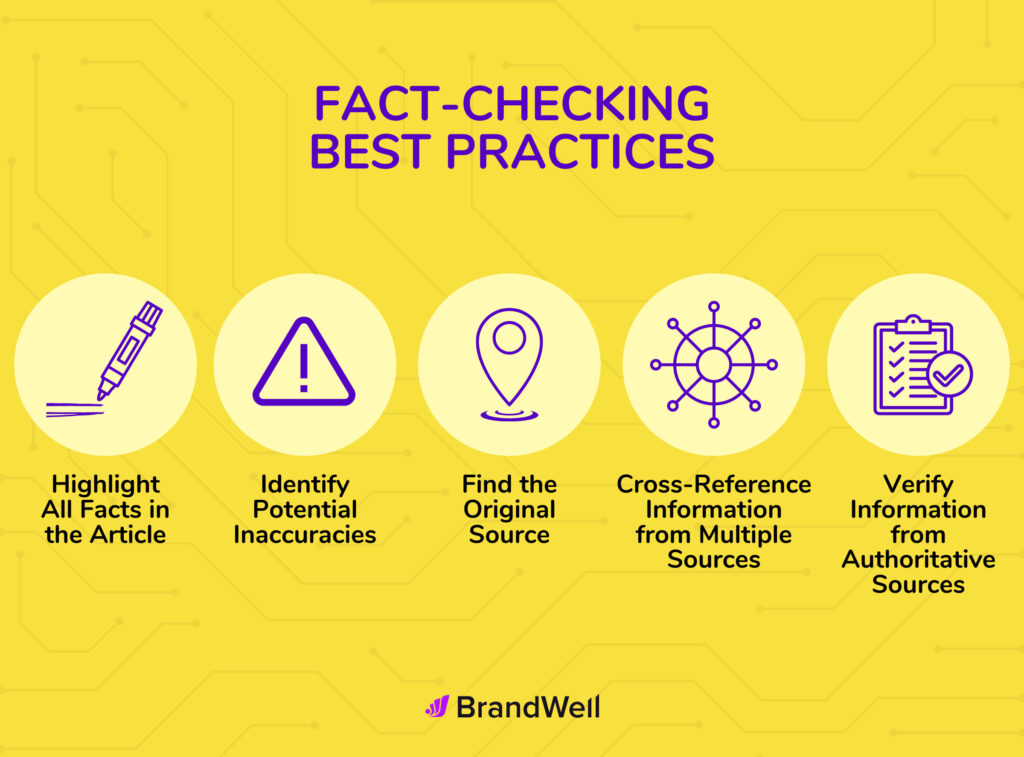
Here is a breakdown of that workflow:
- Isolate Verifiable Claims: Read through your AI-generated draft and pull out every specific, checkable fact. This includes statistics, dates, names, technical specifications, and direct quotes. This process is sometimes called "fractionation."
- Read Laterally: For each claim, open new browser tabs and search for corroborating evidence. Don't rely on a single source. Look for multiple, independent, and reputable sources that confirm the information. Good sources include academic journals, established news organizations, government websites, and official company documentation.
- Verify Every Source: This is crucial. AI models are notorious for inventing sources or citing real sources that don't actually support the claim. Click every link. If a source isn't linked, search for it. If you can't find it or it doesn't contain the information, discard the claim.
- Check for Timeliness: Look at the publication dates of your sources. A technology trend report from 2019 is likely irrelevant for a book you're publishing today. Always seek the most recent credible data.
- Involve a Subject Matter Expert (SME): For your books on tech and IT mentoring, you are the SME. This is your greatest advantage. Your 10 years of experience allow you to spot nuances and contextual errors that a non-expert might miss. For genres outside your expertise, like psychology, this step means you must be even more rigorous in relying on highly authoritative sources.
Test your understanding!
You're writing your tech mentoring book and the AI produces this sentence: "As of 2020, Kubernetes was used by over 80% of Fortune 500 companies to manage their containerized applications, according to a report by the CNCF." Based on the framework above, what are three distinct things you should immediately plan to verify?
Show answer
Here are three key verifications needed:
- Existence and Content of the Source: Does a report from the Cloud Native Computing Foundation (CNCF) from 2020 (or thereabouts) actually exist, and does it contain this statistic?
- Timeliness: The data is from 2020. Is there more recent data available from the CNCF or another reliable source (e.g., Gartner, Forrester) that would be more relevant for your readers today?
- The Claim Itself: Is the "80%" figure accurate? Does it refer specifically to Fortune 500 companies, or a different group? Was it "used by" or just "evaluated by"? The details matter.
3. Free Tools for Verification
Manually checking every fact can be time-consuming. Fortunately, several free tools are designed to help you find reliable, sourced information quickly.
Perplexity AI: Your Research Assistant
You've mentioned using Perplexity before. It is an excellent tool for this task because it's designed as a "conversational answer engine" that automatically provides sources for its claims.
These short videos will give you a great overview of how to use its features specifically for fact-checking.
Learn 80% of Perplexity in under 10 minutes!
First, let's watch "Learn 80% of Perplexity in under 10 minutes!" by Jeff Su. This will show you how to leverage its core features for accuracy.
Watch from 02:21 to 03:51. Pay close attention to the 'Focus' feature, which lets you narrow your search to specific source types like 'Academic', and how you can review and remove unreliable sources from an answer.
How to Use Perplexity AI: The UNDERRATED Search AI
Next, this video from Kevin Stratvert, "How to Use Perplexity AI," provides another look at its source-checking capabilities.
Please watch these three segments: 01:07 - 02:18: This highlights how Perplexity provides cited sources for every claim, giving you confidence in the answers. 03:34 - 05:18: This demonstrates the powerful ability to filter your search to only include academic papers, which is invaluable for your psychology or business books. 10:57 - 12:26: This provides a direct comparison with ChatGPT, showing how Perplexity is inherently more reliable for factual queries because of its built-in citation process.
When you need to verify a statistic, a technical detail, or a historical event, Perplexity should be your first stop. By asking it the right question, you get a summarized answer and a list of links to the original sources.
Google Fact Check Tools & Snopes: The Verification Databases
Sometimes, a claim has already been thoroughly investigated by professional fact-checkers. Instead of starting from scratch, you can search their databases.
The 6 Best AI Fact Checkers to Verify Truth in a Digital Age
The article "The 6 Best AI Fact Checkers to Verify Truth in a Digital Age" reviews several tools. Since you prefer free options, we'll focus on two powerful, free resources it covers.
Please read section 4, "Google Fact Check Tools," and section 6, "Snopes." For each tool, focus on understanding: What its primary function is (a search engine for fact-checks, not an active analyzer). When it is most useful (e.g., for viral claims or recurring topics).
Google Fact Check Tools aggregates findings from reputable fact-checking organizations worldwide. It's an excellent resource for checking if a popular claim or quote has already been debunked.

Snopes is one of the oldest and most respected fact-checking sites. It relies on human journalists and provides deep, contextual explanations that go beyond a simple "true" or "false" rating. It's particularly useful for investigating urban legends, historical myths, and viral social media content.
Conclusion
You now have a complete toolkit for ensuring the factual integrity of your AI-assisted books. Never trust, always verify. Treating every factual statement from an AI as an unverified claim until you have proven it correct is the mindset of a professional author.
Key Takeaways:
- AI models are language predictors, not fact databases, and are prone to hallucinations, outdated information, and bias.
- Adopt a systematic fact-checking workflow: isolate claims, read laterally, verify sources, check timeliness, and apply your own expert review.
- Use Perplexity AI as your primary tool for active research to get quick, sourced answers.
- Use Google Fact Check Tools and Snopes to check if a common or viral claim has already been investigated by professionals.
Preview of the Next Lesson:
We've now covered how to control the AI's style and how to verify its facts. In the next lesson, we will move to the next level of editing: assessing the logical flow and narrative coherence of AI-generated text. This involves looking at the big picture to ensure your chapters and arguments are structured effectively and are easy for a reader to follow.