Hello! Welcome back to your AI authoring course.
In our last lesson, we focused on ensuring the facts in your AI-generated text are accurate by using a systematic verification process. This is a crucial step for building credibility, especially for your non-fiction books.
Today, we move from the granular details of facts to the bigger picture: assessing the logical flow and narrative coherence of AI-generated text. A book can have all the right facts but still be unreadable if the ideas are jumbled, the arguments are weak, or the story is inconsistent. This lesson will equip you with techniques to diagnose and fix these structural issues, ensuring your readers have a smooth and engaging experience.
Specifically, we'll cover:
- What coherence is and why AI struggles with it.
- A manual technique—the reverse outline—to analyze the structure of your text.
- Sentence-level fixes for choppy, disconnected writing.
- How to use AI as a partner to find plot holes and logical gaps in its own output.
1. Understanding Coherence and Why AI Falters
At its core, coherence is what makes a piece of writing easy to understand and follow. It's the logical and narrative glue that holds your book together.

We can think of this in two main ways, relevant to the different genres you're interested in:
- Logical Flow (Non-Fiction): For your business, mentoring, and psychology books, this means your arguments build on each other, transitions are clear, and the reader can follow your train of thought from one point to the next without getting lost.
- Narrative Coherence (Fiction): For your children's books and comics, this means the plot is consistent, characters behave according to their established personalities, and there are no "plot holes"—contradictions that break the story's internal logic.
AI models often struggle with this because they don't understand the text they generate. They are predicting the next word based on patterns, and over long texts, they can lose the thread. This can result in repetitive paragraphs, sudden topic shifts, or characters acting inconsistently. You, as the author-editor, must be the one to ensure the final manuscript makes sense.
2. The Reverse Outline: A Systematic Check-up
One of the most effective ways to assess the logical flow of a chapter is a technique called the reverse outline. Given your IT background, you can think of this as deconstructing a program to understand its logic flow. Instead of writing an outline before you draft, you create an outline from a finished draft to see what structure is actually there.
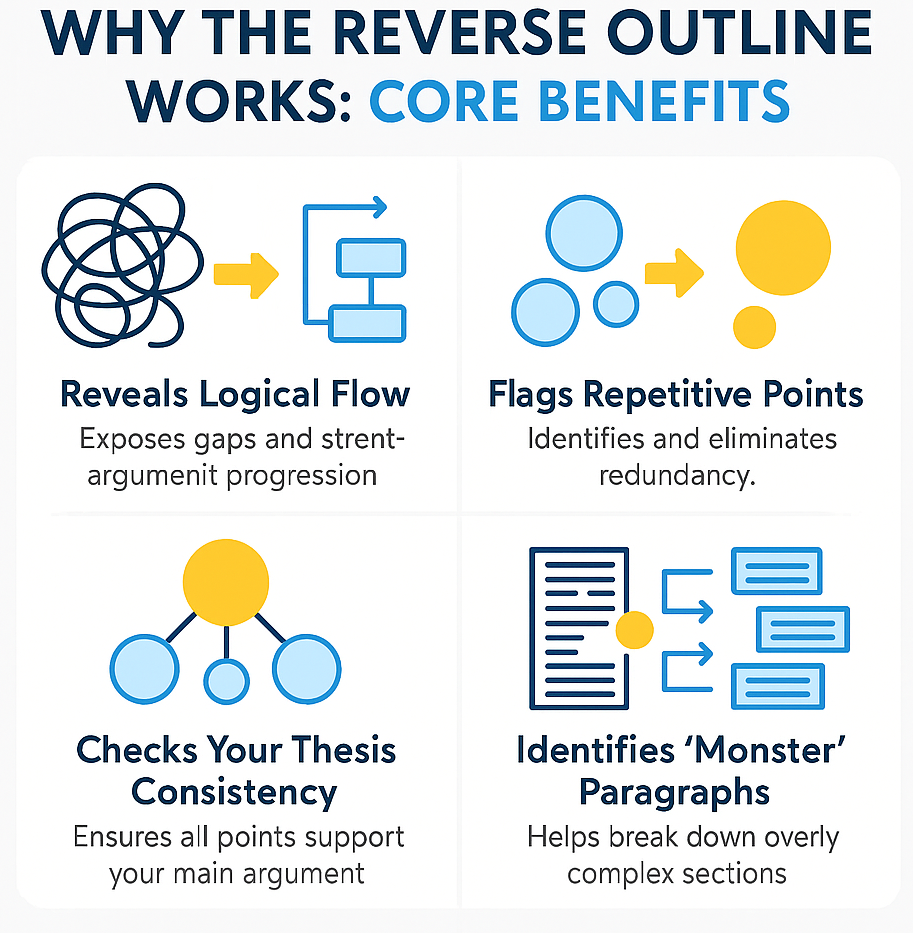
Here’s the simple, three-step process:
- Take your AI-generated chapter or section.
- Read through it, and for each paragraph, write down its main point in a single sentence.
- Now, look only at your list of sentences (the reverse outline).
This high-level view will immediately expose structural problems. Ask yourself:
- Does the order of these sentences make sense?
- Are there any logical jumps or gaps between points?
- Do I repeat the same point in multiple paragraphs?
- Does every single point directly support the chapter's main goal or topic?
Test your understanding!
Imagine an AI generated the following two paragraphs for your tech mentoring book chapter titled "Choosing Your First Programming Language."
Paragraph 1: "Python is an excellent choice for beginners due to its simple, readable syntax. Many universities and coding bootcamps start with Python because it allows students to focus on programming concepts rather than getting bogged down by complex rules. Its extensive libraries for data science, web development, and automation also mean that the skills learned are immediately applicable in the job market."
Paragraph 2: "The syntax of Python is known for being clean and easy to understand, which is why it's a top recommendation for those new to coding. When you are just starting, you want a language that feels intuitive, and Python's design philosophy emphasizes readability. This makes it a great entry point into the world of software development."
If you were creating a reverse outline, what would you write for each paragraph? What problem does this reveal?
Show answer
- Reverse outline point for Paragraph 1: Python is a good first language because its simple syntax helps beginners learn core concepts and its libraries make it job-relevant.
- Reverse outline point for Paragraph 2: Python is a great starting language because its syntax is clean, readable, and intuitive for newcomers.
The problem revealed: The two paragraphs make almost the exact same point about Python's simple syntax. This is a classic AI failure mode—redundancy. The reverse outline makes it obvious that these paragraphs should be combined or that one should be deleted.
3. Improving Flow at the Sentence Level
Once the reverse outline has helped you fix the big-picture structure, you can zoom in to improve the flow from sentence to sentence. AI-generated text can often feel "choppy," like a series of disconnected statements.
Make Your Writing Flow | Sentences: Transitions, Subordination, and Modification
The video "Make Your Writing Flow" from the Writing with Andrew channel is an excellent primer on the mechanics of creating smooth, readable prose. It explains three key techniques.
Please watch the following sections: 02:05 - 04:16: Focus on how transition words (like 'however,' 'in fact,' 'furthermore') act as signposts for the reader. 04:16 - 07:03: Understand how subordination (using dependent clauses) creates a smoother ride than a long series of short, simple sentences. 07:03 - 09:10: See how modifiers can add information without interrupting the main flow of a sentence.
By consciously applying these techniques—adding transitions, combining simple sentences into more complex ones, and using modifiers—you can transform a clunky AI draft into polished, professional prose.
4. Using AI to Find Its Own Flaws
While manual techniques are essential, you can also leverage AI as a powerful analytical partner to find issues with coherence, especially in narrative writing. The key is to give the AI a specific role and a clear task.
To learn how to prompt an AI for this kind of analysis, let's explore some practical steps.
How to Use AI for Fixing Plot Holes and Save Your ...
The article "How to Use AI for Fixing Plot Holes" from Sudowrite offers a fantastic guide on this process. It provides specific prompt formulas you can adapt.
Please read from the beginning down to the end of the "Case Study" section. Pay close attention to: The concept of 'author blindness' and why AI can help overcome it. Step 2: Prepare Your Manuscript: The advice to use summaries or chunks is key, as free AI tools have context limits. Step 3: Master the Art of the Prompt: Study the prompt formulas for continuity, character knowledge, and finding forgotten elements. These are templates you can use directly.
As the article demonstrates, you can't just ask the AI, "Are there any plot holes?" You need to be specific. For example:Based on Chapter 1, what does the character Sarah know about the stolen artifact? Now review Chapter 5. Are her actions and dialogue consistent with only having that knowledge? List any inconsistencies.
This turns the AI into a focused analyst. Another powerful technique is to use the "Custom Instructions" feature in models like ChatGPT to define specific editor personas.
How to Edit a Book with AI (And Why I Hate It)
Let's watch a clip from "How to Edit a Book with AI (And Why I Hate It)" by The Nerdy Novelist. While the title is provocative, it demonstrates a sophisticated technique for getting better analytical feedback from an AI.
Watch from 05:44 to 10:11. Focus on how the presenter creates two personas using Custom Instructions: 'Bob' the critic, who only finds inconsistencies, and 'Harry' the reviser, who implements the fixes. This method forces the AI to be more analytical and less generic.
This persona-based approach is a significant step up from basic prompting and helps you get much more specific and useful feedback on logical and narrative coherence.
Finally, it's helpful to see how these techniques come together in a real-world workflow.
How I Used AI While Writing My Novel | by Michael Iantosca
Let's read a short article from Michael Iantosca, an engineer and technical writer, who details his experience using AI to refine his novel.
Please read the sections "Story and Structure," "Character Development," and "Consistency and Logic." Notice how he used AI to check timeline coherence, character arcs, and world rules—all key components of narrative coherence.
Conclusion
You are the ultimate arbiter of your book's quality. AI is an incredibly powerful tool for generating drafts, but its output requires careful, human-led assessment to ensure it's not just factually accurate, but also logical, coherent, and enjoyable to read.
Key Takeaways:
- Coherence is about logical structure (non-fiction) and narrative consistency (fiction).
- AI-generated text often suffers from repetition, logical gaps, and plot holes due to its lack of true understanding.
- Use the Reverse Outline as a human-centric method to diagnose high-level structural problems in your drafts.
- Fix choppy prose by using transitions, subordination, and modifiers to connect ideas at the sentence level.
- Turn the AI into an analytical partner by using specific, role-based prompts and custom instruction personas to have it detect inconsistencies and plot holes.
Preview of the Next Lesson:
Now that we've covered the fundamentals of generating, fact-checking, and structuring your text, we're ready to move on to the critical business and legal aspects of publishing. In our next lesson, we will begin Module 2 by tackling a topic you've highlighted as a priority: explaining the current copyright landscape for AI-generated text and images. This will lay the foundation for protecting your intellectual property.