Hello! Welcome to the second module of your course, "Legal and Ethical Foundations."
In our last module, we honed your skills in generating and refining AI content, focusing on fact-checking and ensuring narrative coherence. You learned how to act as the author-editor, shaping raw AI output into a well-structured manuscript. Now, we pivot to a crucial topic you've prioritized: protecting your work.
This lesson directly addresses the learning outcome: Explain the current copyright landscape for AI-generated text and images. Understanding these rules is fundamental to your goal of publishing books and building a passive income stream. We will demystify the official stance of the U.S. Copyright Office and explore what it means for you as an AI-assisted author.
We'll cover:
- The core principle of "human authorship" and why purely AI-generated work is not copyrightable.
- Why even sophisticated prompting is generally not enough to claim authorship.
- The three primary ways you can establish copyright in a work that includes AI-generated content.
- The practical consequence of this landscape: the need to disclose and disclaim AI contributions.
Let's begin by establishing the legal foundation.

1. The Core Principle: Copyright Requires a Human Author
The single most important rule to understand is this: in the United States, a work must be created by a human to be eligible for copyright protection. The U.S. Copyright Office has been very clear that works generated entirely by AI, without any creative input or intervention from a human, are not copyrightable. They are considered to be in the public domain.
To get a quick and clear overview of this principle, let's start with a helpful article.
AI-Generated Content and Copyright Law: What We Know
The article "AI-Generated Content and Copyright Law: What We Know" from Built In provides a concise summary of the current legal situation.
Please read the following sections: Start at the top and read down to the section titled "What Is AI-Generated Content?" Read the section "Can AI Art Be Copyrighted?" Finally, read the FAQ answers for "Can AI content be copyrighted?" and "Why can't AI content be copyrighted?" Focus on the consistent message about the requirement for a human creator.
This "human authorship" requirement isn't just a policy; it has been affirmed in federal court. In a landmark case, Thaler v. Perlmutter (2023), the court upheld the Copyright Office's refusal to register an image that the plaintiff claimed was "autonomously created by a computer algorithm." The court stated that "human authorship is a bedrock requirement of copyright."
So, the baseline is clear. If you simply give an AI a prompt and publish the output verbatim, you do not own the copyright to that text or image.
2. The Problem with Prompts: Why Instructions Aren't Authorship
A common question is: "What if I write a really detailed, creative prompt? Isn't that enough human authorship?"
According to the U.S. Copyright Office's current analysis, the answer is generally no. They view prompts as instructions or ideas, which are not copyrightable themselves. The AI system takes your idea (the prompt) and then independently generates the expressive work (the text or image). Since you don't control how the AI executes your instruction, you are not considered the author of the final output.
Given your IT background, you can think of the AI as a 'black box' function. You provide an input (the prompt), but you don't control the internal process that maps that input to a specific output. The process involves a degree of randomness and interpretation by the model that separates your instruction from the final creative expression.
Let's dive into the definitive source on this matter.
Copyright and Artificial Intelligence, Part 2
The U.S. Copyright Office published a detailed report explaining its reasoning. We will read the key sections that break down their analysis of AI-generated works.
This is a legal document, so it's dense. Focus on the main ideas, not the legal citations. Please read: The "EXECUTIVE SUMMARY" (pages ii-iii) to get a high-level overview of their conclusions. The section "D. Prompts" (starts on page 12) and read subsection "2. Analysis" (starts on page 18 and ends on page 22). This is the most important part, as it details exactly why prompts alone are currently deemed insufficient for authorship. Pay close attention to the concepts of user control, the unpredictability of outputs, and the analogy to commissioning an artist.
The report you just read uses an example of a "bespectacled cat" to illustrate the gap between a detailed prompt and the final output. The AI makes many creative choices (the cat's breed, the lighting, the background details) that were not specified in the prompt. This demonstrates the lack of direct control that is central to the Copyright Office's reasoning.
3. The Path to Copyrightability: How to Secure Your IP
This might sound discouraging, but it's not the end of the story. The Copyright Office has clearly outlined a path for protecting works that incorporate AI-generated content. If you provide sufficient human authorship, you can copyright your contribution.
There are three main ways this is achieved.
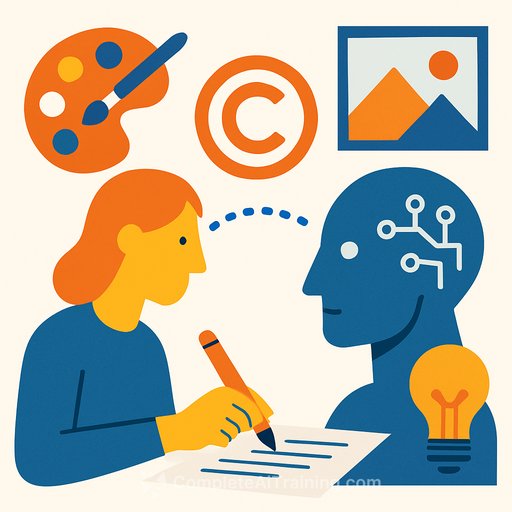
A) Significant Modification of AI Output
This is the most relevant path for your books. You use AI to generate a first draft, but then you perform substantial editing, rewriting, and restructuring. You infuse the text with your unique voice, add your own insights from your 10 years in IT, and rearrange the content to fit your narrative.
In this scenario, you are the author of the final, edited manuscript. The copyright covers your creative expression and modifications.
Can You Copyright an AI Generated Book?
In the video "Can You Copyright an AI Generated Book?", the creator does an excellent job of explaining this distinction between a raw AI draft and a human-edited final product.
Watch from 02:12 to 06:30. Notice how the speaker contrasts a verbatim AI output with a hybrid process of prompting, editing, and stitching content together. This hybrid process is what leads to a copyrightable work.
B) Creative Selection and Arrangement of Content
This applies when you collect AI-generated materials (like images for a comic book or children's book) and arrange them in a creative way, often combined with your own original writing.
The famous case here is Zarya of the Dawn, a comic book. The author, Kristina Kashtanova, wrote the story and dialogue but used the AI tool Midjourney to create the images. The Copyright Office ruled that:
- The individual AI-generated images were not copyrightable.
- The text of the story was copyrightable.
- The creative selection, coordination, and arrangement of the images and text throughout the book was copyrightable as a whole.
Essentially, she received copyright for the book as a compilation, but not for the raw AI images within it.
C) Using Your Own Work as an "Expressive Input"
This is a powerful concept for visual works. If you create an original piece of art (e.g., a drawing) and then use an AI to modify or enhance it, your original human authorship can be protected.
A lawyer explains this clearly using a real-world example that the Copyright Office reviewed.
How To Copyright AI (Step By Step Guide) | Lawyer Explains
Let's watch a clip from "How To Copyright AI" where an attorney breaks down the different types of human contribution.
Watch from 03:37 to 09:25. Pay close attention to the two key examples: The "expressive input" case (the cyborg woman with roses), where a human drawing was the starting point. The comic book example (Zarya of the Dawn), where the human arranged the AI images creatively.
Test your understanding!
You are creating a children's book about a friendly dragon. You perform the following actions:
- You write a 500-word story about the dragon.
- You use an AI image generator with the prompt "cute green dragon sitting in a library" to create the cover image.
- You take that AI-generated image and use Canva (a free design tool) to add the title you wrote and your author name.
- You publish the book with your story and the modified cover image.
Based on what you've learned, which parts of this final product are likely protected by your copyright?
Show answer
Based on the U.S. Copyright Office's guidance:
- Your 500-word story is fully copyrightable. It is an original work of human authorship.
- The raw AI image of the dragon is NOT copyrightable. It's considered the product of the machine.
- Your contribution to the cover (the text and the arrangement of that text on the image) IS copyrightable. This falls under "creative selection and arrangement" or "modification." The copyright on the cover is thin—it only protects your specific arrangement, not the underlying AI image.
4. The Practical Consequence: Disclosure and Disclaiming
Because a work created with AI is a mix of human-authored (copyrightable) and machine-generated (public domain) content, you have a responsibility to be transparent when you register your copyright. You must disclaim the portions of the work that were generated by AI.
This is not a penalty; it's a clarification. It allows you to formally protect your human contributions while acknowledging the parts you don't own.
How To Copyright AI (Step By Step Guide) | Lawyer Explains
Let's return to the lawyer from the "How To Copyright AI" video to see how this disclosure works in practice.
Watch the section from 18:50 to 20:36. The lawyer demonstrates how you would fill out the "Limitation of Claim" section on a copyright application, specifying what material to exclude (the AI part) and what new material is being registered (the human part). This illustrates the principle of separating human from machine authorship.
Understanding this principle of disclosure is vital not just for copyright registration, but also for publishing on platforms like Amazon KDP, which have their own policies requiring you to report the use of AI.
Conclusion
Navigating the copyright landscape for AI can seem complex, but it boils down to a few key principles centered on human creativity. While the law is still evolving, the current framework from the U.S. Copyright Office provides a clear path for authors like you.
Key Takeaways:
- Human Authorship is King: Only works created by humans can be copyrighted. Purely AI-generated content is in the public domain.
- Prompts Are Not Enough: Instructing an AI is not the same as authoring the output. You need to do more to claim copyright.
- Your Contribution is Key: You can secure copyright for your creative work by (1) significantly modifying AI drafts, (2) creatively arranging AI elements, or (3) using your own art as a starting point.
- Disclose to Protect: To register a copyright for a mixed-media work, you must identify and disclaim the AI-generated material to protect your human-authored contributions.
Preview of the Next Lesson:
Now that you understand the legal basis for copyright, we'll move on to its practical application in the marketplace. Our next lesson will cover how to identify platform policies (e.g., Amazon KDP) regarding the use and disclosure of AI-generated content. You'll learn what you need to tell platforms about your process to publish your books correctly and ethically.