Bonjour! Welcome to your sixth lesson.
In our last lesson, we learned how to use ordinal numbers and months to talk about dates. This is a great skill for sharing your birthday or scheduling appointments.
Today, we will build on your ability to introduce yourself by learning how to ask and answer questions about personal information like your job, nationality, and family. When you meet someone new, these are the questions people often ask. Mastering them will help you have more meaningful conversations.
1. Asking about Nationality and Origin
When you meet someone, a common topic is where you are from. You already know how to say "I am from France." Let's learn the questions you might hear and how to ask them yourself.
Common questions include:
- Where are you from? (Où habitez-vous / De quel pays venez-vous ?)
- What's your nationality? (Quelle est votre nationalité ?)
- What languages do you speak? (Quelles langues parlez-vous ?)
Here are the typical answers:
- I am from [Country]. → I am from France.
- I am [Nationality]. → I am French.
- I speak [Language]. → I speak French and a little English.
Now, let's watch a short video to see these questions in a conversation. A woman is registering for an English course and has to provide her personal information.
Personal Information Question and Answer | English Conversation | Listen English Daily Practice
In this video from 'Learn English with Jessica', pay attention to the questions the receptionist asks about nationality and language.
Please watch the clip from 00:00 to 01:40. Listen for the questions 'What's your nationality?' and '...any other languages?'. Notice how the student answers.
As you heard in the video, the conversation went like this:
Receptionist: What's your nationality?
Student: Mexican. I'm a student... I'm here for the summer.
Receptionist: I see. So you speak Spanish and any other languages?
Student: No, just Spanish and a little English.
2. Talking about Your Job
One of the most common questions in English is "What do you do?". This question means "What is your job?".
There are a few ways to answer this question.
- I'm a + [your job]. → I'm a nurse.
- I work in + [a field or place]. → I work in a hospital. or I work in healthcare.
- I work for + [a company]. → I work for the public hospital service.
The next video gives excellent examples, including one for a nurse, which will be very useful for you.
Talking About Your Job in English - Spoken English Lesson
This lesson from 'Oxford Online English' will teach you how to describe your job in detail. It includes very relevant vocabulary for you.
First, watch from 00:31 to 02:15 to learn the basic structures 'I'm a...', 'I work in...', and 'I work for...'. Then, watch the example of the nurse from 04:23 to 05:07. Notice the phrases 'I have to look after patients' and 'I'm responsible for...'. Finally, watch from 05:56 to 07:05 to learn adjectives to describe your job. The word 'rewarding' (gratifiant) is often used for jobs like nursing.
Based on the video, you can now build a great answer about your job:
- What do you do?
I'm a nurse. I work in a hospital. I have to look after patients. It's a challenging job, but it's very rewarding.
To ask about someone else's job, you can say:
- What does he do? → He is a doctor.
- What does she do? → She is a teacher.
Test your understanding!
Imagine you meet a new person. How would you ask them about their job? And if they ask you "What do you do?", how would you answer in one or two sentences?
Show answer
- To ask: "What do you do?"
- To answer: "I'm a nurse. I work in a hospital." (or a similar answer using the structures you learned).
3. Asking about Family
It's also common to talk about family. Let's look at some vocabulary and questions.
First, let's learn the vocabulary for family members and jobs with this helpful image.

Study the family tree and the list of jobs. Can you see who does what? For example, "My grandfather is a farmer."
Now, let's look at the key questions you can use. You can find these question structures on the "Personal Information" vocabulary page.
This webpage gives a clear list of simple questions and answers about family and marital status.
Please read the short sections titled 'Marital Status' and 'Family'. Focus on the questions like 'Are you married?', 'Do you have any children?', and 'How many brothers and sisters do you have?'.
Here is a summary of the main questions:
| Question | Possible Answers |
|---|---|
| Are you married? | Yes, I am. / No, I'm single. |
| Do you have any children? | Yes, I have two children. / No, I don't. |
| Do you have any brothers or sisters? | Yes, I have one brother. / No, I'm an only child. |
| What does your father/mother do? | He's a teacher. / She's a doctor. |
To hear these questions in a natural conversation, let's watch one more clip.
Personal Information Question and Answer | English Conversation | Listen English Daily Practice
This part of the 'Learn English with Jessica' video is a conversation focused entirely on family.
Watch the video from 08:42 to 10:18. Listen to the questions about the father's job, mother's job, and sisters.
4. Practice Time!
Now it's time to put everything together. The worksheet below will help you practice asking and answering all the types of questions we learned today.
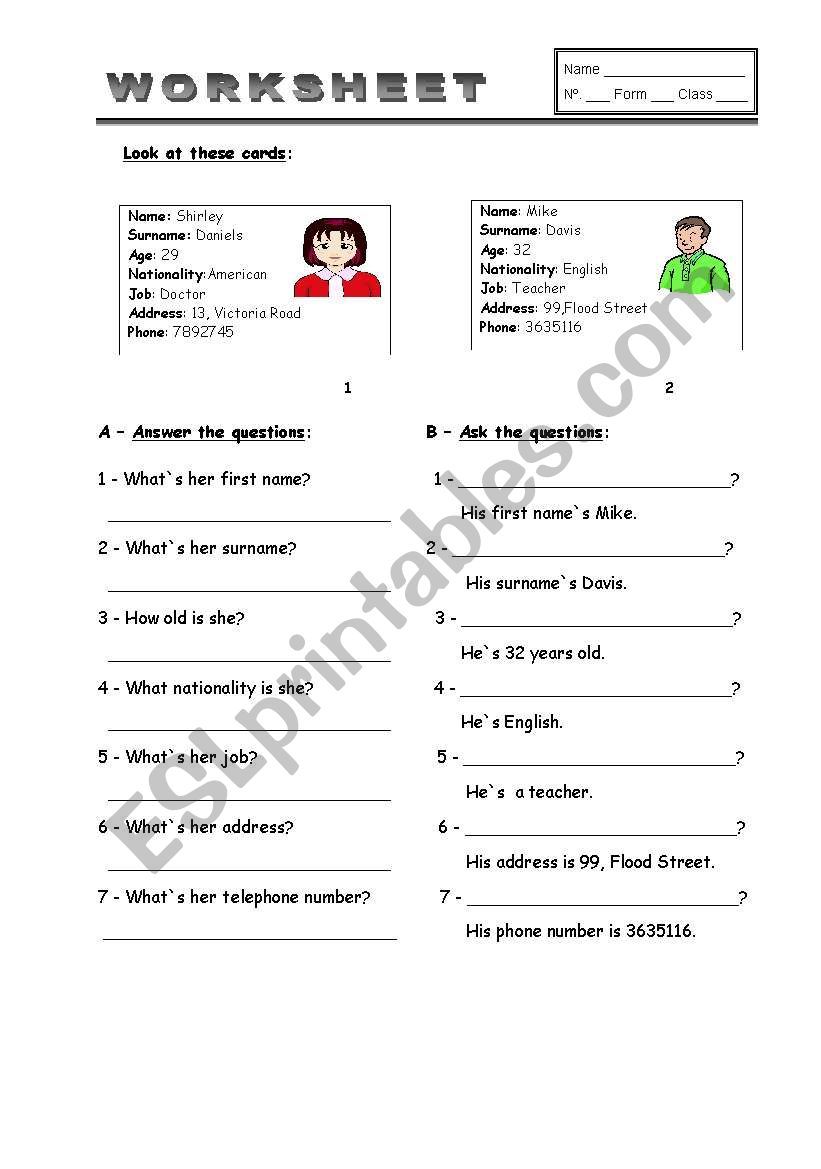
Please complete both parts of the exercise on a piece of paper or in your head.
- Part A: Read Shirley's information card and answer the questions. For example:
What's her name?->Her name is Shirley. - Part B: Look at Mike's answers and write the correct question. For example:
My surname is Peterson.->What's your surname?
This is a great exercise for practicing his and her, which you learned in a previous lesson.
Show answers for Part A
- Her name is Shirley.
- Her surname is Taylor.
- She is 25 years old.
- She is British.
- She is a journalist.
- Her address is 34 Queen's Street, Liverpool.
- Her phone number is 456 99 88.
Show answers for Part B
- What's your name?
- What's your surname?
- How old are you?
- What's your nationality?
- What do you do? / What's your job?
- What's your address?
- What's your phone number?
Conclusion
Excellent work! You've learned how to handle some of the most common questions in English conversations. This is a big step toward feeling more confident when you speak with people.
Key Takeaways:
- You can now ask and answer questions about nationality and origin using "Where are you from?".
- You can talk about your job using "I'm a nurse" and add details like "I have to look after patients". You also know how to ask "What do you do?".
- You can ask and answer simple questions about your family, such as "Are you married?" and "Do you have any sisters?".
In our next lesson, we will learn a very important skill for any language learner: how to ask for clarification when you don't understand. Phrases like "Can you repeat that, please?" are essential tools that will help you in real conversations.