Bonjour! Welcome to your fifth lesson.
In our last lesson, we learned how to use adjectives like happy, friendly, and French to describe people. This is a very useful skill for everyday conversations.
Today, we will learn another essential skill: how to talk about dates. The learning outcome for this lesson is to use ordinal numbers (first, second, third) and months to say and understand dates. This will help you talk about your birthday, make appointments, and understand holidays.
1. The Months of the Year
First, let's learn the twelve months of the year. In English, the names of the months always start with a capital letter (e.g., January, not january).
Here is the list of the twelve months in order:
- January
- February
- March
- April
- May
- June
- July
- August
- September
- October
- November
- December
Correct pronunciation is very important. Let's practice saying the months.
Pronunciation: Ordinal numbers, months, and dates
The video 'Pronunciation: Ordinal numbers, months, and dates' has a section that is perfect for practicing. Listen to the speaker and repeat each month.
Please watch the video from 06:58 to 08:32. Listen carefully to the pronunciation of each month and try to say the words aloud.
Some months can be tricky to spell. For a written reference and some tips on common spelling mistakes, you can review the following article.
Months in English – names, abbreviations, and pronunciation
The article 'Months in English' provides a clear list of the months and also discusses common spelling and pronunciation errors. It's a useful page to save for future reference.
Please read the section 'Names, order and abbreviations' to see the list of months. Then, look at the section 'Common mistakes with months in English' to see tips on spelling and pronunciation.
Test your understanding!
Unscramble (remettez dans l'ordre) the letters to find the month.
- hcraM → ?
- lyJu → ?
- breemecD → ?
- ryabFreu → ?
Show answer
- March
- July
- December
- February
2. Ordinal Numbers
To say a date, we don't use the numbers you already know for counting (one, two, three). Those are called cardinal numbers. For dates, we need ordinal numbers, which tell us the position or order of something (first, second, third).
Look at this chart. It shows the ordinal numbers from 1st to 31st, which you need for dates.
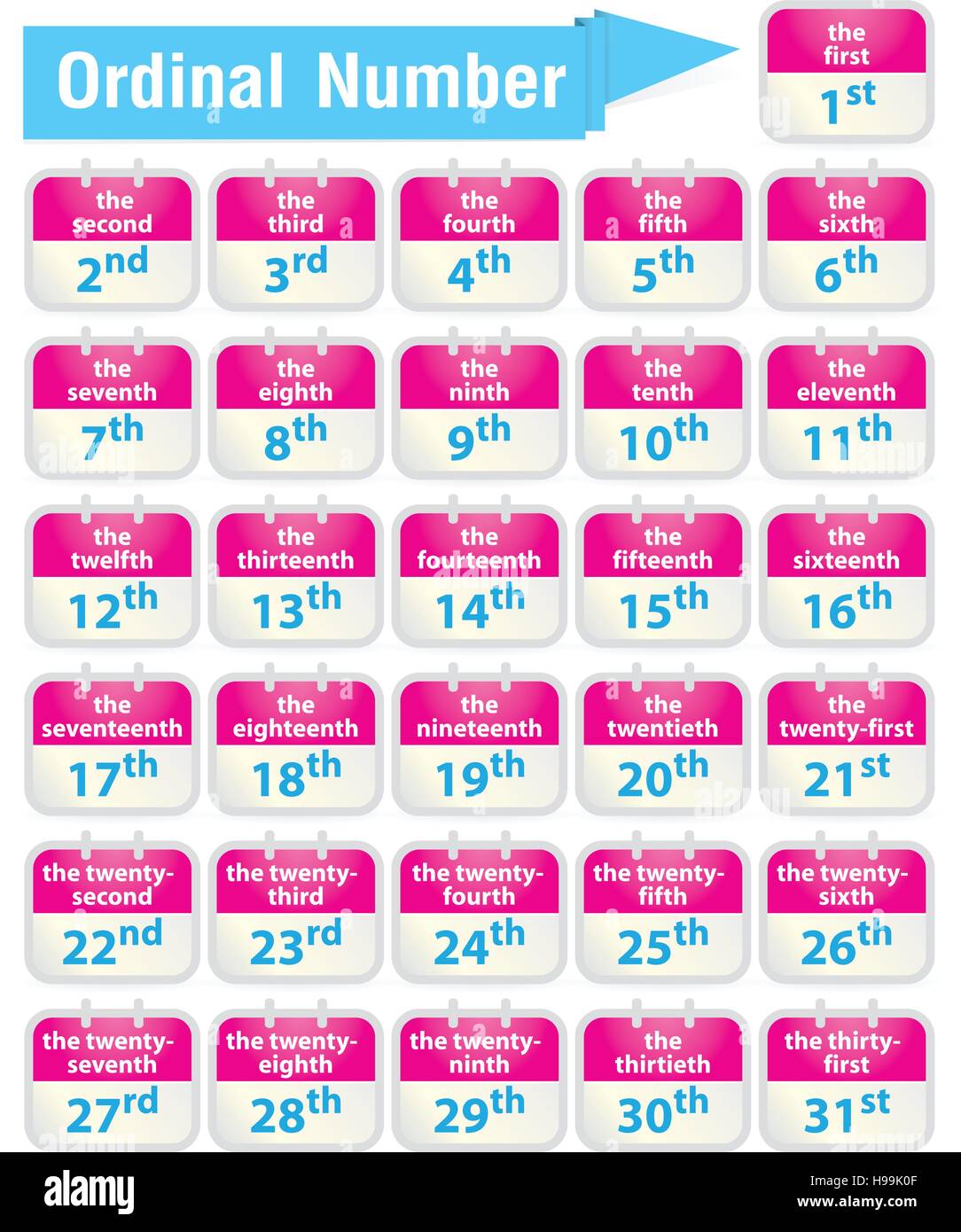
As you can see, there are a few rules to learn:
- First (1st), Second (2nd), and Third (3rd) are irregular.
- Most other numbers just add -th at the end:
four→fourth(4th),six→sixth(6th). - There are some small spelling changes for numbers like
five→fifth(5th) andtwelve→twelfth(12th). - For numbers ending in
-y, liketwenty, we change theytoiebefore adding-th:twenty→twentieth(20th).
Let's read a short text that explains these rules clearly.
BBC Learning English - Course: intermediate / Unit 5
The article from BBC Learning English explains how to form and spell ordinal numbers. It is a good summary of the rules.
Please read the section that starts with 'Catherine: And to make a cardinal number into an ordinal number...' and ends with '...to make sixtieth: s-i-x-t-i-e-t-h'. This section explains the spelling rules.
Now, let's practice the pronunciation. The "th" sound can be difficult, so it's good to listen and repeat.
Pronunciation: Ordinal numbers, months, and dates
Let's return to the video from Professor Korten. This time, we will focus on the ordinal numbers.
Watch from 00:41 to 04:50. The speaker will pronounce the ordinal numbers. Repeat after him. Pay special attention to the 'th' sound in words like 'fourth' and 'fifth'.
3. How to Say and Write Dates
Now let's combine the months and ordinal numbers to form dates.
Spoken Dates
In English, there are two common ways to say a date. For example, if the date is November 14:
- The fourteenth of November
- November the fourteenth
Both are correct! Notice that we say the words the and of, even if they are not written.
Let's watch a short video that explains this very well. It also explains how to say the year.
How To Read Dates In English - Spoken English Lesson
This excellent video from Oxford Online English clearly explains how to say dates and years.
First, watch from 00:29 to 01:19 to learn the two ways to say the day and month. Then, watch from 01:19 to 03:41 to learn how to pronounce years like 1995, 2008, and 2023.
Written Dates: UK vs. US English
It is also important to know that the order of the day and month is different in written English between the UK and the US.
- UK format: day / month / year (e.g., 04/07/2023 = 4th July 2023)
- US format: month / day / year (e.g., 04/07/2023 = April 7th, 2023)
When you see a date written with numbers, be careful! The meaning can change depending on the format.
The following image shows short conversations about birthdays. It is a good example of how we use dates in context.

Practice Exercise
How do you say these dates in English? Write them out in words using one of the two forms you learned.
Example: 10/01 (UK Format: day/month) → The tenth of January. OR January the tenth.
- 25/12 (Christmas Day) →
- 14/07 (Bastille Day in France) →
- 01/04 (April Fools' Day) →
- 31/10 (Halloween) →
Show answer
- The twenty-fifth of December / December the twenty-fifth.
- The fourteenth of July / July the fourteenth.
- The first of April / April the first.
- The thirty-first of October / October the thirty-first.
Conclusion
Great job today! You have learned a very practical and important part of everyday English.
Key Takeaways:
- You can now name the 12 months of the year and pronounce them.
- You know what ordinal numbers are (
first,second,third, etc.) and how to form them. - You can say a date in two ways: "the first of May" or "May the first".
- You understand the difference between the UK (day/month) and US (month/day) written date formats.
In our next lesson, we will continue building your conversational skills by learning how to ask and answer questions about personal information, like your job, nationality, and family. This will connect perfectly with what you learned today, as you will soon be able to ask, "When is your birthday?".