Bonjour ! Welcome to your seventh lesson.
In our last lesson, we learned how to ask and answer questions about personal information like your job and nationality. This is great for starting conversations. But what happens when you don't understand what the other person says? It's a normal part of learning, and today, we'll focus on exactly that.
Our goal is to learn how to ask for clarification when you don't understand. We will learn several polite and effective phrases that are much better than just saying "I don't understand." This skill will make your conversations smoother and help you learn faster.
1. Why We Need More Than "I Don't Understand"
In English, saying "I don't understand" or "What?" can sometimes sound too direct or even a little rude, especially depending on your tone of voice. Learning a few alternative phrases will help you sound more polite and natural.
Let's start with a short video that explains which common phrases to avoid and why.
I don't understand - 10 common English phrases you can use instead
In this first clip from the video 'I don't understand' by English Etc. With Julie, you will learn why phrases like 'I don't understand', 'What?', and 'Repeat please' are not always the best choices.
Please watch from 01:12 to 03:33. Pay attention to the explanation for each of the three phrases to avoid.
As the video explains, these phrases can block communication. The other person doesn't know why you don't understand (the speed, a word, the idea). Using more specific phrases is much more helpful.
2. Simple and Quick Ways to Ask for Repetition
Often, you just need someone to say something again because you didn't hear it clearly. For this, you can use simple, one-word questions. The key is to use a rising intonation, making your voice go up at the end, so it sounds like a question.
I don't understand - 10 common English phrases you can use instead
Now, let's learn two very simple and polite words you can use. This clip from the same video introduces 'Sorry?' and 'Pardon?'.
Watch from 03:33 to 05:00. Notice how the speaker's intonation goes up at the end of 'Sorry?' and 'Pardon?'.
Using "Sorry?" or "Pardon?" with a questioning tone is a quick, effective, and polite way to ask someone to repeat themselves.
3. Asking for Specific Help
Sometimes, the problem isn't just that you didn't hear, but how the person is speaking. Maybe they are speaking too quietly or too quickly. In these cases, you can be more specific.
Here are some phrases for different situations:
- When you can't hear someone:
- "Sorry, could you speak up a little?" ('Speak up' means to speak louder).
- When you missed what was said:
- "Sorry, I didn't quite catch that." ('To catch' something here means to hear or understand it).
- When someone is speaking too fast:
- "I didn't catch that, would you mind speaking slower?"
The video explains these phrases clearly.
I don't understand - 10 common English phrases you can use instead
This next clip will teach you how to ask someone to speak louder, repeat themselves, or speak more slowly.
Watch from 05:00 to 06:15 for the phrases 'Could you speak up a little?' and 'I didn't quite catch that.' Then, watch from 08:49 to 09:52 for the phrase 'Would you mind speaking slower?'
Test your understanding!
Imagine you are in a busy café trying to order a coffee. The barista tells you the total price, but you can't hear it because of the noise. What is a polite phrase you could use?
Show answer
You could say:
- "Sorry?"
- "Pardon?"
- "Sorry, I didn't quite catch that."
- "Sorry, could you speak up a little?"
Any of these would be appropriate!
4. Clarifying Meaning and Confirming Understanding
What if you heard all the words, but you don't understand a specific point or want to check if your understanding is correct? This is a very powerful communication skill.
To ask about a specific word or idea:
- "I'm not sure what you mean by [word/phrase]."
- "Could you explain what you mean by [word/phrase]?"
To check if you have understood correctly:
- "Just to make sure I've understood you correctly, you mean..."
Let's watch the final clip to see these phrases in action.
I don't understand - 10 common English phrases you can use instead
This clip shows how to ask for clarification on a specific point and how to confirm that you've understood correctly.
Watch from 09:52 to 11:46 to learn phrases for asking about a specific word or idea you don't understand. Then, watch from 06:36 to 08:49 to learn how to confirm your understanding.
This strategy is very useful. For example, in your work, if a doctor uses a medical term you don't recognize in English, you could say: "I'm not sure what you mean by 'prophylactic treatment'. Could you explain that?"
5. Choosing the Right Phrase: Formal vs. Informal
The phrase you choose can depend on the situation. Are you talking to a friend or a manager? Some phrases are more informal, while others are more formal.
This document gives an excellent overview of phrases for different levels of formality.
This document, 'SL9. Asking for Clarification', categorizes many useful phrases. We will focus on the lists it provides.
Please read the section titled 'Part 1 -- Clarification Expressions'. Focus on the three lists under 'Situation 2': Informal, Neutral, and Formal. Notice the differences between them.
As you can see:
- Informal: "Huh?", "What was that?", "You lost me." (Best with friends)
- Neutral: "Could you say that again, please?", "I'm not sure I'm following you." (Good for most situations)
- Formal: "I beg your pardon, but I don't quite understand.", "I wonder if you could say that in a different way." (Best for work or official settings)
Summary of Phrases
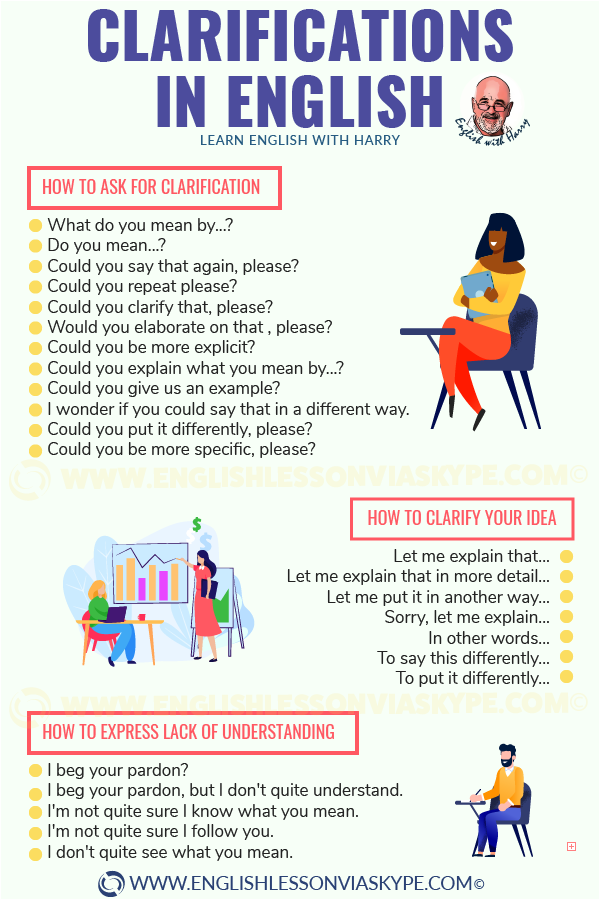
Here is a helpful image that summarizes many of the phrases we have learned today. You can use it as a quick reference.
Practice Time!
Let's imagine a situation. You are a nurse, and an English-speaking colleague is explaining a patient's medication schedule.
Colleague: "Okay, so for Mr. Smith, he gets his analgesics PRN, but the beta-blockers are BID, and make sure to hold the diuretics if his BP is too low."
You understood most of it, but two things are unclear:
- You don't know what "PRN" means.
- You want to confirm your understanding of "BID". You think it means twice a day.
How would you ask for clarification politely and professionally? Think about the phrases we learned.
Show possible answers
Here are some excellent ways you could respond:
-
To ask about "PRN":
- "Sorry, I didn't catch that first part. Could you explain what you mean by 'PRN'?"
- "I'm sorry, I'm not sure what you mean by 'PRN'."
-
To confirm the meaning of "BID":
- "Just to make sure I've understood you correctly, when you say 'BID', you mean twice a day, correct?"
- "So, in other words, the beta-blockers should be given twice a day?"
Conclusion
Great job today! Learning how to manage moments of confusion is one of the most important skills for a language learner. It shows you are engaged in the conversation and allows you to learn from it.
Key Takeaways:
- Avoid using just "What?" or "I don't understand." It's better to be more specific and polite.
- For simple repetition, use "Sorry?" or "Pardon?" with a rising intonation.
- You can ask someone to speak slower or speak up.
- You can ask for the meaning of a specific word with "What do you mean by...?"
- You can confirm your understanding with "Just to make sure I've understood..."
This lesson concludes our first module! You've built a strong foundation. In our next lesson, we will begin a new module, "Describing Your Home and Surroundings," starting with learning the names of common rooms and objects in a house.