Hello! Welcome to your next lesson. In the previous module, we wrapped up our study of single-source shortest path algorithms with Bellman-Ford, focusing on how to handle negative edge weights and detect negative cycles.
Today, we're shifting gears to a completely different but equally powerful tool in the competitive programmer's arsenal: the Disjoint Set Union (DSU) data structure, also known as Union-Find. Your learning goal for this lesson is to implement the Disjoint Set Union (DSU) data structure with path compression and union by rank/size.
DSU is fundamental for solving a wide class of problems related to connectivity, grouping, and partitioning. It allows you to efficiently answer questions like: "Are these two elements in the same group?" and "Merge these two groups." By the end of this lesson, you'll understand how DSU works and be able to code an optimized version that is blazingly fast.
Let's dive in!
1. What is a Disjoint Set Union (DSU)?
At its core, DSU is a data structure that keeps track of a collection of elements partitioned into a number of non-overlapping (disjoint) sets. Think of it like managing social groups. You have a bunch of people, and each person belongs to exactly one group. The DSU helps you quickly figure out which group someone belongs to and lets you merge two groups into one (for example, when two different clubs decide to join forces).
To get a clear visual and conceptual understanding of DSU and its three main operations (make_set, find, and union), let's start with a video.
The video 'Union Find Visually Explained' by Hello Byte provides an excellent introduction. It uses a company hierarchy analogy to make the concepts of sets, representatives (roots), and merging very intuitive.
Please watch from the beginning to 06:49. Pay close attention to: The three core operations: make_set, find, and union. How a forest of trees is used to represent the sets. How a simple parent array is used in code to implement this tree structure.
As the video explains, we can represent our sets as a forest of trees. Each tree corresponds to one set, and the root of the tree is the representative of that set. We implement this using a parent array, where parent[i] stores the parent of element i. If an element is its own parent (parent[i] == i), it is the root of its tree.
The operations are:
make_set(Initialization): Every element starts in its own set, so we initializeparent[i] = ifor all elementsi.find(i): To find the representative of the set containingi, we travel up the tree by following parent pointers until we reach the root.union(i, j): To merge the sets containingiandj, we first find their respective roots. If they are different, we make one root the child of the other.
2. The Problem with a Naive Implementation
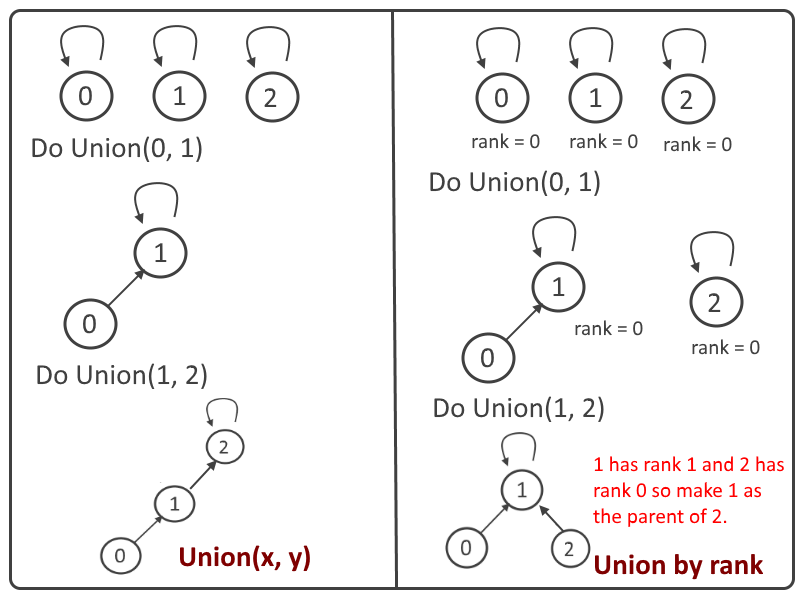
The simple approach described above works, but it can be very inefficient. If we are not careful about how we perform the union operation, we can end up creating very tall, skinny trees that resemble linked lists.
When this happens, a find operation has to traverse this long chain, making its time complexity linear, or , where is the number of elements. For competitive programming, per query is often too slow.
Let's see exactly why this is a problem. The same video from Hello Byte explains this inefficiency clearly.
Watch the segment from 07:49 to 08:52. Notice how a specific sequence of union operations creates a long, unbalanced tree, leading to a slow find operation.
To solve this, we introduce two powerful optimizations: Union by Rank/Size and Path Compression.
3. Optimization 1: Union by Rank or Size
To prevent our trees from becoming too tall, we need a smarter way to merge them. The idea is simple: when uniting two trees, we should attach the shorter tree to the root of the taller tree. This heuristic helps keep the overall height of the resulting tree from growing unnecessarily.
We can track the "tallness" in two ways:
- Union by Rank: We maintain a
rankarray. The rank is an upper bound on the height of the tree. When merging, we attach the root with the lower rank to the root with the higher rank. If the ranks are equal, we attach one to the other and increment the rank of the new root. - Union by Size: We track the number of elements (size) in each set. When merging, we attach the smaller set to the larger one.
Both strategies are effective. We will focus on Union by Rank for our implementation, as it's a classic approach.
4. Optimization 2: Path Compression
Path compression is an optimization applied during the find operation. It's a clever way to flatten the tree structure on the fly.
When we call find(x), we traverse a path from x up to the root. Path compression says: once we've found the root, let's go back down that same path and make every node we visited a direct child of the root.

The next time we call find on any of those nodes, the lookup will be much faster because the path to the root is now just one step.
5. The Optimized Implementation in Python
Now, let's combine these two optimizations to create an efficient DSU implementation. This is the standard template you'll use in competitive programming.
Chapter 14: Union-Find (Disjoint Set Union - DSU)
The article 'Union-Find (Disjoint Set Union - DSU)' on shawonnotes.com provides a clean and complete Python implementation of the UnionFind class that uses both path compression and union by rank. Let's study this code.
Please read the Python code block for the UnionFind class. Focus on understanding how the find and union methods implement the optimizations we just discussed.
Let's break down that implementation:
class UnionFind:
    def __init__(self, n):
        # Each node is its own parent initially
        self.parent = list(range(n))
        # Rank of each tree is initially 1 (or 0, both are valid starting points)
        self.rank = [1] * n

    def find(self, x):
        # If x is not the root of its set...
        if self.parent[x] != x:
            # ...recursively find the root and set it as x's parent.
            # This is path compression!
            self.parent[x] = self.find(self.parent[x])
        return self.parent[x]

    def union(self, x, y):
        # Find the roots of the sets containing x and y
        root_x = self.find(x)
        root_y = self.find(y)

        # If they are not already in the same set...
        if root_x != root_y:
            # ...merge them based on rank (Union by Rank).
            if self.rank[root_x] > self.rank[root_y]:
                self.parent[root_y] = root_x
            elif self.rank[root_x] < self.rank[root_y]:
                self.parent[root_x] = root_y
            else:
                # If ranks are equal, one becomes the new root
                # and its rank increases.
                self.parent[root_y] = root_x
                self.rank[root_x] += 1
            return True # Indicates a successful merge
        return False # Indicates they were already in the same set
__init__: Sets up theparentandrankarrays. It takes time.find(x): The recursive one-linerself.parent[x] = self.find(self.parent[x])is the magic of path compression. It finds the root and updates the parent ofxin a single motion.union(x, y): Implements the union by rank logic. It finds the roots, compares their ranks, and attaches the lower-ranked tree to the higher-ranked one. Notice it also handles the case where ranks are equal.
Test your understanding!
Suppose you have a UnionFind instance. You have two sets, A and B. The root of set A is node 0 with rank = 3. The root of set B is node 5 with rank = 2.
What happens to the parent and rank arrays when you call union(0, 5)?
Show answer
Since rank[0] (3) is greater than rank[5] (2), the tree with the smaller rank is attached to the tree with the larger rank.
parent[5]will be set to0.- The ranks do not change in this case. The rank of the new combined tree rooted at
0remains3.
Conclusion
You have now learned how to implement one of the most efficient data structures for handling dynamic connectivity. When combined, path compression and union by rank/size make the DSU operations incredibly fast. The amortized time complexity for both find and union is nearly constant, denoted as , where is the inverse Ackermann function. For any practical input size in programming competitions, you can consider this to be .
Key Takeaways:
- DSU is used to manage a collection of disjoint sets.
- It is implemented using a
parentarray to represent a forest of trees, where each tree is a set. - A naive implementation can lead to performance for
findoperations. - Union by Rank/Size keeps the trees balanced and shallow during
unionoperations. - Path Compression flattens the trees during
findoperations. - Together, these optimizations give DSU nearly constant-time performance for its main operations.
Up Next:
Now that you have built this powerful tool, it's time to use it! In the next lesson, you will apply the DSU data structure to solve connectivity problems, starting with a classic LeetCode problem: finding the number of connected components (or "provinces") in a graph.