Hello! Welcome back to our project.
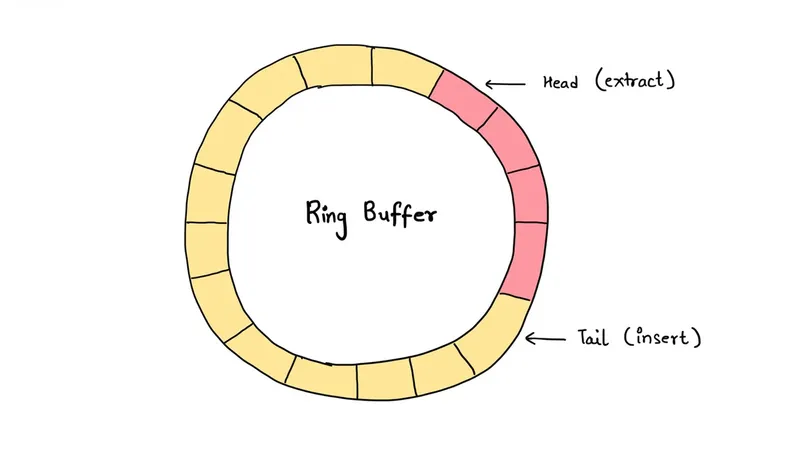
In the last lesson, we established a crucial architectural pattern for our telemetry engine: the per-thread buffer design. We decided that to eliminate write-side contention and avoid the "observer effect," every instrumented application thread will get its own dedicated Single-Producer, Single-Consumer (SPSC) ring buffer. A single background consumer thread will then be responsible for collecting data from all of these buffers.
This lesson moves from design to implementation. Our learning outcome is to implement a manager class to hold a collection of SPSC ring buffers, one for each instrumented thread. This manager will act as the central registry for our data pipeline, forming the bridge between the many producer threads and our single consumer.
The Role of the TelemetryManager
Before we write any code, let's clarify the responsibilities of our manager class:
- Storage: It must maintain a collection of all active SPSC ring buffers.
- Registration: It needs to provide a thread-safe mechanism for a newly instrumented application thread to create and register its own buffer.
- Access for the Consumer: It must provide a way for our background consumer thread to safely access and iterate over the collection of buffers to poll for new data.
This manager is the cornerstone of our architecture, so its design must be both robust and efficient.
Storing and Owning the Buffers
Our first implementation decision is how to store the collection of SPSC queue objects. Since the number of threads is dynamic, std::vector is a natural choice for the container. But what should the vector hold?
std::vector<SPSCQueue*>: Using raw pointers would force us to manage the memory for each queue manually. Forgetting todeletea queue when a thread finishes would lead to a memory leak. This is error-prone.std::vector<std::shared_ptr<SPSCQueue>>: This would manage memory for us, butstd::shared_ptrimplies shared ownership. In our design, the manager has sole ownership of the buffers; the producer threads only need to use them, not own them. Usingshared_ptrwould add unnecessary overhead for reference counting.std::vector<std::unique_ptr<SPSCQueue>>: This is the best fit.std::unique_ptrexpresses exclusive ownership and handles memory deallocation automatically (RAII). This perfectly models our design: theTelemetryManagerowns the buffers.
So, our manager class will contain a member like std::vector<std::unique_ptr<SPSCQueue<...>>>.
Protecting the Collection: A Shared Resource
While each individual SPSC queue is lock-free between its single producer and single consumer, the TelemetryManager itself is a shared resource.
- Multiple application threads might try to register a new buffer at the same time.
- The consumer thread might be iterating over the vector of buffers while another thread is trying to add a new one.
These scenarios create a data race on the std::vector itself. Therefore, we must protect access to the vector. A std::mutex is the standard tool for this job.
A key insight here is that this lock is on the cold path. A new buffer is registered only when a thread generates a telemetry event for the first time. The frequent, performance-critical "hot path" is the act of writing to an already-existing buffer, which remains a fast, lock-free operation. The minor cost of a mutex lock during the rare event of thread registration is an acceptable and necessary trade-off for correctness.
Implementing the TelemetryManager Class
Let's translate this design into C++ code. We'll start with a simplified stub for our SPSCQueue, representing the complex component you learned to build in the previous module.
// A simplified stub for our SPSC queue from the previous module.
// In a real implementation, this would be the fully-featured,
// cache-aligned, lock-free queue.
template<typename T>
class SPSCQueue {
public:
    SPSCQueue(size_t capacity) { /* ... */ }
    bool try_push(const T& value) { /* ... */ return true; }
    bool try_pop(T& value) { /* ... */ return false; }
};

// For our example, the events will just be simple integers.
using Event = int;
Now, we can implement the TelemetryManager.
#include <iostream>
#include <vector>
#include <memory>
#include <mutex>
#include <functional>

class TelemetryManager {
public:
    TelemetryManager() = default;

    // Disallow copying and moving to prevent accidental duplication
    // of this singleton-like manager.
    TelemetryManager(const TelemetryManager&) = delete;
    TelemetryManager& operator=(const TelemetryManager&) = delete;

    /**
     * @brief Creates and registers a new SPSC buffer for a thread.
     * @param capacity The capacity of the ring buffer to create.
     * @return A non-owning raw pointer to the created buffer. The manager retains ownership.
     */
    SPSCQueue<Event>* register_new_thread_buffer(size_t capacity) {
        // Lock the mutex to protect access to the m_buffers vector.
        std::lock_guard<std::mutex> lock(m_mutex);

        // Create a new queue and add it to our collection.
        // std::make_unique handles the allocation.
        auto new_queue_ptr = std::make_unique<SPSCQueue<Event>>(capacity);

        // Get the raw pointer to return before we move ownership into the vector.
        SPSCQueue<Event>* raw_ptr = new_queue_ptr.get();

        // std::move transfers ownership of the unique_ptr into the vector.
        m_buffers.emplace_back(std::move(new_queue_ptr));

        std::cout << "Manager: Registered a new buffer. Total buffers: " << m_buffers.size() << std::endl;

        return raw_ptr;
    }

    /**
     * @brief Iterates over all registered buffers and executes a function on each.
     * @param func A callable (e.g., a lambda) that takes a SPSCQueue<Event>*
     */
    void for_each_buffer(const std::function<void(SPSCQueue<Event>*)>& func) {
        // Lock the mutex to ensure the collection isn't modified while we iterate.
        std::lock_guard<std::mutex> lock(m_mutex);

        for (const auto& buffer_ptr : m_buffers) {
            func(buffer_ptr.get());
        }
    }

private:
    // This mutex protects the m_buffers vector from concurrent access.
    std::mutex m_mutex;

    // The vector of unique_ptrs owns all the SPSC queue objects.
    std::vector<std::unique_ptr<SPSCQueue<Event>>> m_buffers;
};
This implementation directly reflects our design goals:
m_buffersstoresstd::unique_ptrs, ensuring proper ownership and memory management.register_new_thread_bufferprovides a thread-safe way for producers to add their buffers, returning a non-owning raw pointer for them to use.for_each_bufferprovides a thread-safe way for the consumer to access the buffers. Passing a callable function is a clean and safe pattern that ensures the collection remains locked during the entire iteration.
Test your understanding!
In the register_new_thread_buffer method, why do we return a raw pointer (SPSCQueue<Event>*) instead of a std::unique_ptr<SPSCQueue<Event>> or std::shared_ptr<SPSCQueue<Event>>? What does this imply about ownership?
Show answer
We return a raw pointer because the TelemetryManager must remain the sole owner of the buffer object.
- If we returned a
std::unique_ptr, we would be transferring ownership to the caller (the producer thread), which is incorrect. The manager would no longer own the buffer. - If we returned a
std::shared_ptr, we would be creating shared ownership, which is more complex than needed and adds reference-counting overhead.
By returning a raw pointer, we are giving the producer thread access to the buffer without giving it ownership. The producer can use the pointer to call try_push, but it is not responsible for the buffer's lifetime. The TelemetryManager's std::unique_ptr in the m_buffers vector guarantees that the buffer will be correctly deallocated when the manager is destroyed.
An Alternative Approach: Fixed-Size Array with Atomics
Our mutex-based solution is simple, correct, and performs well for the "cold path" of thread registration. However, in systems where the maximum number of threads is known and performance on this path is still absolutely critical, an alternative lock-free approach exists.
Efficient Inter-Process Pub-Sub in C++: A Lock-Free, Low- ...
The article 'Efficient Inter-Process Pub-Sub in C++' describes a high-performance SPMC (Single-Producer, Multi-Consumer) queue. While the producer/consumer logic is different from ours, its method for managing a collection of consumers is highly relevant to our problem of managing a collection of producer buffers.
Please read sections 5.2 ('The Queue') and 5.5 ('Dynamic Consumer Registration'). In section 5.2, notice how the class LockFreePubSubQueue holds a std::array<ConsumerSlot, MaxConsumers>. This is analogous to our TelemetryManager holding a collection of buffers. It pre-allocates a fixed-size array. In section 5.5, study the register_consumer function. Instead of a mutex, it uses an atomic compare_exchange_strong loop to find and claim an inactive slot in the pre-allocated array. This is a common lock-free pattern for managing a pool of resources.
The approach in the article uses a fixed-size array and atomics to find an empty slot.
Pros:
- It's a fully lock-free approach, which can be beneficial in certain real-time contexts.
- All memory is pre-allocated, avoiding potential allocations during runtime.
Cons:
- It requires setting a hard
MaxThreadslimit. If you exceed this, registrations will fail. - The implementation is more complex than our
std::mutexandstd::vectorapproach.
For our project, the mutex-based dynamic vector is a robust and perfectly suitable solution. However, knowing about this atomic-based fixed-array pattern is valuable for your low-level engineering toolkit.
Conclusion
We have successfully implemented the central nervous system of our telemetry capture system. The TelemetryManager provides a clean, thread-safe, and efficient way to manage the lifecycle of our per-thread SPSC buffers.
Key Takeaways:
- The manager class centralizes the control and ownership of all SPSC ring buffers.
- Using
std::vector<std::unique_ptr<...>>is an effective C++ pattern for managing a dynamic collection of objects with clear ownership. - Even in a system built on lock-free components, central registries or collections often require traditional locks (
std::mutex) for safety. This is acceptable on the "cold path." - Designing APIs that take callable objects (like lambdas) is a powerful pattern for providing safe access to internal, protected data.
What's Next?
We've built the manager that holds the buffers. The next logical step is to create the entity that interacts with it. In our next lesson, we will focus on the learning outcome: "Implement a background consumer thread that polls all thread buffers and consolidates events." We will bring our system to life by creating the worker thread that uses the for_each_buffer method to drain data from the producers and prepare it for visualization.