Hello! Welcome back to your journey building a high-performance telemetry engine.
In our last lesson, we created a powerful "on/off" switch for our PROFILE_EVENT macro using preprocessor directives. This allows us to completely remove any instrumentation overhead in release builds, which is a fantastic achievement. However, when profiling is enabled, our macro is still passing full, human-readable strings for every event. This is inefficient and something a professional-grade profiler would avoid.
Today, we will fix that. This lesson's goal is to implement a string interning table using a hash map to reduce data size and enable fast comparisons. We will replace bulky, slow-to-compare strings with lightweight, fast integer IDs. This change is fundamental to achieving high-frequency event capture without impacting the application's performance.
1. The Problem with Strings
In high-performance contexts, strings are problematic for two main reasons:
- Memory Overhead & Allocations: Every time you create or manipulate a string, you often trigger heap memory allocations and data copies. For a profiler capturing thousands of events per second, this overhead is unacceptable.
- Slow Comparisons: Comparing two strings, like
"PlayerJumped"and"PlayerLanded", requires iterating over each character until a difference is found or the strings end. Comparing two integer IDs is a single, lightning-fast CPU instruction.
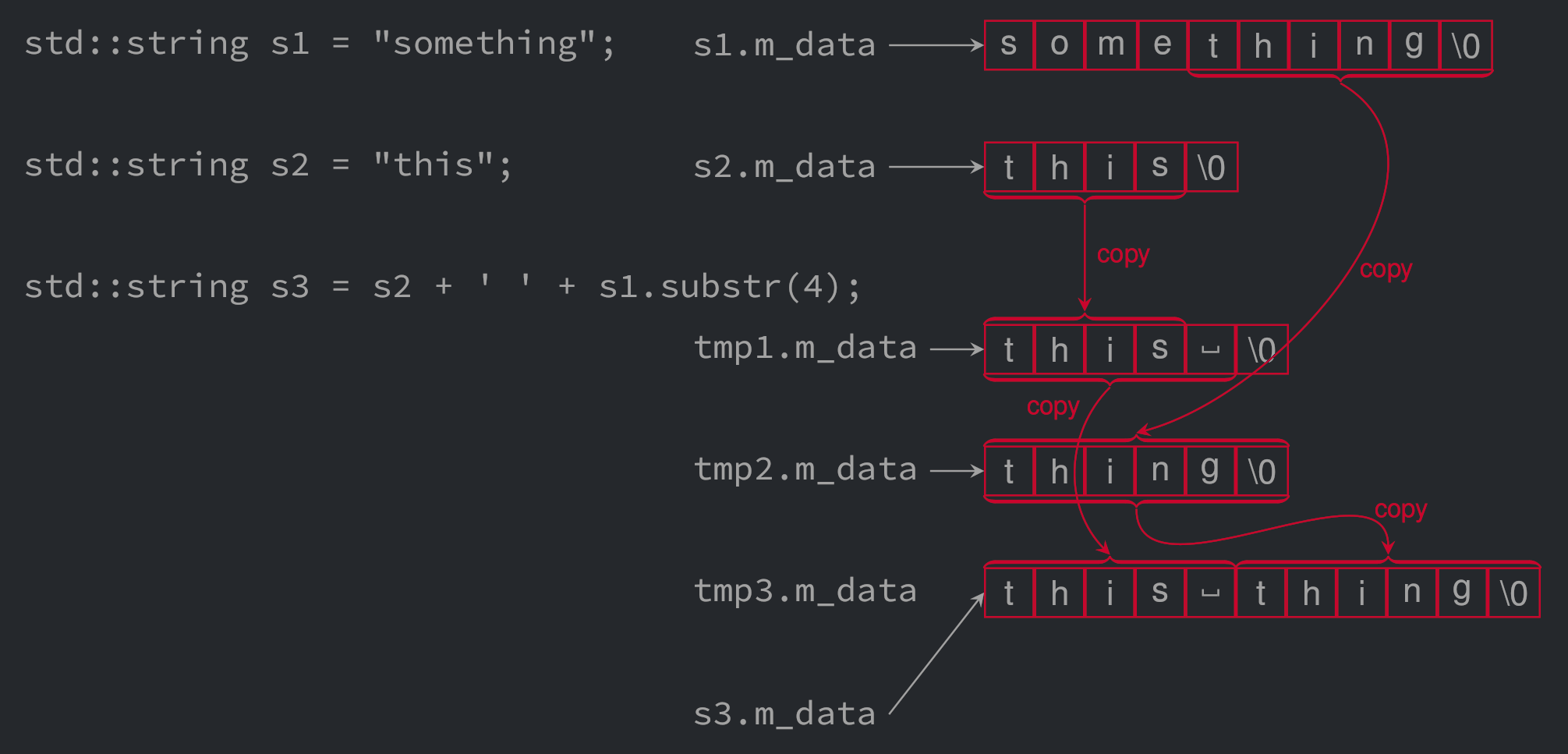
The solution is string interning: a process where we store only one copy of each unique string. Every time that string appears, we refer to it using a unique identifier (an "interned ID").
To see the dramatic performance impact of this technique, let's watch a short video.
Interning Strings for a 10x speedup | C++ | Compiler Hacking
The video 'Interning Strings for a 10x speedup' by Tim R Morgan demonstrates this exact concept within the context of a compiler. It perfectly illustrates the 'before' and 'after' performance gains.
Watch the following three short clips: What is String Interning? (00:00 - 01:21): Focus on the core idea of replacing strings with numbers for faster comparisons. The Benchmark Result (12:31 - 18:01): You don't need to follow all the C++ code details, but observe the initial benchmark time and the final, much faster result. Recap (23:21 - 24:00): A quick summary of the achievement.
As the video shows, the performance gain from interning can be an order of magnitude or more. For our telemetry engine, this means we can log more events with less impact.
2. The Right Tool: std::unordered_map
To implement string interning, we need a data structure that can quickly answer the question: "Have I seen this string before, and if so, what is its ID?" This is a perfect use case for a hash map.
In C++, the standard library provides std::unordered_map, a hash map implementation that gives us fast key-value lookups. The key will be the std::string we want to intern, and the value will be its uint32_t ID.
Since you're building your C++ foundations, it's worth getting a solid grasp of how to use maps.
Maps in C++ (std::map and std::unordered_map)
The video 'Maps in C++' from The Cherno is an excellent introduction to both std::map and std::unordered_map. We'll focus on std::unordered_map.
Please watch the following segments: Introduction to Maps (00:00 - 03:40): Understand the concept of a key-value store and the fundamental difference between std::map (an ordered tree) and std::unordered_map (a hash table). Using unordered_map (07:59 - 08:17): Note how the API is nearly identical to std::map. Interacting with Maps (16:43 - 21:00): This is the most critical part. Pay close attention to the difference between using the index operator [] (which inserts if the key doesn't exist) and using .find() to check for a key's existence without modifying the map.
The key takeaways from the video are:
std::unordered_mapis built on a hash table, making it very fast for lookups (our primary use case).std::stringcan be used as a key directly because the C++ standard library already knows how to hash it.- The
find()method is the correct tool for checking if a string already exists in our table, as it avoids unintended insertions.
3. Implementing the String Interning Table
Now, let's design and implement a StringInterner class. This class will manage the mapping between strings and their IDs. For simplicity in our project, we can treat this as a singleton—a single, globally accessible object.
Our interner needs two core data structures:
- A map from string to ID for fast lookups:
std::unordered_map<std::string, uint32_t> m_string_to_id; - A vector to store the actual string data, allowing us to look up a string by its ID if needed (e.g., for the UI later):
std::vector<std::string> m_id_to_string;
Here is a complete implementation of a basic StringInterner.
#include <iostream>
#include <string>
#include <vector>
#include <unordered_map>
#include <cstdint>

class StringInterner {
public:
    // Get the singleton instance
    static StringInterner& get() {
        static StringInterner instance;
        return instance;
    }

    // The main function: returns an ID for a given string
    uint32_t intern(const std::string& str) {
        // 1. Check if the string is already in the map
        auto it = m_string_to_id.find(str);
        if (it != m_string_to_id.end()) {
            // If found, return the existing ID
            return it->second;
        }

        // 2. If not found, create a new ID
        uint32_t new_id = m_id_to_string.size();

        // 3. Add the new string to the reverse-lookup vector
        // Note: In a real-world high-perf scenario, we might use a more
        // memory-efficient storage, but std::vector is fine for now.
        m_id_to_string.push_back(str);

        // 4. Add the new string-to-ID mapping to the map
        m_string_to_id[str] = new_id;

        return new_id;
    }

    // Optional: A way to get the string back from an ID
    const std::string& lookup(uint32_t id) const {
        return m_id_to_string[id];
    }

private:
    // Private constructor to enforce singleton pattern
    StringInterner() = default;

    std::unordered_map<std::string, uint32_t> m_string_to_id;
    std::vector<std::string> m_id_to_string;

public:
    // Delete copy and move operations to prevent copies of the singleton
    StringInterner(const StringInterner&) = delete;
    void operator=(const StringInterner&) = delete;
};

// --- Example Usage ---
int main() {
    uint32_t id1 = StringInterner::get().intern("Player.Health");
    uint32_t id2 = StringInterner::get().intern("Engine.FPS");
    uint32_t id3 = StringInterner::get().intern("Player.Health");

    std::cout << "ID for 'Player.Health': " << id1 << std::endl;
    std::cout << "ID for 'Engine.FPS':    " << id2 << std::endl;
    std::cout << "ID for 'Player.Health': " << id3 << std::endl;

    // We can verify that id1 and id3 are identical.
    if (id1 == id3) {
        std::cout << "The IDs for the same string are identical, as expected." << std::endl;
    }

    // We can also look up the original string from an ID
    std::cout << "ID " << id2 << " corresponds to string: '" << StringInterner::get().lookup(id2) << "'" << std::endl;

    return 0;
}
When you run this code, you'll see that "Player.Health" is assigned an ID (e.g., 0) the first time, and the exact same ID is returned on the second call. A new ID (e.g., 1) is created for the new string "Engine.FPS".
Test your understanding!
Imagine our intern function was mistakenly implemented using the [] operator for the check, like this:
uint32_t intern_buggy(const std::string& str) {
    if (m_string_to_id[str]) { // Incorrect check!
        return m_string_to_id[str];
    }
    // ... logic to create new ID ...
}
Based on the video you watched, what is the primary bug this would cause when interning a string for the first time?
Show answer
The [] operator on std::unordered_map performs an "access or insert" operation. If the key (str) does not exist, it will be inserted into the map with a default-constructed value (which is 0 for uint32_t).
The buggy if (m_string_to_id[str]) check will then evaluate if (0), which is false. The code will proceed to the "create new ID" section, incorrectly creating a second entry for the same string and overwriting the one that was just inserted. Using .find() correctly separates the act of checking from the act of inserting.
4. Under the Hood: Performance and Data-Oriented Design
As someone interested in low-level systems, it's valuable to look past the std::unordered_map abstraction. How does it work?
A hash map is an array of "buckets". To find a value, you first compute a hash of the key (a number), then map that hash to a bucket index. If multiple keys hash to the same bucket (a "collision"), a common strategy is separate chaining, where each bucket points to a linked list of items.
Master Hash Table Implementation in C++: Hash Functions & ...
This article, 'Master Hash Table Implementation in C++', demonstrates building a hash table from scratch in C. While we are using C++'s library, understanding the underlying principles is invaluable.
Skim through these two sections to get a conceptual understanding: Defining the Hash Table Data Structures: Look at the Ht_item (key-value pair) and HashTable structs. This shows the basic building blocks. Handling Collisions: Focus on the diagrams and the LinkedList struct. This explains the idea of separate chaining to handle hash collisions.
This linked-list approach is common, but traversing lists can be slow due to poor cache locality (nodes can be scattered all over memory). For ultimate performance, some designs favor more data-oriented layouts.
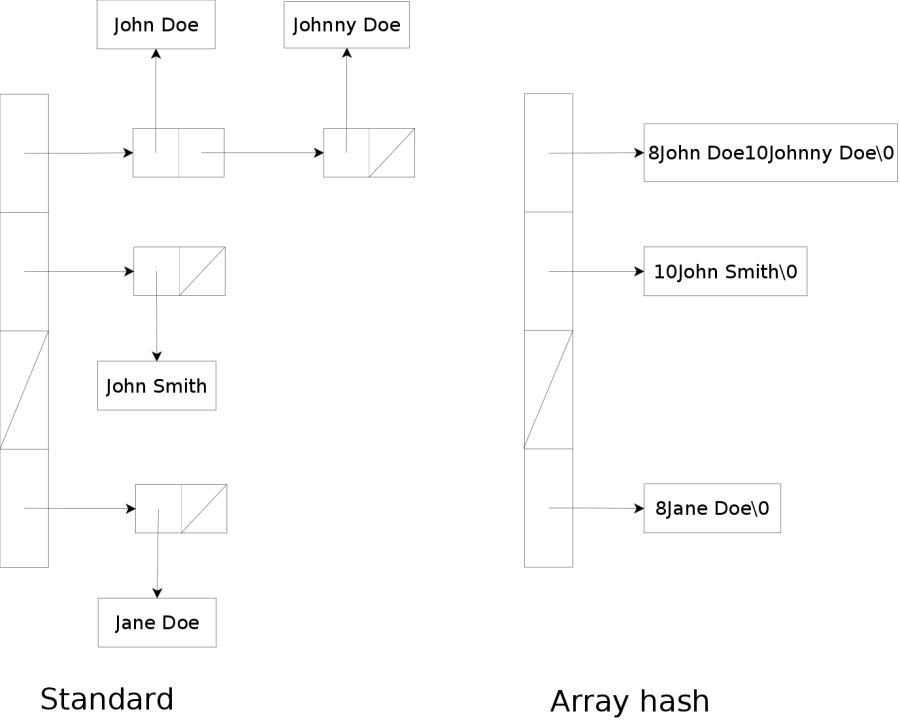
While std::unordered_map's internal implementation is up to the library vendor, understanding these trade-offs is crucial for a systems programmer. Knowing that even standard containers have performance characteristics can inform future design decisions, especially when you might need to write your own specialized data structures.
Conclusion
You have now implemented a core optimization for our telemetry engine. By replacing raw strings with interned IDs, you have drastically reduced the per-event data size and made comparisons trivial.
Key Takeaways:
- String Interning is a crucial pattern in high-performance applications like compilers and profilers. It involves storing a single copy of each unique string and referencing it via an ID.
- This technique significantly reduces memory usage and makes comparisons orders of magnitude faster.
std::unordered_mapis the ideal C++ standard library tool for building an interning table, providing fast key-value lookups.- Using
.find()is the correct way to check for a key's existence without causing side effects.
What's Next?
Our PROFILE_EVENT macro now generates several pieces of data for each event: a timestamp, file/line information, and now an interned string ID. In the next lesson, we will learn how to serialize event data into a compact binary format before pushing to the ring buffer. This is the final step in preparing our event data for efficient, high-speed transport from the application threads to our background consumer thread.