Hello! Welcome back.
In the last lesson, we took full control of our object's lifecycle by implementing the Rule of Five. You learned that when a class manages a resource (like a raw pointer), you must define five special member functions to handle copying, moving, and destruction correctly. We saw that deep copying solves correctness issues but can be slow, and that move semantics—transferring resource ownership—is the key to optimization.
This lesson dives deep into the heart of that optimization. We'll move beyond just knowing that move constructors exist and explore the fundamental C++ mechanisms that make them work. Your goal is to master how to apply move semantics to optimize resource transfers using std::move and rvalue references.
Understanding this is not just academic; it's a prerequisite for writing high-performance C++ code. The zero-overhead data capture you're aiming for in your telemetry engine relies on eliminating every unnecessary allocation and copy, and move semantics is your primary tool for that.
The Problem: Expensive Copies of Temporary Objects
Let's start by revisiting the core problem. We often create temporary, unnamed objects in our code, such as the return value of a function. Before C++11, the language had to treat these temporaries the same as any other object, often resulting in expensive deep copies that were immediately thrown away.
This short video from CppCon provides an excellent, high-level overview of this exact problem and introduces how modern C++ solves it automatically for temporary objects.
Back to Basics: Move Semantics - Nicolai Josuttis - CppCon 2021
The video 'Back to Basics: Move Semantics' by Nicolai Josuttis clearly illustrates the performance cost of copying temporary objects and how C++11 compilers can automatically optimize this by 'moving' instead of copying.
Please watch from 0:45 to 7:47. The first part (until 5:02) demonstrates the unnecessary allocation and copy that happens when pushing a temporary std::string into a std::vector in C++03. The second part (from 5:02 onwards) shows how a C++11 compiler automatically uses a move operation in the same scenario, 'stealing' the memory from the temporary object instead of copying it.
As you saw, the compiler is smart enough to detect that the return value of getdata() is a temporary and can apply a more efficient move operation. But how does it know? The answer lies in value categories.
Distinguishing Lvalues and Rvalues
To enable these optimizations, C++ formalizes the difference between persistent objects and temporary ones using value categories.
- An lvalue (locator value) is an expression that refers to an object that persists beyond a single expression. You can think of it as an object that has a name. You can take its address.
int x = 10; // x is an lvalue MyObject obj; // obj is an lvalue - An rvalue (right-hand-side value) is an expression that refers to a temporary object that is destroyed at the end of the expression in which it was created. You can't take its address.
int y = x + 5;       // The expression (x + 5) produces an rvalue
MyObject get_obj();
MyObject z = get_obj(); // The expression get_obj() produces an rvalue
The key insight of C++11 was this: if an object is an rvalue, it's about to be destroyed anyway. So, it's safe for us to "steal" its resources (like heap-allocated memory) instead of performing an expensive copy.
To do this, C++ introduced a new type of reference: the rvalue reference, denoted by &&.
- An lvalue reference (
MyClass&) can bind to an lvalue. - An rvalue reference (
MyClass&&) can bind to an rvalue.
This allows us to overload functions based on the value category of the argument.
void process_data(const MyClass& obj); // Takes any object, but as const reference
void process_data(MyClass&& obj);      // Overload for rvalues (temporaries)
When process_data is called with an lvalue, the first version is chosen. When it's called with an rvalue, the compiler prefers the second version. We now have a way to create a special code path for temporary objects.
Implementing a Move: The Resource Heist
Now that we can detect an rvalue with an rvalue reference, we can implement the move constructor and move assignment operator you were introduced to in the last lesson. A move operation is essentially a resource heist:
- Copy the pointer (and size/capacity) from the source object to the new object.
- Set the source object's pointer to
nullptr. This is crucial to prevent a double-free when the temporary source object is destroyed.
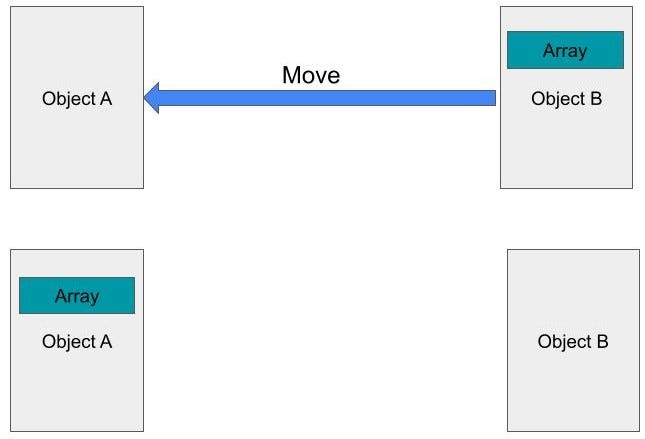
The following video provides a very clear, practical demonstration of building a move constructor from scratch.
The Cherno's video 'Move Semantics in C++' provides a hands-on walkthrough of implementing a move constructor for a custom string class.
Watch from 3:39 to 10:57. The video builds a simple String class and shows: The setup of the class with a heap-allocated buffer. The problem: creating an Entity that owns a String triggers a costly copy. The solution: implementing a move constructor that steals the pointer and nullifies the source, creating a 'hollow object'. This perfectly demonstrates the resource heist.
Forcing a Move with std::move
So far, we've only discussed automatic moves from rvalues (temporaries). But what if we have an lvalue (a named object) that we are finished with and want to move from? This is a common scenario, especially when transferring ownership of large objects.
This is where std::move comes in. It's one of the most important and most misunderstood tools in modern C++.
std::move does not move anything.
Instead, std::move is a cast. It unconditionally casts its argument to an rvalue reference. By doing this, it tells the compiler, "I give you permission to treat this lvalue as if it were an rvalue. You may steal its resources."
String s1("Hello");

// String s2(s1); // This would call the copy constructor. s1 is an lvalue.

String s2(std::move(s1)); // This calls the MOVE constructor.
                         // std::move(s1) produces an rvalue reference.
The Stack Overflow answer below provides an exceptionally clear explanation of this concept.
This Stack Overflow answer titled 'What is move semantics?' is legendary in the C++ community. We'll read the section that explains std::move.
Read the section titled 'Moving from lvalues'. It precisely explains the role of std::move as an explicit way to enable moving from an lvalue, making it clear that it's a cast that enables a move, rather than performing the move itself.
A Critical Detail: Named Rvalue References are Lvalues
This is a subtle but crucial point that often trips up even experienced developers. Inside the body of a function, a parameter of type MyClass&& has a name. And because it has a name, the expression referring to it is an lvalue.
Consider our move constructor:
// from the previous lesson's example
MemoryBlock(MemoryBlock&& other) noexcept
    : _data(other._data), _length(other._length) // Is this okay?
{
    other._data = nullptr;
    other._length = 0;
}
If MemoryBlock had a member variable that was also a class with a move constructor (e.g., a std::string), simply using it in the initializer list would call its copy constructor!
class MyContainer {
    std::string _name;
    // ...
public:
    MyContainer(MyContainer&& other) noexcept
        // 'other._name' is an lvalue, so this calls std::string's COPY constructor!
        : _name(other._name)
    {
        // ...
    }
};
Why? Because other is a named variable within the constructor's scope. The compiler won't implicitly move from it because you might want to use it again later in the function body.
To fix this, we must use std::move to cast the named rvalue reference parameter back into an rvalue reference before passing it to the member's constructor.
class MyContainer {
    std::string _name;
    // ...
public:
    MyContainer(MyContainer&& other) noexcept
        // Correct: explicitly cast to an rvalue to trigger the move constructor of _name
        : _name(std::move(other._name))
    {
        // ...
    }
};
This concept is explained perfectly in the following article.
Move semantics and rvalue references in C++11
The article 'Move semantics and rvalue references in C++11' from cprogramming.com has a section dedicated to this exact pitfall.
Read the sections 'A problem: When rvalue references are lvalues' and 'std::move'. It walks through the problem of initializing members inside a move constructor and shows how std::move is the required solution. It clearly states the rule: a named rvalue reference is an lvalue.
The Aftermath: The Moved-From State
After an object has been moved from (e.g., after std::move was used on it), it is left in a valid but unspecified state.
- Valid: The object can be safely destroyed without crashing the program. Its invariants must hold. For a class with a pointer, this usually means the pointer is
nullptr. - Unspecified: You don't know what value the object holds. It might be empty, it might hold some default value, etc. You should not rely on its previous value.
The only safe things to do with a moved-from object are to destroy it or to assign a new value to it.
String s1("Hello");
String s2(std::move(s1));

// DO NOT DO THIS:
// std::cout << s1; // Undefined behavior (or at least unspecified)

// THIS IS SAFE:
s1 = "World"; // Assigning a new value is okay.
Test your understanding!
Let's combine these concepts. You have a Widget class that contains a dynamically allocated DataBlock.
#include <iostream>
#include <utility> // for std::move

struct DataBlock {
    int* data;
    size_t size;
    // (Imagine constructors, etc.)
};

class Widget {
private:
    DataBlock _block;
public:
    // Constructor
    Widget(size_t size) {
        _block.size = size;
        _block.data = new int[size];
        std::cout << "Widget created with size " << size << std::endl;
    }

    // Destructor
    ~Widget() {
        delete[] _block.data;
    }

    // Task 1: Implement the copy constructor
    Widget(const Widget& other) {
        // ... your code here ...
        std::cout << "Widget COPIED." << std::endl;
    }

    // Task 2: Implement the move constructor
    Widget(Widget&& other) noexcept {
        // ... your code here ...
        std::cout << "Widget MOVED." << std::endl;
    }
};

Widget create_widget() {
    return Widget(100); // Returns a temporary object (rvalue)
}

int main() {
    Widget w1(50);

    // Test case 1: Should call the copy constructor
    Widget w2 = w1;

    // Test case 2: Should call the move constructor (from a temporary)
    Widget w3 = create_widget();

    // Test case 3: Should call the move constructor (from an explicit move)
    Widget w4 = std::move(w1);

    return 0;
}
Complete the copy and move constructors for the Widget class so that the main function runs correctly and produces the expected "COPIED" and "MOVED" output for each test case. Pay special attention to what happens to the source object in each case.
Show answer
Here is the completed implementation:
// Task 1: Implement the copy constructor (Deep Copy)
Widget(const Widget& other)
    : _block{nullptr, other._block.size}
{
    _block.data = new int[other._block.size];
    std::copy(other._block.data, other._block.data + other._block.size, _block.data);
    std::cout << "Widget COPIED." << std::endl;
}

// Task 2: Implement the move constructor (Resource Heist)
Widget(Widget&& other) noexcept
    : _block{other._block.data, other._block.size}
{
    // Invalidate the source object
    other._block.data = nullptr;
    other._block.size = 0;
    std::cout << "Widget MOVED." << std::endl;
}
Explanation:
- The copy constructor performs a deep copy. It allocates new memory for
_block.dataand copies the contents fromother. Theotherobject is left untouched. - The move constructor performs a resource transfer. It "steals" the
datapointer andsizefromother._block. Then, it crucially setsother._block.datatonullptrto ensure that whenotheris destroyed, it doesn't free the memory that this newWidgetnow owns. This leavesotherin a valid (destructible) but empty state.
Conclusion
You have now explored the low-level machinery of C++'s most important modern performance feature. This knowledge is not just theoretical; it directly impacts how you'll design the data structures for your telemetry profiler, where moving millions of event records per second without copying is the only way to achieve the required performance.
Key Takeaways:
- Move semantics optimizes performance by transferring resources from temporary objects (rvalues) instead of copying them.
- Rvalue references (
&&) are a language feature that allows function overloading to detect rvalues. - A move constructor/assignment "steals" the internal resources of the source object and leaves the source in a valid but unspecified state (usually by nulling out pointers).
std::moveis a cast that turns an lvalue into an rvalue reference, signaling your intent to allow a move.- A named variable of type
T&&is an lvalue, so you must usestd::moveon it to pass it to another move constructor.
Implementing the Rule of Five manually is powerful, but it's also verbose and a source of potential bugs. Now that you understand exactly how it works, you're ready to appreciate the modern C++ way of automating it.
In our next lesson, we will introduce smart pointers (std::unique_ptr and std::shared_ptr). These are RAII wrappers that implement the Rule of Five (or variations of it) for you, providing safe, automatic, and efficient memory management. You've learned the principles the hard way; now you'll see how to apply them the smart way.