Hello! Welcome to our next lesson.
In our last session, we wrestled with the complexities of manual memory management by implementing the Rule of Five and using move semantics. You saw firsthand that while moving resources is far more efficient than copying them, managing ownership manually is tedious and error-prone. This begs the question: can we automate this process?
The C++ answer is a resounding "yes," and it's based on a core design philosophy called RAII (Resource Acquisition Is Initialization). This lesson is dedicated to mastering this concept by learning to use smart pointers (std::unique_ptr and std::shared_ptr) to manage memory with RAII.
Smart pointers are essentially lightweight classes that wrap a raw pointer. They automatically handle the allocation and, more importantly, the deallocation of memory by following the RAII principle. They implement the Rule of Five for you, ensuring that resources are released correctly when the smart pointer object goes out of scope—no matter how or when that happens. For your goal of building a high-performance telemetry engine, mastering smart pointers is non-negotiable. They are the idiomatic way to write safe, clear, and efficient modern C++ code.
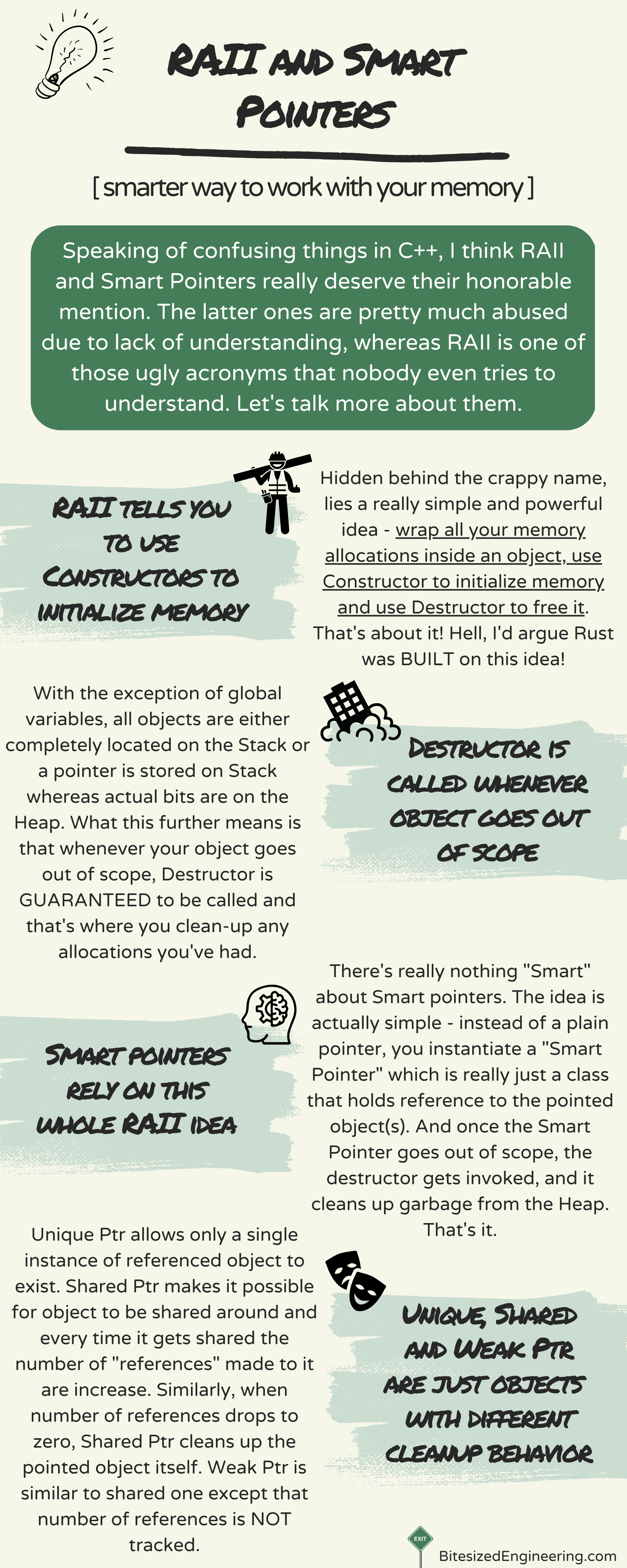
We'll explore the two main types of smart pointers, understand their distinct ownership models, and analyze their performance characteristics—a critical aspect for your project.
Exclusive Ownership: std::unique_ptr
The simplest and most efficient ownership model is exclusive ownership: one and only one object is responsible for a resource. If that owner is destroyed, the resource is destroyed with it.
std::unique_ptr is the C++ embodiment of exclusive ownership. It is a "move-only" type, meaning you cannot copy it, only transfer its ownership to another std::unique_ptr. This makes it a very lightweight wrapper around a raw pointer with almost no performance overhead.
The following video provides an excellent introduction to std::unique_ptr by first demonstrating the dangers of raw pointers and then refactoring the code to use this smart pointer.
unique_ptr: C++'s simplest smart pointer
The video 'unique_ptr: C++'s simplest smart pointer' by mCoding clearly explains the problems smart pointers solve and how std::unique_ptr works.
Please watch from the beginning to 5:15. Pay attention to: The various ways raw pointer management can fail (memory leaks, double deletes). How replacing Widget* with std::unique_ptr<Widget> solves these problems automatically. The use of std::make_unique to create the smart pointer. This is the modern, safe way to do it. How the compiler enforces exclusive ownership by preventing copies and forcing you to use std::move to transfer ownership.
As you saw, std::unique_ptr provides compile-time safety. It makes entire categories of memory bugs impossible.
Now, to connect this back to our last lesson, let's look at how it does this. The next part of the same video walks through building a simplified unique_ptr. You'll see that it's just a class that applies the Rule of Five concepts you've already learned.
unique_ptr: C++'s simplest smart pointer
Continuing with the same video, this segment reveals the 'magic' behind unique_ptr by implementing one from scratch.
Watch from 5:53 to 9:31. This is the most important part of the video for you. Notice how the custom MyUniquePtr class: Has a destructor that calls delete (the core of RAII). Deletes the copy constructor and copy assignment operator. Implements a move constructor and move assignment operator to transfer ownership. This is a perfect practical application of the previous lesson.
Because of its minimal overhead and compile-time safety checks, std::unique_ptr should be your default choice for managing dynamically allocated memory.
Shared Ownership: std::shared_ptr
Sometimes, exclusive ownership isn't flexible enough. You might have a resource that needs to be kept alive as long as any part of your system is using it. This is called shared ownership.
std::shared_ptr implements this using reference counting. Internally, it maintains a "control block" on the heap that stores a counter.
- When a new
std::shared_ptris created that points to the same object (e.g., via copy), the reference count is incremented. - When a
std::shared_ptris destroyed, the reference count is decremented. - When the count reaches zero, the managed object is finally deleted.
The following video introduces this concept and demonstrates its use.
Modern C++: Upgrade Your Skills with Shared Pointers!
The video 'Modern C++: Upgrade Your Skills with Shared Pointers!' from Dave's Garage gives a practical overview of std::shared_ptr.
Please watch the following segments: 0:28 to 2:48: Introduction to shared ownership, the Netflix analogy, and the key features like the use count. 3:56 to 6:45: Creating shared pointers with std::make_shared, seeing the use count change on copy, and using reset().
Performance: The Cost of Convenience
Your project requires a deep understanding of performance trade-offs. While smart pointers are safer, are they "free"? The answer depends on which one you use.
std::unique_ptr Performance:
- Memory: Same size as a raw pointer (unless a custom deleter is used).
- Overhead: In an optimized build, operations like dereferencing (
->or*) compile down to the same machine code as a raw pointer. It is considered a zero-cost abstraction.
std::shared_ptr Performance:
This is where things get more complex. std::shared_ptr is powerful, but it comes with costs.
How much is the overhead of smart pointers compared to ...
This Stack Overflow answer provides a fantastic, multi-faceted analysis of smart pointer overhead, which is directly relevant to your high-performance goals.
Please read the top two answers (by lisyarus and Lothar). The first answer gives a quick, high-level summary of the overheads. The second answer dives much deeper into the costs of std::shared_ptr, which you need to be aware of: Memory Overhead: A shared_ptr is typically twice the size of a raw pointer (one for the object, one for the control block). Allocation Overhead: make_shared is more efficient, but creating a shared_ptr still involves a heap allocation for the control block. Runtime Overhead: The reference count must be updated atomically to be thread-safe. Atomic operations are significantly slower than simple reads/writes.
The key takeaway for your telemetry project is that std::shared_ptr should be used judiciously. Its overhead, particularly the atomic reference counting, can become a bottleneck in tight loops or high-frequency data paths.
The Achilles' Heel of std::shared_ptr: Circular References
There's one major pitfall with std::shared_ptr: if two objects hold shared_ptrs to each other, they create a circular reference.
struct B; // Forward declaration

struct A {
    std::shared_ptr<B> ptr_b;
};

struct B {
    std::shared_ptr<A> ptr_a;
};

// ...
auto a = std::make_shared<A>();
auto b = std::make_shared<B>();
a->ptr_b = b;
b->ptr_a = a;
Now, a's reference count is 2 (the a variable and b->ptr_a), and b's reference count is 2 (the b variable and a->ptr_b). When a and b go out of scope, their counts only drop to 1. They never reach zero, and the memory for both objects is leaked.

The solution is std::weak_ptr. A weak_ptr is a non-owning, "observing" pointer. It can be created from a shared_ptr but does not affect the reference count.
To safely access the object a weak_ptr points to, you must call its lock() method. This returns a shared_ptr.
- If the object is still alive,
lock()returns a validshared_ptr. - If the object has been destroyed,
lock()returns an emptyshared_ptr.
The Dave's Garage video you watched earlier has an excellent section explaining this.
Modern C++: Upgrade Your Skills with Shared Pointers!
Let's revisit the Dave's Garage video to see how std::weak_ptr solves the circular reference problem.
Watch from 8:51 to 12:38. This section explains the purpose of weak_ptr and demonstrates the lock() and expired() methods.
Best Practices: Choosing the Right Pointer
With this knowledge, we can establish some "golden rules" for modern C++ memory management.
The booklet 'Smart Pointers in Modern C++' has a fantastic summary of best practices and common mistakes. This distills everything we've learned into actionable advice.
Read chapters '7: Practical Coding Techniques' and '9: Patterns, Anti-Patterns, and Best Practices' (pages 17-21). Pay special attention to: Passing Smart Pointers to Functions: This is critical. Don't pass a smart pointer by value if you just want to read from the object. Pass by const&, or even better, pass a raw pointer (const T*) or reference (const T&) to signal that the function has no involvement in the object's lifetime. Golden Rules: This is your cheat sheet. The most important rule is: Prefer std::unique_ptr by default. Only use std::shared_ptr when shared ownership is a fundamental part of your design.
Test your understanding!
You are designing a part of a system that processes incoming data packets. You have a Packet class and three functions that interact with it.
#include <memory>
#include <vector>

struct Packet {
    // some data
};

// Function 1: A factory that creates a new Packet from raw data.
// The caller of this function becomes the sole owner of the Packet.
??? create_packet(/*...*/) {
    // ... logic to create packet ...
    return std::make_unique<Packet>(); // or std::make_shared?
}

// Function 2: This function archives a packet by storing it in a long-term log.
// The log needs to share ownership of the packet, as other systems might
// still be processing it.
void archive_packet(??? packet) {
    // static std::vector<std::shared_ptr<Packet>> log;
    // log.push_back(packet); // or std::move(packet)?
}

// Function 3: This function inspects a packet's header for routing information.
// It does NOT need to keep the packet alive or affect its lifetime in any way.
void inspect_packet(??? packet) {
    // ... read data from packet ...
}
For each of the three function signatures (???), determine the most appropriate parameter or return type. Choose from std::unique_ptr<Packet>, std::shared_ptr<Packet>, const Packet*, or const Packet&. Briefly justify your choice for each.
Show answer
Here are the most appropriate choices:
-
std::unique_ptr<Packet> create_packet(/*...*/) { ... }- Justification: The function is a factory that creates a new resource. Returning a
std::unique_ptrclearly and efficiently transfers exclusive ownership to the caller. There is no reason to incur the overhead of astd::shared_ptrat the point of creation.
- Justification: The function is a factory that creates a new resource. Returning a
-
void archive_packet(std::shared_ptr<Packet> packet) { ... }- Justification: The function's purpose is to share ownership with the archive log. Passing a
std::shared_ptrby value correctly expresses this intent. The caller would pass theirshared_ptr, and the copy inside the function would increment the reference count, ensuring the packet stays alive in the log.
- Justification: The function's purpose is to share ownership with the archive log. Passing a
-
void inspect_packet(const Packet* packet) { ... }orvoid inspect_packet(const Packet& packet) { ... }- Justification: This function is a non-owning observer. It only needs to read data from the packet. Passing a smart pointer would be incorrect and inefficient because it implies some interaction with the object's lifetime. Passing a raw pointer or a const reference is the standard C++ idiom for "borrowing" an object without affecting its ownership. It is fast and clearly communicates the function's intent.
Conclusion
You have now learned the modern C++ way to manage memory. By using smart pointers, you leverage the RAII idiom to write code that is safer, clearer, and often just as fast as manual memory management.
Key Takeaways:
- RAII is the principle of tying a resource's lifetime to an object's scope.
std::unique_ptrprovides exclusive, move-only ownership with virtually zero overhead. It should be your default choice.std::shared_ptrprovides shared ownership via atomic reference counting. It is flexible but comes with performance costs (memory, allocation, and runtime). Use it only when shared ownership is essential.std::weak_ptris a non-owning observer used to break circular references that can occur withstd::shared_ptr.- Pass smart pointers to functions only when you intend to manipulate ownership. For non-owning access, use raw pointers or references.
We've now covered object lifecycle from construction and destruction (Rule of Five) to automatic management (smart pointers). The next logical step is to go deeper into the memory layout of our objects.
In our next lesson, we will explore memory alignment requirements and padding in structs. This is fundamental to Data-Oriented Design and a prerequisite for understanding how to structure your data to be friendly to CPU caches—a topic that is absolutely critical for the high-performance telemetry engine you are building.