Hello! Welcome back.
In our last lesson, we established why rendering millions of data points directly is a terrible idea. We saw that it creates an unreadable visual mess, generates a crippling number of draw calls for the CPU and GPU, and thrashes the CPU cache with inefficient memory access. You can't solve a problem you don't understand, and we now have a very clear picture of the multi-faceted performance challenge we face.
Today's lesson is the first step toward the solution. We will tackle the learning outcome: Design the data structure for a min-max tree to store aggregated data. This structure is the heart of our high-performance Level-of-Detail (LOD) plotter. It will allow us to decouple the rendering workload from the size of our dataset by pre-calculating and storing summary information in a way that is incredibly fast to query.
Let's get started.
The Core Problem: Fast Range Queries
The problem from our last lesson boils down to this: for any given horizontal pixel range on our plot, we need to find the minimum and maximum data values within that range instantly. If we can do that, we can draw a single vertical line representing potentially thousands of data points, as suggested by the KDAB article "A Speed-Up for Charting on Embedded".
Doing this naively by scanning the array for each query is too slow. We need a more intelligent data structure. This is a classic problem in competitive programming and systems design, and the solution is a Segment Tree. For our specific use case, we'll be implementing a variant of it that we'll call a Min-Max Tree.
To understand why a specialized tree is so effective, let's watch a short video that compares the performance of different approaches.
Segment Tree Range Minimum Query
This video from Tushar Roy's 'Coding Made Simple' series explains the motivation behind using a Segment Tree for range queries, comparing its performance against naive iteration and a pre-computation matrix.
Watch the first 2 minutes and 43 seconds. Focus on the complexity analysis: O(mn) for the naive approach, O(n^2) space for pre-computation, and finally the O(log n) query time for the Segment Tree. This demonstrates the efficiency we're aiming for.
An O(log n) query time is exactly what we need. It means that even if our dataset grows from one million to one billion points, the time it takes to query a range will only increase by a tiny, constant amount.
The Conceptual Structure: A Tree of Aggregates
A min-max tree is a binary tree built on top of our original data array. Here’s how it works:
- Leaf Nodes: Each leaf node in the tree corresponds to a single data point from the input array.
- Internal Nodes: Each internal (or parent) node stores the aggregated minimum and maximum values of the entire range covered by its children.
- Root Node: The root of the tree stores the global minimum and maximum of the entire dataset.
This hierarchical structure allows us to "zoom out" from individual data points to larger and larger summary ranges.
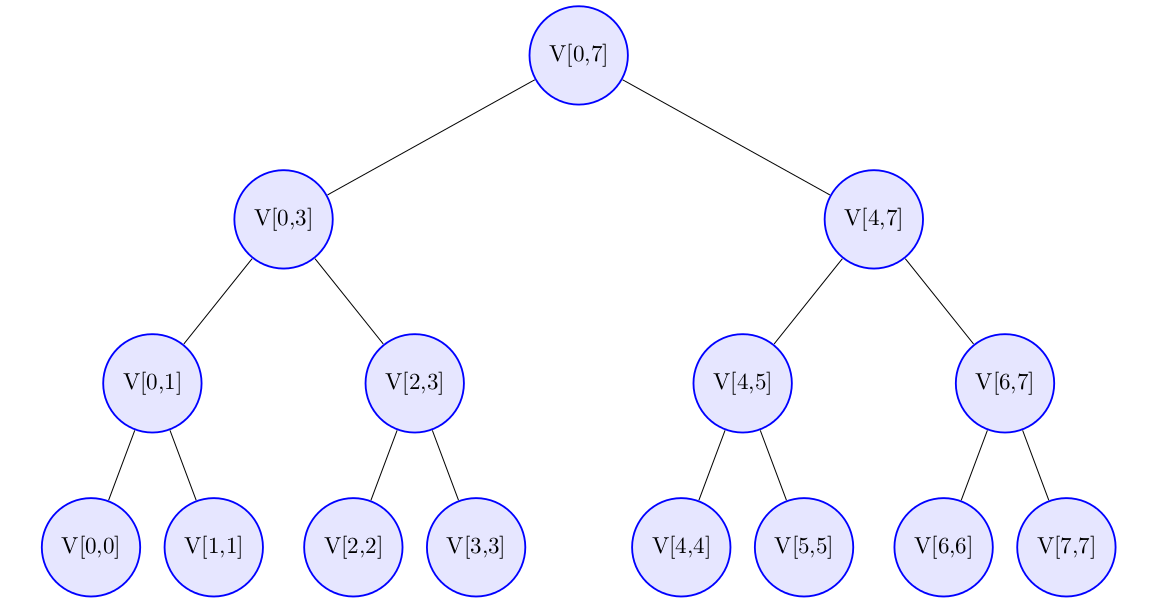
Let's see this structure being built.
Segment Tree Range Minimum Query
This clip from the same video demonstrates how an array is recursively split to form the binary tree structure, and how parent nodes are populated with the aggregated (minimum) value from their children.
Watch from 2:43 to 5:04. Notice how the array is split in half repeatedly. The key insight is how a parent node's value is derived from its children, forming a bottom-up aggregation.
Designing the Node Data Structure
The first step in designing our tree in C++ is to define the data that each node will hold. Based on our goal, every node must store the minimum and maximum value for the range it represents. A simple struct is perfect for this.
template <typename T>
struct MinMaxNode {
    T min_val;
    T max_val;
};
This is very similar to the node struct in the GeeksForGeeks article "Min-Max Range Queries in Array". When we build the tree, each MinMaxNode will be initialized. For leaf nodes, min_val and max_val will both be the value of the single data point it represents. For an internal node, its values will be computed from its children:
parent.min_val = std::min(left_child.min_val, right_child.min_val);parent.max_val = std::max(left_child.max_val, right_child.max_val);
This simple, recursive definition is the foundation of the build process we will implement in the next lesson.
Designing the Tree Storage: An Array for Performance
While we call it a "tree," implementing it with pointers (Node* left_child;) would be a performance mistake. As we learned in the last lesson, pointer chasing leads to scattered memory access and frequent cache misses. This is contrary to the Data-Oriented Design philosophy of our project.
The performant solution is to store the entire tree in a single, contiguous block of memory: a std::vector or a raw array. We can map the tree structure to array indices using a standard formula derived from binary heaps:
For a node at index i:
- Its left child is at index
2 * i + 1. - Its right child is at index
2 * i + 2. - Its parent is at index
(i - 1) / 2(using integer division).
This layout is extremely cache-friendly. When you access a parent node, its children are likely already in the same cache line or will be brought in by the prefetcher.
The following video segment explains this array representation and how to calculate the required size of the array.
Segment Tree Range Minimum Query
This final clip from Tushar Roy's video explains how the conceptual binary tree is mapped to a flat array using the heap-indexing formula and discusses the space complexity.
Watch from 10:04 to 13:32. Pay close attention to the formulas for child and parent indices. Also, note the rule for determining the size of the array: if the input array has n elements, the segment tree array will have, at most, 4*n elements in a robust implementation (or 2 * next_power_of_2(n) - 1 for a more precise size).
Test your understanding!
Suppose you have an input data array with 100 elements. Using the rule of thumb that a segment tree might need up to 4*n elements for storage, how large would you allocate your std::vector<MinMaxNode> to be? Why not just size it to 100?
Show answer
You would allocate the std::vector to have a size of 400.
The reason it needs to be larger than the original 100 elements is that the vector must store not only the leaf nodes (which correspond to the original data) but also all the internal nodes up to the root, which contain the aggregated min-max values for all the sub-ranges. The 4*n sizing is a safe upper bound that ensures there's enough space for any n, avoiding complex power-of-two calculations during allocation.
Putting It All Together: A C++ Class Design
We can now sketch out a preliminary design for our MinMaxTree class in C++. This API is inspired by the one proposed in the excellent KDAB article, which is highly relevant to our charting goal.
#include <vector>
#include <limits>
#include <algorithm> // for std::min/max

template <typename T>
class MinMaxTree {
public:
    // Constructor: Takes the original data and builds the tree
    MinMaxTree(const std::vector<T>& data) {
        // We will implement the build logic in the next lesson
    }

    // Public query function
    MinMaxNode<T> getMinMaxInRange(size_t rangeBegin, size_t rangeEnd) const {
        // We will implement the query logic in a future lesson
    }

private:
    // The struct for our nodes, as defined before
    struct MinMaxNode {
        T min_val = std::numeric_limits<T>::max();
        T max_val = std::numeric_limits<T>::lowest(); // Note: NOT ::min()!
    };

    std::vector<MinMaxNode> m_tree;
    size_t m_num_leaves; // The number of elements in the original data array

    // Private recursive helper functions for building and querying
    // void buildRecursive(...);
    // MinMaxNode queryRecursive(...) const;
};
This class encapsulates the design principles we've discussed:
- It's a template, so it can work with
float,double,int, etc. - It stores the tree in a single
std::vector(m_tree) for performance. - It exposes a clean public API for querying, hiding the complex recursive logic.
- The
MinMaxNodeis a private implementation detail. Notice the initialization values, which ensure that any real data point will correctly replace the initial defaults. The KDAB article (LINK, section 2) has a great warning aboutstd::numeric_limits<T>::min(), which is a common pitfall!
A Data-Oriented Refinement: Buckets
The KDAB article also suggests a powerful optimization that fits perfectly with our goals. Instead of each leaf node representing a single data point, it can represent a small, fixed-size array of points, often called a "bucket".
Crafting an Append-Only Min–Max Tree as a Search Index
Let's read about this optimization. This section from the KDAB article explains the concept and its primary benefit: cache efficiency.
Read the section 'Crafting an Append-Only Min–Max Tree as a Search Index.' Focus on the paragraph that begins 'Because I want to keep the tree small and profit from caching effects...'. This is the key idea.
The design implication is this:
- The tree becomes much shorter and wider.
- When a query range falls entirely within a single leaf bucket, we do a fast linear scan on that small bucket.
- This is extremely cache-efficient, as the entire bucket (e.g., 64-128 elements) will likely fit in a single CPU cache line.
For our design, this means we can choose to have the leaves of our MinMaxTree point to ranges in the original data array, rather than storing single values. This is an advanced design choice we will consider during implementation to squeeze out maximum performance.
Conclusion
We have now designed the data structure that will form the backbone of our efficient LOD plotter. We've moved from a high-level concept to a concrete C++ class design, making specific choices to prioritize performance and align with data-oriented principles.
Key Takeaways:
- A Min-Max Tree (a type of Segment Tree) is a binary tree that stores pre-aggregated minimum and maximum values for ranges of an underlying data array.
- The node structure is simple: it just needs to hold a
min_valand amax_val. - For performance, the tree should be stored in a contiguous array or vector, not with pointers, using heap-style indexing (
2*i+1,2*i+2) to navigate. - The design can be further optimized by using buckets at the leaf nodes, which improves cache locality for small range scans.
What's Next?
With a solid design in place, the next logical step is to bring it to life. In the next lesson, we will focus on the learning outcome: Implement a bottom-up algorithm to build the min-max tree from an array of data points. We will write the C++ code for the build logic we sketched out today, turning our data structure design into a functional component.