Welcome back! In our last lesson, you built a powerful Notion database to serve as the command center for your outreach. You now have the system to track every prospect, but a system is only as good as the process it manages. Random DMs and sporadic check-ins won't land the high-ticket clients you're after.
This lesson bridges that gap. We're moving from organizing your pipeline to defining the strategic actions that move prospects through it. You will learn how to design a professional, multi-channel follow-up sequence—often called a "cadence"—that defines exactly when and where to contact a prospect. This systematic approach ensures you remain persistent without being annoying, dramatically increasing your chances of getting a response.
A well-designed cadence is the engine of a successful outreach campaign. For someone with your analytical mindset, this is where you can methodically engineer a process, test its effectiveness, and optimize it based on data—a topic we'll explore in the final module.
Why One Channel Isn't Enough
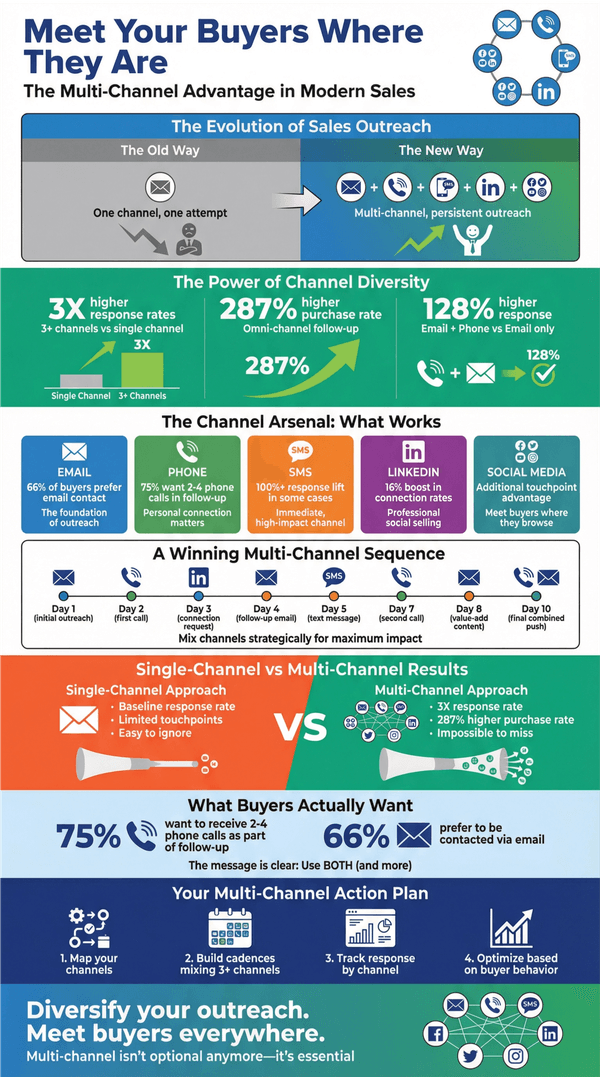
As a DM setter, you're an expert on Instagram and Facebook. However, relying on a single channel means you're competing in an incredibly noisy environment. When you strategically contact prospects across different platforms—like email and LinkedIn in addition to social DMs—you stop being just another message and start building a memorable presence. This multi-channel approach is non-negotiable for serious prospecting.
The data overwhelmingly supports this. Let's start with a foundational article from Mixmax that explains the core principles.
Multichannel Sales Outreach: A Complete Guide
This guide provides an excellent overview of why multi-channel outreach is so effective and the key components of building a successful sequence.
First, read the introduction, What is Multichannel Outreach?, which highlights a key statistic: combining channels can boost response rates by 287%. Next, jump to the section on building your strategy. Focus on choosing the right channels and, most importantly, nailing down your timing. The article suggests a cadence of six to eight touches over two to three weeks is a great starting point. Then, read about the "Anatomy of a High-Performing Sequence." Pay close attention to moving between channels and getting your timing and frequency right, which recommends waiting 24-48 hours between messages. Finally, review the FAQ section at the end. The answers to "How many channels are too many?" and "How long should I wait between sending a message?" are excellent rules of thumb.
The key takeaway is that persistence pays off, but it must be structured. You're not just sending more messages; you're creating a cohesive conversation that unfolds across multiple platforms and several days.
The Core Components of Your Follow-Up Cadence
Designing a cadence involves defining three key variables for your target clients (high-ticket coaches and agencies):
- Channels: The platforms you will use to communicate. For your goals, the primary channels will be Email, LinkedIn, and Instagram/Facebook DMs.
- Frequency: The number of "touchpoints" or messages in your sequence.
- Timing: The duration of the cadence and the spacing between each touchpoint.
A surprising number of sales require multiple follow-ups. A separate resource from Growleads provides some hard data on this.
Optimizing B2B Sales Outreach Cadence: Timing, Frequency, and Follow-Up - Growleads
This article is packed with data on outreach timing and frequency, which will appeal to your analytical background.
Read the introduction, which makes a powerful point: 80% of sales require at least five follow-ups, yet most people give up after one. Next, read the section "Set the Right Frequency for Engagement." Focus on the recommendations for spacing touchpoints (2-3 days apart) and the ideal cadence duration (17-21 days). Finally, look at the section "Follow-Up Strategies That Keep Conversations Alive." The part on email follow-up rhythm provides a concrete schedule you can adapt.
A Practical Cadence Example
Now, let's translate this theory into a practical, actionable plan. The image below from Nutshell outlines a simple but effective 14-day, 5-touchpoint sequence. This is an excellent starting point for your own cadence.
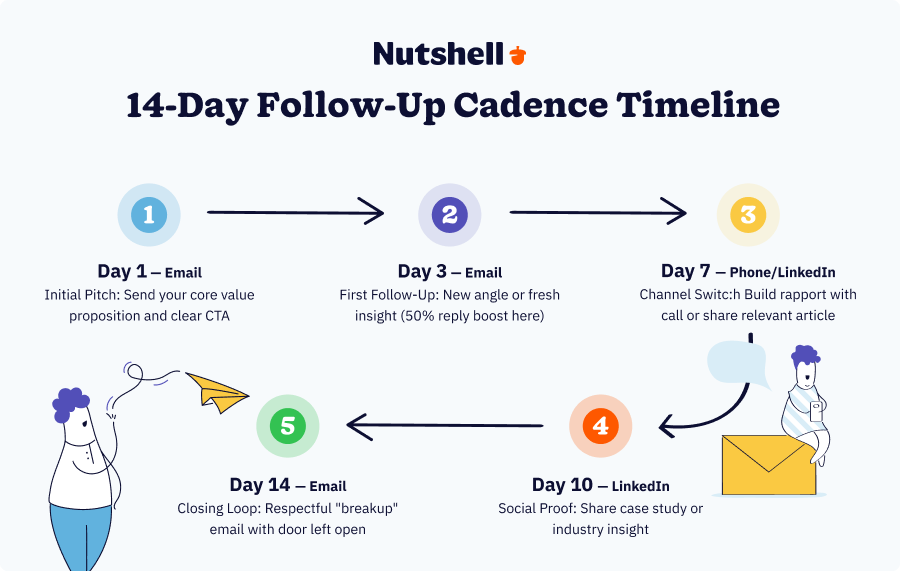
Let's break down how this model applies to you as a DM setter targeting a coach:
- Day 1 - Email (Initial Pitch): You send your personalized, value-first cold email or DM that you drafted in the previous module.
- Day 3 - Email (First Follow-Up): A simple reply to your first message. You could offer a new angle or a fresh insight. For example, "Just wanted to add one more thought..."
- Day 7 - LinkedIn (Channel Switch): Send a connection request. This makes your name familiar in a new context. You can add a short note: "Hi [Name], I sent you an email a few days ago regarding your [topic]. Wanted to connect here as well."
- Day 10 - LinkedIn (Social Proof): Share something valuable. This could be sending them a link to a relevant case study via DM or even thoughtfully commenting on one of their recent posts to add value publicly.
- Day 14 - Email (Closing Loop): The "breakup" email. This is a polite, professional message that lets them know you won't be following up further, but keeps the door open. Example: "Hi [Name], I haven't heard back so I'll assume now isn't the right time. I'll stop my follow-ups for now, but please feel free to reach out if anything changes. Best, [Your Name]."
This balanced cadence respects the prospect's time while ensuring you remain top-of-mind.
Alternative Model: The Aggressive Urgency Cadence
While the 14-day model is a fantastic standard, there is a more aggressive approach favored by some top sales professionals. This model prioritizes getting a quick "yes," "no," or objection by compressing the follow-ups into a shorter timeframe.
The video below explains this philosophy. It focuses on creating a sense of urgency and demonstrating that you are a real person actively trying to connect, not just an automated sequence.
10 Years of Expert Cold Email Advice in 36 Minutes (B2B Sales)
The speaker, Connor, outlines a much faster, more direct follow-up strategy. This provides a compelling alternative to the standard B2B cadence.
Watch the section from this timestamp. Pay close attention to his reasoning for a shorter, more intense cadence: three follow-ups within a 7-8 day span, with each message coming 24-48 hours apart. He argues that this signals urgency and prevents the prospect from thinking you're just another automated email bot.
An aggressive cadence might look like this:
- Day 1: Initial Email/DM.
- Day 2: LinkedIn Connection Request.
- Day 3: First Email/DM Follow-up (short and direct).
- Day 5: Second Email/DM Follow-up (adds value or asks for their thoughts).
- Day 7: Final "Breakup" Email/DM.
Which model is right for you? It depends.
- The Balanced Cadence is excellent for high-value prospects where building a long-term relationship is key.
- The Aggressive Cadence is effective for higher-volume outreach where you need to qualify or disqualify prospects quickly to maintain efficiency.
Your task is to start with one, implement it using your Notion tracker, and measure the results.
Integrating Your Cadence with Notion
Your Notion tracker is already built to run this process. The Next Follow-up date property is the engine.
Here’s your daily workflow:
- Open your "Today's Follow-ups" view in Notion. This shows you exactly who needs a touchpoint today.
- For each prospect, check their
StatusandNotesto see which step of the cadence they're on (e.g., Touchpoint #3). - Send the appropriate message on the designated channel.
- Immediately update their record in Notion:
- Log the activity in the
Notesfield (e.g., "Sent Day 7 LinkedIn connection req"). - Update the
Last Contactproperty to today's date. - Set the
Next Follow-update according to your cadence (e.g., 3 days from now for Touchpoint #4).
- Log the activity in the
- Once you update the
Next Follow-update, the prospect will disappear from today's view and will reappear on the correct day for the next step.
This disciplined process ensures no one ever falls through the cracks.
Conclusion
You now have a complete framework for designing and executing a professional follow-up sequence. You've moved beyond ad-hoc DMs and have a structured process that can be managed, measured, and improved.
Key Takeaways:
- Go Multi-Channel: Combine email, LinkedIn, and social DMs to increase response rates and build familiarity.
- Structure Your Persistence: A cadence defines the frequency and timing of your touchpoints, typically 5-8 touches over 2-3 weeks.
- Choose a Model: Start with a balanced 14-day cadence or experiment with a more aggressive 7-day urgency cadence to fit your style and volume.
- Use Your Tracker: The Notion database you built is the perfect tool to manage your cadence. The
Next Follow-update is the key to automating your to-do list.
In the next and final module, we will bring your analytical skills to the forefront. Having implemented a consistent outreach process, you will have data to analyze. We will explore how to calculate Key Performance Indicators (KPIs) like reply rates and meeting booked rates to determine which channels, messages, and cadences are most effective, allowing you to systematically optimize your path to landing high-ticket clients.