Hello! Welcome to the third module of your composition journey. In the previous modules, we established the "where" by familiarizing ourselves with the piano roll, and the "when" by exploring rhythm and the emotional power of tempo. Now, we begin to explore the "what"—the actual notes that form the foundation of melody and harmony.
Today's lesson is a major step toward composing the kind of music you love. We're going to learn how to construct a major scale. This isn't just a theoretical exercise; it's like learning the recipe for a foundational ingredient. The major scale is the basis for countless pieces of music that sound bright, hopeful, or triumphant. By mastering its structure, you gain a powerful tool for intentionally creating these moods in your own compositions. Our goal is to construct a major scale in the piano roll using a specific, universal pattern of whole and half steps.
The Building Blocks: A Quick Review
To build a scale, we need to be comfortable with its smallest components: whole steps and half steps. You'll remember from our first module that a half step (or semitone) is the smallest distance between two notes on the piano roll—moving from one key to the very next one, with no keys in between. A whole step (or tone) is simply two half steps.
For a dynamic refresher on this crucial concept, the following video provides a clear, visual explanation right within a DAW context.
music theory for music producers (you'll actually use this)
This video by TAETRO offers a practical, producer-focused look at music theory. We'll start with his excellent explanation of steps.
Please watch the section from this point, where the presenter defines and demonstrates whole steps and half steps. Pay close attention to how he visualizes these intervals on the keyboard, especially noting the half steps between E-F and B-C.
With whole steps (W) and half steps (H) clearly in mind, you are ready to learn the formula that turns these simple intervals into a powerful musical scale.
The "Secret Formula" for the Major Scale
Every major scale in Western music, no matter what note it starts on, is built using the exact same pattern of intervals. Think of it as a secret recipe or a blueprint for creating a specific, recognizable sound—the "major" sound.
That pattern is: Whole, Whole, Half, Whole, Whole, Whole, Half or W-W-H-W-W-W-H.
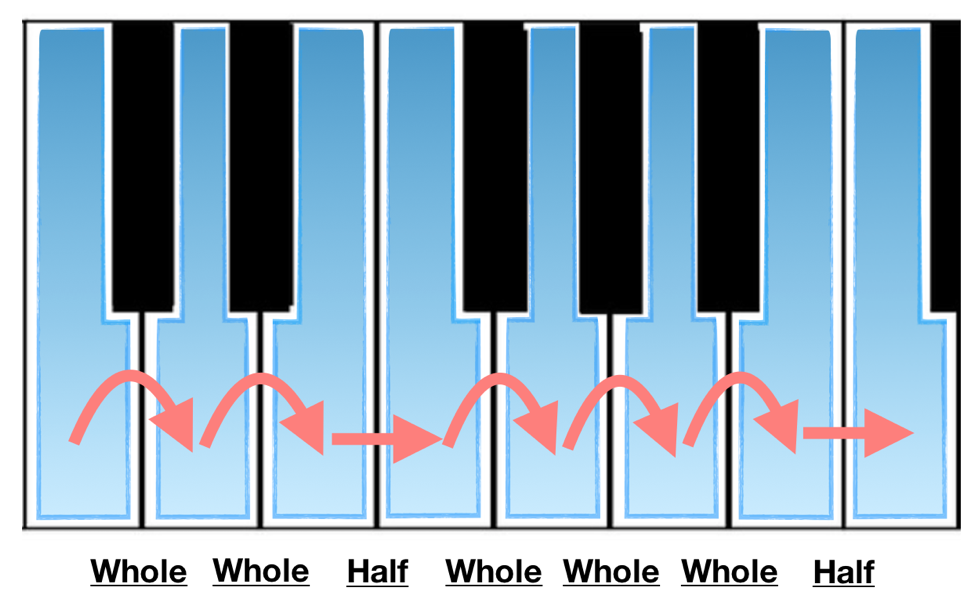
This sequence of seven jumps gives you the eight notes of the scale (the first note, plus seven others, ending on the starting note an octave higher). The specific placement of the two half steps is what gives the major scale its distinct character.
Let's see this formula presented in a couple of slightly different ways to solidify your understanding.
Music Scales Guide: Major, Minor, Pentatonic and Modes
This article from ACE Studio gives a concise, clear definition of the major scale pattern.
First, read the section "Whole Steps and Half Steps" for a clear textual definition of the pattern. Then, look at the next section, "Distances Between Scale Notes," which shows the same pattern written with numbers (2 for a whole step, 1 for a half step). This is a common notation you'll see.
Applying the Formula: Building the C Major Scale
Now, let's put this formula into practice. The easiest place to start is with the C Major scale, because it uses only the white keys on a piano.
The TAETRO video you watched a moment ago has a perfect follow-up segment where the presenter uses the W-W-H-W-W-W-H formula to build the C Major scale from scratch.
music theory for music producers (you'll actually use this)
Let's continue with the TAETRO video to see the formula in action.
Watch from this segment. First, he'll introduce the "secret formula" itself. Then, he will meticulously build the C Major scale, note by note, calling out each whole or half step. Follow along visually on his piano roll.
Practical Exercise 1: Constructing C Major in BandLab
It's your turn. Theory is only useful when you can apply it.
- Open a new project in BandLab with a piano instrument.
- Open the Piano Roll editor.
- Start on C4. Place this note at the beginning of the first measure. This is your root note.
- Follow the formula:
- W: From C, go up a whole step (two half steps). You'll land on D. Place the D4 note.
- W: From D, go up another whole step. You'll land on E. Place the E4 note.
- H: From E, go up a half step (one half step). You'll land on F. Place the F4 note.
- W: From F, go up a whole step. You'll land on G. Place the G4 note.
- W: From G, go up a whole step. You'll land on A. Place the A4 note.
- W: From A, go up a whole step. You'll land on B. Place the B4 note.
- H: From B, go up a half step. You'll land back on C, but one octave higher (C5). Place the C5 note.
Play it back. That familiar, bright sound is the C Major scale you just built from a simple formula.
The True Power of the Formula
The real magic of the W-W-H-W-W-W-H pattern is that it's universal. It doesn't just work for C. You can start on any of the 12 notes, apply the exact same pattern of jumps, and you will create the major scale for that starting note. This is how you can write music in any key.
To prove this, let's watch one more clip where the formula is applied to a starting note that isn't C, forcing us to use the black keys.
A Producers Guide to Scales in FL Studio | Major & Minor Scales, Music Theory for beginners
This video from Mello Dee Beats provides another excellent, producer-focused demonstration of scale construction.
Watch the section from this point. The presenter first builds the C Major scale using the root-whole-whole-half... formula, reinforcing what you've just learned. Then, he immediately applies the same formula to build the F-sharp (F#) Major scale. Notice how the pattern of jumps is identical, but the resulting notes are completely different and include several black keys.
This demonstrates that the pattern, not the specific notes, defines the scale. You now have the key to unlock any major scale you want.

Practical Exercise 2: Constructing G Major in BandLab
Let's try one more, this time with a scale that introduces a single black key.
- In your BandLab piano roll, find and place a G4 note. This is your new root note.
- Apply the W-W-H-W-W-W-H formula step-by-step, counting the semitones on your piano roll for each jump:
- Start: G
- W up from G is... A
- W up from A is... B
- H up from B is... C
- W up from C is... D
- W up from D is... E
- W up from E is... F# (F-sharp). This will be a black key!
- H up from F# is... G (one octave higher)
Enter these notes (G, A, B, C, D, E, F#) into your piano roll. Play them back. Even though it starts on a different note and includes a black key, it has that same "major" quality as the C Major scale. You've successfully used the formula to create a new scale.
Conclusion
Today you've unlocked a fundamental concept in music. You've learned that the bright, happy sound of a major scale isn't random; it's the product of a precise and repeatable formula.
Here are your key takeaways:
- The major scale is built with a specific pattern of intervals: Whole-Whole-Half-Whole-Whole-Whole-Half (W-W-H-W-W-W-H).
- This pattern is universal. You can start on any of the 12 chromatic notes, apply this formula, and you will construct a major scale.
- The piano roll is the perfect visual tool for building scales by counting out whole steps (two semitones) and half steps (one semitone).
You now have the ability to create the foundational palette of notes for any major key. This is the first and most important step to writing melodies and harmonies that sound cohesive and intentional.
In our next lesson, we will explore the other side of the emotional coin. If the major scale is the sound of happiness and brightness, what about the melancholic, somber, or reflective moods so prevalent in Ludovico Einaudi's work? For that, we need the minor scale, which has its own unique formula and a distinctly different emotional character.