Welcome to the next step in your journey as a composer. In our last lesson, we established a steady heartbeat for your music using the metronome and internalized the feel of 4/4 time. You now have a solid foundation for rhythm. Today, we will explore one of the most powerful tools for shaping the emotional character of a piece: tempo.
Our goal is to learn how to adjust the project's tempo (measured in Beats Per Minute, or BPM) in BandLab and, more importantly, to understand and describe how these changes in speed can dramatically alter the mood of your music. For a composer like Ludovico Einaudi, whose work you admire, tempo is not just a technical setting; it's a fundamental part of the emotional narrative, dictating whether a piece feels somber, hopeful, spacious, or urgent.
The Language of Speed and Mood
At its simplest, tempo is the speed of music. In a DAW like BandLab, we define this with a precise number: BPM. However, for centuries, composers have used descriptive words—mostly Italian—to communicate not just speed, but also the intended feeling or character.
This infographic provides an excellent overview, connecting the traditional terms with their modern BPM equivalents and the moods they evoke.
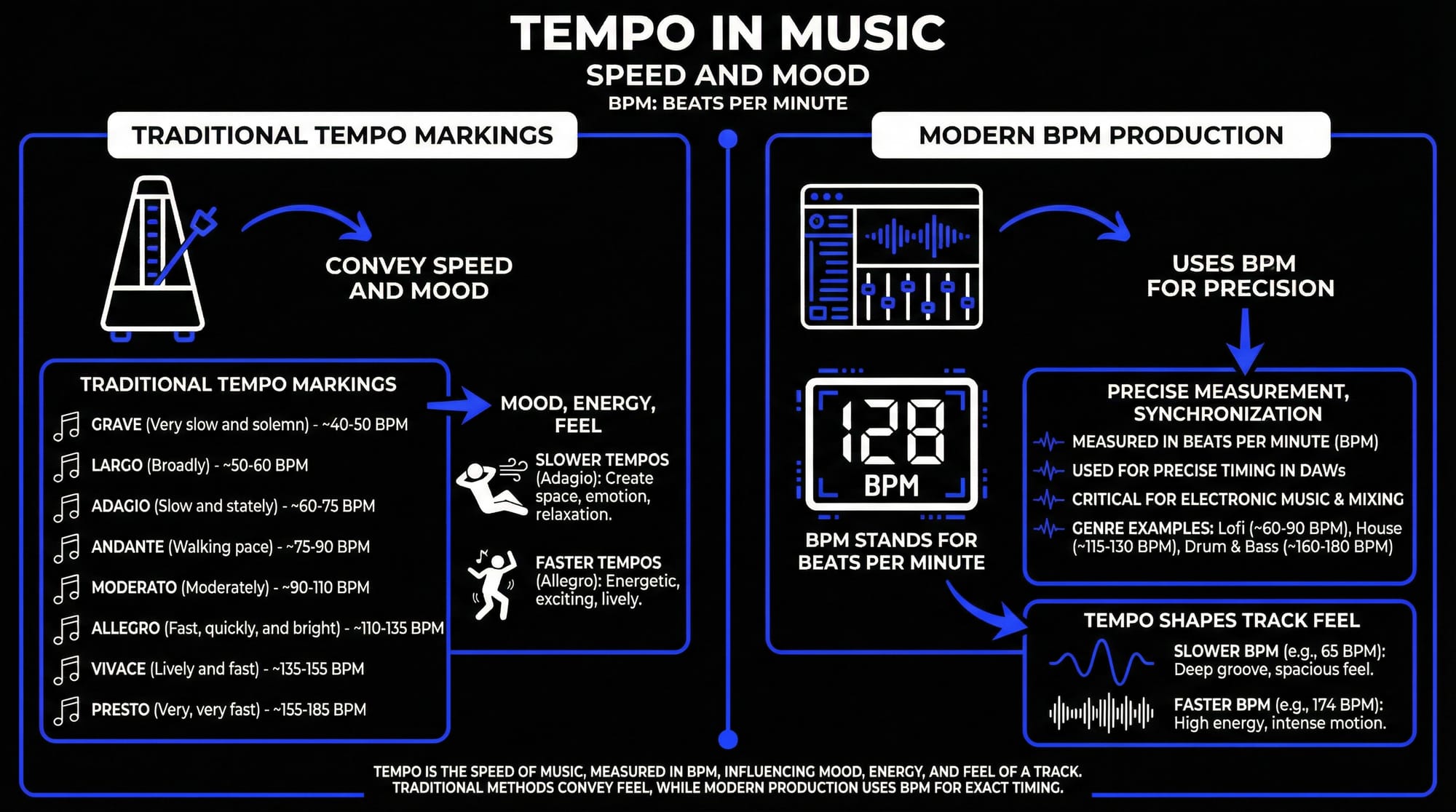
Take a moment to study the two sides. On the right, you see "Modern BPM Production," which is the world you operate in within BandLab. It's about precision. On the left, you see the "Traditional Tempo Markings," which are the language musicians use to talk about the feel.
To understand this connection more deeply, let's look at a few key terms you'll often encounter. The following article from Symphony Nova Scotia explains why these terms are Italian and how they blur the line between speed and emotion.
How do musicians know how fast to play a piece? And why are the ...
This reading explains the history of tempo markings and their connection to mood.
Please read the section that begins "Before the metronome" to understand why composers still use these descriptive words. Then, review the list of common Italian tempo indicators. Pay attention to these three in particular, as they represent very different emotional worlds: Adagio: Slow and stately. Often used for pieces that are calm, introspective, or somber. Andante: At a walking pace. A neutral, flowing tempo that feels natural and unhurried. Allegro: Fast, quickly, and bright. Conveys energy, joy, and excitement.
As you can see, choosing a tempo is your first major decision in setting the emotional tone of a composition.
Hearing the Difference: How Tempo Shapes Feeling
Reading about tempo is one thing; hearing its effect is another. A simple change in BPM can transform the same set of notes from a melancholic reflection into an upbeat dance.
The following video demonstrates this beautifully. The presenter plays the same chord progression at different speeds, and the change in character is immediate and powerful.
The Real Secret Behind Your Music's Tempo
This video, from the channel Learning Music Skills, illustrates how tempo changes the emotional impact of a piece.
Watch these two key demonstrations: First, listen to the faster example starting at this section. Notice the light, joyful quality the presenter talks about. Then, listen to the much slower version at this point. Observe how the music now feels heavier and more spacious, giving each chord time to "breathe and shine."
The video makes a crucial point: slower tempos allow the listener to "take in every single detail," which is a hallmark of the minimalist, emotional style you're aiming for. A faster tempo might be exciting, but a slower tempo is often where deep emotion resides.
Practical Exercise: Sculpting Mood in BandLab
Now it's time to apply this in your own workspace. We will take a simple musical idea and manipulate its mood just by changing the tempo.
First, you need to know where to find the tempo control. It's located in the top transport bar of your project.

Let's put this into practice:
- Open a new project in BandLab. Select the "Virtual Instruments" option and choose a piano sound.
- Create a Simple Pattern: In the piano roll, create a very simple, four-bar pattern. For example, place a single C4 quarter note on the first beat of each of the four bars. It should look something like this: a note at 1.1, a note at 2.1, a note at 3.1, and a note at 4.1.
- Experiment with Tempo and Mood:
- Set the Tempo to 60 BPM. This is in the Adagio range. Press play and listen. How does it feel? Does it sound calm, sad, thoughtful? Write down one or two words that come to mind.
- Change the Tempo to 85 BPM. This is close to Andante. Play the pattern again. The notes are the same, but the feeling is different. Is it more neutral now, like a slow walk?
- Jump the Tempo to 125 BPM. Now you're in the Allegro range. Listen again. The simple C notes suddenly have a new life. Does it feel happy, energetic, or even urgent?
This simple exercise demonstrates your power as a composer. Without changing a single note, you have completely transformed the emotional message of your music just by adjusting the BPM.
A Glimpse Ahead: Expressive Tempo
While a song often has one main tempo, many pieces—especially solo piano works by composers like Einaudi—don't stick to it rigidly. They breathe. Musicians use a technique called rubato, an Italian word meaning "robbed time," to subtly speed up and slow down for expressive effect. This is what makes a performance feel human and emotional, rather than robotic.
You don't need to master this today, but it's an important concept to be aware of. The following video explains and demonstrates rubato very clearly.
In this video, music theorist David Bennett explains various types of tempo changes. We will focus on one specific, highly expressive technique.
Please watch the segment on rubato, from this point. Notice how the first example, played at a fixed tempo, sounds mechanical, while the second performance, which uses rubato, is full of emotion and life.
This idea of expressive, flexible time is central to the piano music you love. For now, focus on choosing a single, powerful base tempo for your ideas. But keep in the back of your mind that this tempo can be bent and shaped to add even more feeling later on.
Conclusion
Today you've moved beyond the mechanical "tick-tock" of the metronome to understand tempo as a primary tool for emotional expression. You are no longer just placing notes on a grid; you are deciding the pace at which your musical story unfolds.
Here are the key takeaways from our lesson:
- Tempo is the speed of music, measured in Beats Per Minute (BPM).
- The tempo you choose has a direct and powerful impact on the mood of your music. Slower tempos (like Adagio) often feel more spacious, calm, or melancholic, while faster tempos (like Allegro) convey energy and joy.
- You can easily set the overall mood of a piece by adjusting the project tempo in BandLab's main control bar.
- Expressive piano music often uses rubato—subtle variations in speed—to make the music feel more human and emotional.
You've now explored the two core elements of rhythm: how notes are organized in time (note durations) and how fast that time flows (tempo). In our next module, we will shift our focus from "when" to "what." You will learn about the 12 notes of music and how they are organized into scales, the fundamental building blocks for creating the melodies and harmonies you hear in Einaudi's work.