In our last session, you mastered the formula for the major scale, learning how to create the bright, hopeful sound that forms the basis of so much music. You now have the blueprint for building a major scale starting from any note. This lesson explores the other essential tonality in Western music, one that is absolutely central to the emotive, reflective style of composers like Ludovico Einaudi.
Today, we will delve into the natural minor scale. While the major scale often feels sunny and optimistic, the minor scale provides the palette for more somber, melancholic, and pensive moods. By the end of this lesson, you will be able to construct any natural minor scale in your piano roll using its own unique and universal formula. This will double your expressive range, giving you the power to consciously choose the emotional foundation of your compositions.
The Formula for the Minor Sound
Just like its major counterpart, the natural minor scale is not a random collection of notes. It's built using a specific, repeatable pattern of whole and half steps. This consistency is what gives it a distinct and recognizable emotional character.
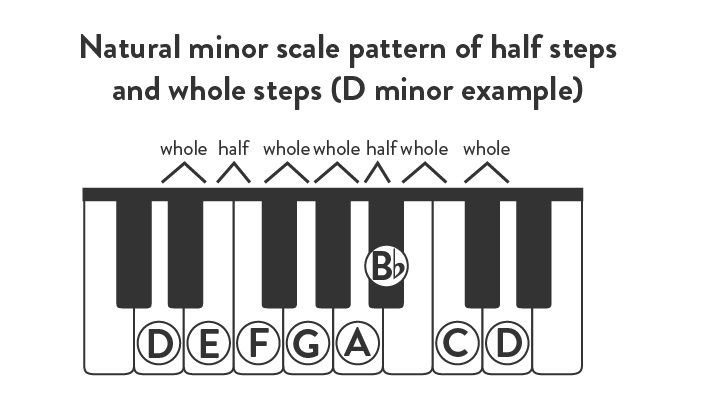
The formula for the natural minor scale is: Whole, Half, Whole, Whole, Half, Whole, Whole — or, more concisely, W-H-W-W-H-W-W.
Notice the different placement of the half steps compared to the major scale's W-W-H-W-W-W-H pattern. This small change in the "recipe" is responsible for the dramatic shift in mood.
The following image illustrates this pattern on a piano keyboard, using D minor as an example. Trace the steps with your finger to see how the formula creates the scale.
Seeing and Hearing the Minor Scale in a DAW
Reading the formula is one thing, but seeing it applied in a piano roll is where it truly clicks. The following video provides a clear, practical demonstration of how to build a minor scale using the W-H-W-W-H-W-W formula right inside a DAW.
A Producers Guide to Scales in FL Studio | Major & Minor Scales, Music Theory for beginners
Watch this segment from the "A Producers Guide to Scales" by Mello Dee Beats. The presenter will walk you through the formula and build a couple of minor scales from scratch.
Pay close attention from the demonstration where he constructs C minor. Then, observe how he applies the exact same formula starting on a different note from the A# minor example. This reinforces the universality of the pattern.
To reinforce this concept, let's turn to a concise written explanation. The following article expands on the minor scale and provides the A minor scale as a key example.
What is Melody in Music? A Guide to Pitch, Scales, and Keys - Blog | Splice
This reading from the Splice blog offers another look at the minor scale's construction and character.
Please read the section titled "The minor scale." Focus on how it introduces the A minor scale as the white-key example, and internalize the W-H-W-W-H-W-W formula presented.
Practical Exercise 1: Constructing the A Minor Scale
Now it's time to apply this in BandLab. We'll start with the A minor scale. Just as C major was the easiest major scale (all white keys), A minor is the easiest minor scale for the same reason. This makes it the perfect starting point.
- Open a new project in BandLab with a piano instrument and open the piano roll.
- Find and place the note A3 at the beginning of the first measure. This is your root note.
- Now, apply the W-H-W-W-H-W-W formula, placing one note for each step:
- W: From A, go up a whole step (2 semitones) to B.
- H: From B, go up a half step (1 semitone) to C.
- W: From C, go up a whole step to D.
- W: From D, go up a whole step to E.
- H: From E, go up a half step to F.
- W: From F, go up a whole step to G.
- W: From G, go up a whole step to A (one octave higher, so A4).
You should now have the notes: A, B, C, D, E, F, G, A. Play them back. Listen carefully to the emotional quality. It should sound more contemplative or somber compared to the C major scale you built in the last lesson.
The Formula is Universal
Just like with major scales, the power of this formula is that it works from any starting note. Building minor scales that start on other notes will require you to use the black keys in your piano roll.
Let's look at one more example. The article below shows the C natural minor scale, which includes black keys (flats), visualized on a piano roll.
Piano scales: essentials for producers and songwriters | Native Instruments Blog
This article from Native Instruments provides another clear breakdown of the natural minor scale.
In the section on "Minor piano scales," read the paragraph that begins "Let’s start with the natural minor." Pay special attention to the image of the C natural minor scale on the piano roll; it's a great visual of how the formula incorporates black keys.
Practical Exercise 2: Constructing the E Minor Scale
Let's build one more scale to solidify your understanding. E minor is a very common key in both piano and guitar music. It involves one black key.
- In your BandLab project, find and place E4 as your starting root note.
- Carefully apply the W-H-W-W-H-W-W formula, counting the semitones in the piano roll for each step.
- Write down the notes you get, or better yet, place them directly into the piano roll.
Once you've tried it yourself, check your work against the solution below.
- Start: E
- W up from E is... F# (a black key)
- H up from F# is... G
- W up from G is... A
- W up from A is... B
- H up from B is... C
- W up from C is... D
- W up from D is... E (one octave higher)
The correct E minor scale is: E, F#, G, A, B, C, D, E. Play it back and hear that distinct minor sound, even with a different starting note.
Conclusion
You have now added a vital tool to your composer's toolkit. Where you once had only the "bright" palette of the major scale, you now also have the "melancholic" palette of the minor scale. Understanding these two foundational structures is a massive step toward writing music that intentionally conveys emotion.
Here are your key takeaways from this lesson:
- The natural minor scale evokes a more somber or reflective mood compared to the major scale.
- It is built with a universal pattern of intervals: Whole-Half-Whole-Whole-Half-Whole-Whole (W-H-W-W-H-W-W).
- This formula can be applied to any starting note in the piano roll to create its corresponding natural minor scale.
In our next lesson, we will put this knowledge to immediate practical use. We'll focus on entering the two most fundamental scales—C Major and A minor—into the piano roll and begin to explore the fascinating relationship they share.