In the last two lessons, you learned the fundamental recipes for creating major and minor scales—the W-W-H-W-W-W-H pattern for a bright, happy sound, and the W-H-W-W-H-W-W pattern for a more somber, reflective mood. You now have the theoretical blueprint for building these scales from any starting note.
Today's lesson is all about putting that theory into direct, hands-on practice. We will focus on entering the two most essential scales in Western music—C Major and A minor—into BandLab's piano roll. These scales are the perfect starting point because they are the simplest to visualize and construct, laying a crucial foundation for the pieces you want to compose. By the end of our session, you'll be able to confidently build these two key musical palettes from scratch in your DAW.
C Major: The Foundational Scale
The C Major scale serves as the primary reference point in music theory. Its simplicity is its greatest strength for learning. As you're about to see, it has a unique characteristic that makes it incredibly easy to work with in the piano roll.
The following article from MusicRadar clearly explains this.
How to understand scales by using your DAW's piano roll | MusicRadar
This article provides a concise, DAW-centric explanation of basic scales. We will refer to it for both C Major and A minor.
Please read the first few paragraphs, from If you play all the white notes, and then jump down to Step 1, reading the short paragraph that begins This run of notes. This will confirm the notes that make up the C Major scale.
As the article states, the C Major scale is composed of all the "white keys" on a piano, starting from C. This makes it incredibly easy to identify in BandLab's piano roll.
The image below shows the C Major scale laid out in a piano roll, just like the one you use in BandLab. Notice how the notes ascend step-by-step, using only the white-key equivalents.
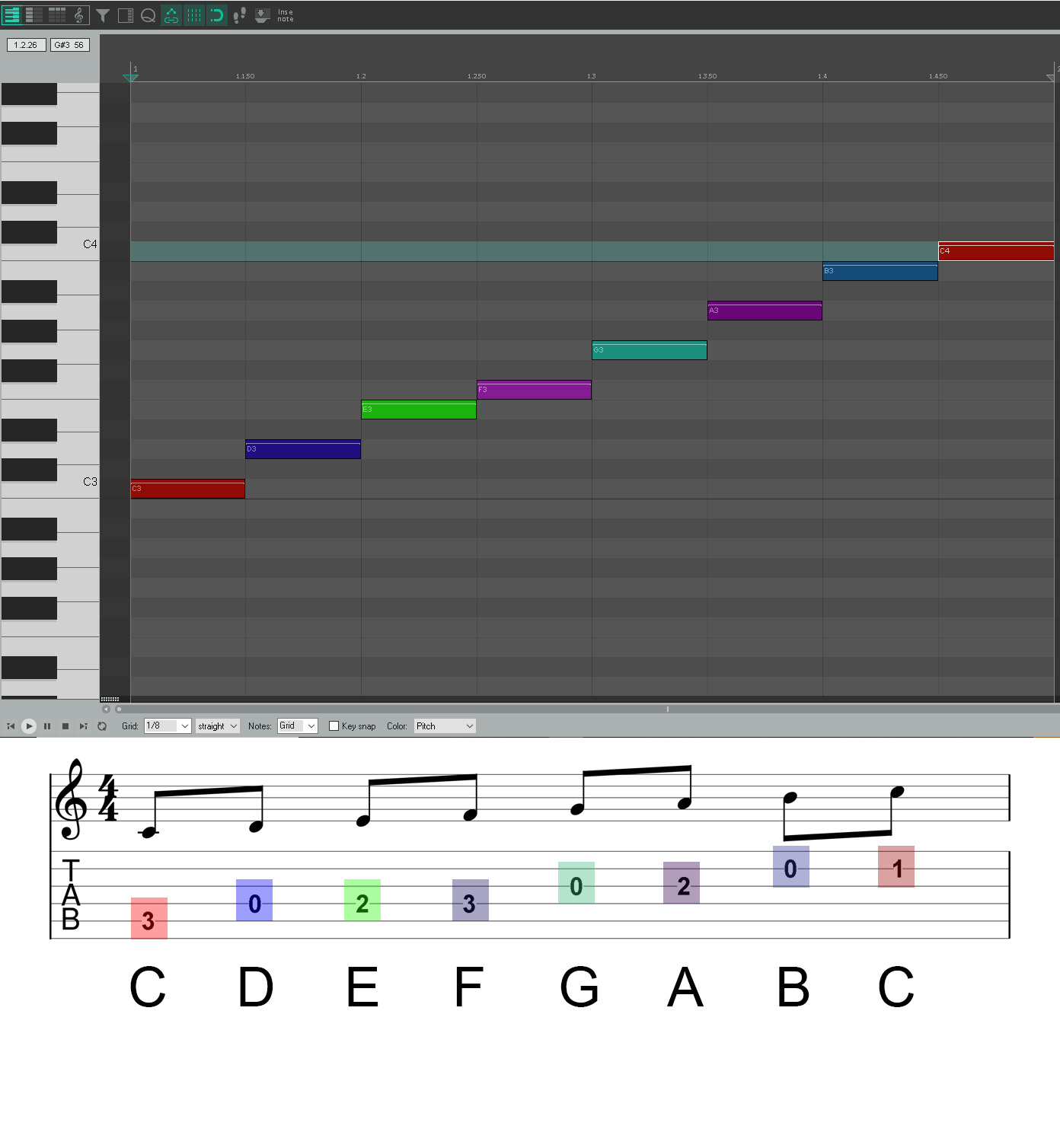
Practical Exercise 1: Entering the C Major Scale
Now it's your turn to build this in BandLab. This exercise will solidify the look and feel of this fundamental scale.
- Open a new project in BandLab and create a track with a piano instrument (like "Felt Piano," which is great for an Einaudi-like sound).
- Double-click the track region to open the MIDI Editor, which contains the piano roll.
- Locate the note C4. This is a common middle C and a good starting point. Click to place a note there.
- Following the "all white keys" rule, enter the rest of the notes one by one, moving upwards: D4, E4, F4, G4, A4, B4, and finally C5 (the C an octave higher).
- Press play and listen to the scale. You should hear that familiar, bright sound you learned about in our first lesson on scales.
A Minor: The Relative Minor
Just as C Major is the simplest major scale, A minor holds the same status for minor scales. It also has a special relationship with C Major, which you will discover momentarily.
Let's return to the MusicRadar article to see why A minor is just as straightforward.
How to understand scales by using your DAW's piano roll | MusicRadar
We will use the same article as before to define the A minor scale.
Find the paragraph that begins Let’s look back, and then go down to Step 3 and read the paragraph defining the A minor scale: handy way of remembering.
You've likely noticed something remarkable: the A minor scale also uses only the white keys, just starting from A. This means it contains the exact same set of notes as C Major! This is not a coincidence, and it's a critical concept we will explore in our next lesson.
Practical Exercise 2: Entering the A Minor Scale
Let's enter this scale and hear the difference for yourself.
- In the same BandLab project, you can either create a new piano track or simply move the playhead further down the timeline on your existing track.
- Find and place the note A3 (an octave below A4) in the piano roll.
- Following the "all white keys" rule, enter the rest of the notes moving upwards: B3, C4, D4, E4, F4, G4, and ending on A4.
- Now, listen back to this scale. Even though you used the exact same notes as the C Major scale, the feeling is completely different. By starting and ending on A, the scale sounds more melancholic and reflective—the signature sound of the minor key.

Visualizing Scales in the DAW
You've now manually entered the two most important scales. Many modern DAWs offer features to help you visualize these scales, reinforcing what you've learned. While BandLab doesn't have an automatic "scale highlighting" feature like some other programs, understanding the concept is still incredibly valuable for your development as a composer.
The following video demonstrates this feature in FL Studio. Don't worry about the different software; focus on the idea of the DAW visually separating the "right" notes from the "wrong" ones for a given key.
A Producers Guide to Scales in FL Studio | Major & Minor Scales, Music Theory for beginners
This video, "A Producers Guide to Scales," shows how a DAW can visually highlight the notes of a scale in the piano roll.
Watch the section from this segment where the presenter demonstrates the "Scale Highlighting" feature. Notice how he selects a key (like C Major or A minor) and the piano roll instantly shades the correct notes, giving him a visual guide for composing.
Thinking in this way—visualizing the "safe zone" of notes for your chosen key—is a powerful skill. For now, your "safe zone" for C Major and A minor is simple: it's all the white keys.
Conclusion
In this lesson, you've transitioned from theory to practice, building the foundational C Major and A minor scales within your own creative environment. This is a significant practical step towards composing your own music.
Here are the key takeaways:
- C Major is the simplest major scale, consisting of all the white notes from C to C (C-D-E-F-G-A-B-C). It has a bright, open sound.
- A minor is the simplest natural minor scale, consisting of all the white notes from A to A (A-B-C-D-E-F-G-A). It has a more somber, reflective sound.
- You can now confidently enter both of these scales into BandLab's piano roll, creating a visual map for your compositions.
- Crucially, you've seen and heard how the same collection of notes can produce two distinct emotional palettes simply by changing the starting point, or root note.
This last point is the perfect gateway to our next topic. The special connection between C Major and A minor is known as a relative key relationship. In our next lesson, we will explore this concept further, learning how to visually find the relative minor of any major key and compare their emotional characters.