Welcome back. In our last lesson, we established a framework for annotating as you read, turning the process into an active conversation with the text. You learned to question, summarize, and react in the margins of your book. Today, we will zoom in on one of those skills—questioning—and transform it into a powerful engine for maintaining your reading momentum.
This lesson focuses on a technique specifically designed to combat the feeling of putting a book down and never picking it back up. We will explore how to generate predictive 'what if' questions during reading to maintain engagement with the plot. By actively speculating about the future of the story, you create a compelling reason to return to the page: to find out if you were right.
1. Engineering Curiosity: The Information Gap
Why is it so hard to stop watching a TV series that ends on a cliffhanger? The answer lies in a psychological principle known as the "information gap." When we have a piece of information, but realize another piece is missing, our brains generate a powerful sense of curiosity—a "need to know"—that motivates us to seek out the missing information and close the gap.
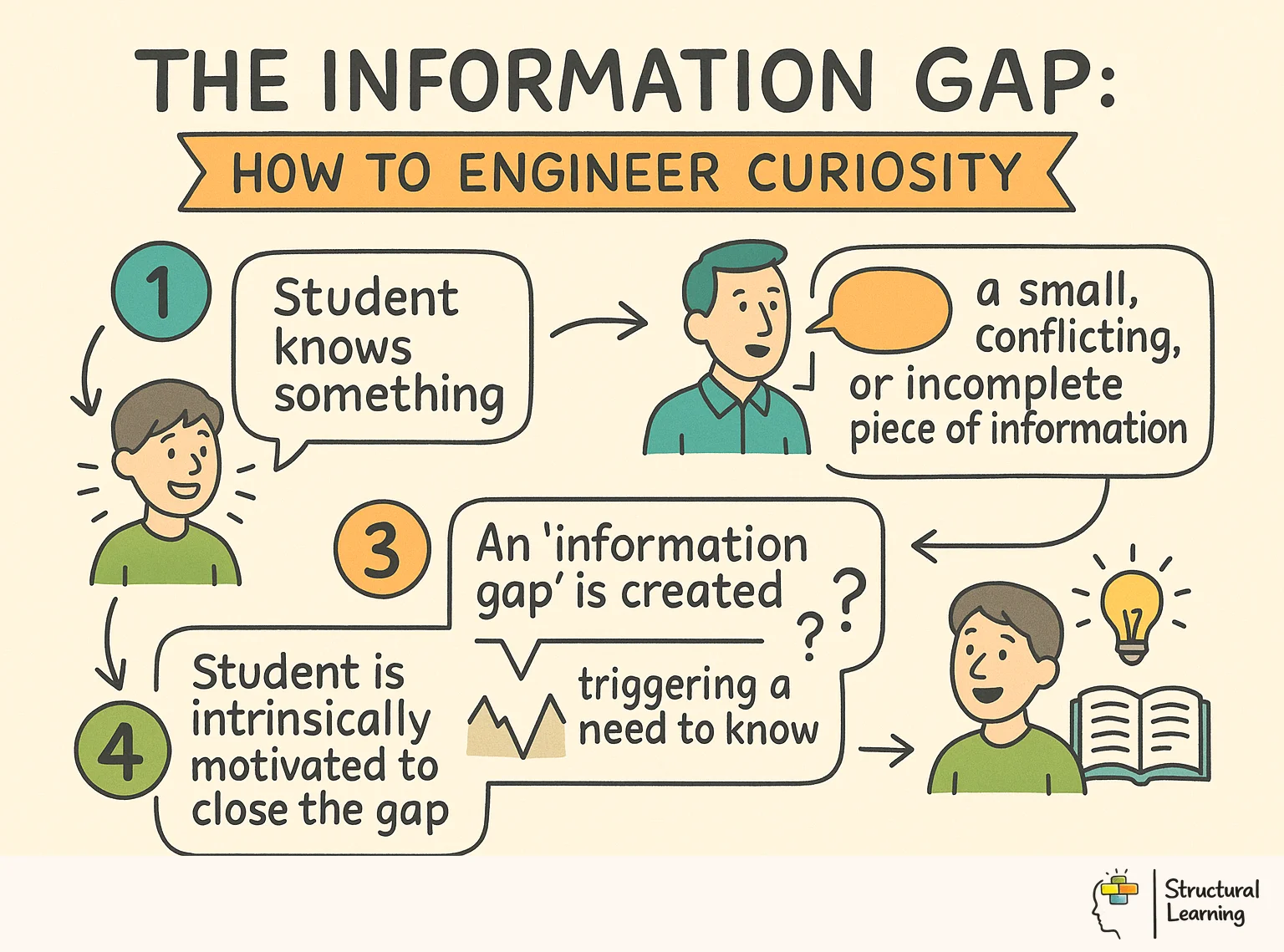
Skilled authors are masters of creating these gaps. They present a mysterious character, a strange event, or an unanswered question, knowing it will hook the reader. As readers, we can amplify this effect. Instead of passively waiting for the author to provide answers, we can actively formulate the questions ourselves. This is especially relevant to the mystery and sci-fi genres you enjoy, which are fundamentally built on "What if...?" propositions.
Your experience as a project manager provides a useful parallel. You don't just follow a project plan; you actively engage in scenario planning. You ask, "What if a key dependency is delayed?" or "What if the user requirements change?" This predictive thinking allows you to stay ahead of the project. We will now apply this same forward-looking, analytical mindset to the plot of a novel.
2. Moving Beyond "What Happened?" to "What If?"
In our last lesson, your annotations likely included questions of clarification ("What does this word mean?"). To drive engagement, we need to ask questions that look forward, not backward. The educational framework known as Bloom's Taxonomy helps distinguish between different levels of thinking and questioning.
Question Generation: A Key Comprehension Strategy
This article from Reading Rockets provides an excellent overview of using Bloom's Taxonomy to deepen reading comprehension. It gives us a structured way to think about the kinds of questions we can ask.
First, read the introductory paragraphs to understand why question generation is so effective. Next, familiarize yourself with the different levels of thinking by reviewing the table under the heading "Bloom’s Revised Taxonomy." Pay close attention to the final level, Creating, which is described with the prompt "(what if?)." This is our target for this lesson. Finally, review the two tables under "Teach question terms and prompts." Focus on the columns for "Analyzing," "Evaluating," and especially "Creating." The prompts here—like "What if…", "What would have happened if…"—are the exact tools we'll be using. The final example for the novel Hatchet shows how these questions look in practice.
As the article shows, simple questions of "Remembering" (Who is the main character?) are necessary for basic comprehension. But it's the "Creating" questions that ignite curiosity. When you ask, "What if the main character's closest ally is secretly working against them?", you are no longer just a reader; you are a co-creator of the story's potential, exploring its possibilities alongside the author.
3. A Practical Method: The Predict-Read-Repair Cycle
Knowing you should ask predictive questions is one thing; integrating it into your reading habit is another. A powerful and simple method for this is the Directed Reading-Thinking Activity (DRTA). It formalizes the process of prediction into a three-step cycle:
- Predict: At a natural pause point in the text, stop and ask, "What do I think will happen next?"
- Read: Continue reading with your prediction in mind.
- Repair/Confirm: As you get more information, check if your prediction was accurate. If it was, great! If not, revise your mental model based on the new information. This "repair" step is just as valuable, as it deepens your understanding of the author's choices.
This cycle turns reading into an interactive game.
[PDF] Reading at the Edge of Your Seat: Motivation and the Prescribed ...
This document provides a concise and practical guide to the DRTA method. It uses a classic short story by O. Henry to demonstrate the predict-read-repair cycle in action.
Read the sections that introduce the DRTA strategy and its three stages: Predict, Read, and Repair. Then, follow the example walkthrough with the story "After Twenty Years." Pay attention to the moments the guide suggests pausing to ask predictive questions, such as "What's Going to Happen Next?" and "Will Jimmy Wells show up?". Notice how these questions create suspense and a desire to keep reading to find the answer. Finally, read the concluding paragraph on how this becomes an automatic and exciting part of the reading process.
The key is to make this a conscious habit. Every time you finish a reading session, don't just place your bookmark and walk away. Pause for a moment, and leave yourself with an open question. This question becomes the "cliffhanger" that pulls you back to the book tomorrow.
4. Your Predictive Reading Toolkit
To make this practical, let's consolidate these ideas into a toolkit you can use with any book.
1. Identify Pause Points: Look for moments of tension, surprise, or decision.
* A character receives a mysterious message.
* A clue is discovered (or a potential red herring).
* A character faces a difficult choice.
* A chapter ends on a dramatic note.
2. Formulate "What If" Questions: Using the prompts from Bloom's Taxonomy, turn these pause points into open-ended questions. Instead of "Will he succeed?", ask "What if his plan succeeds, but at a terrible cost?"
Learn More From Every Paragraph | Active Reading Example
This video provides a brilliant demonstration of a deep reader's thought process. The presenter reads a single paragraph and then shows how he combines the text with his own knowledge to generate inferences and, most importantly, "open questions."
Watch from his deep reading process. Notice how he doesn't just absorb facts but connects them and asks questions about what's missing. Then, pay close attention to the section from "We also usually leave with some open questions". This is the exact state of mind you want to cultivate at the end of a reading session. It's the curiosity generated by these open questions that makes you eager to continue.
3. Record Your Predictions: Use the annotation skills from our last lesson. A simple P: or ?-> in the margin followed by your question is enough. This creates a record of your thought process and makes the book a personal intellectual journey.

The goal is not to be a perfect fortune-teller. The goal is to be an engaged and curious participant. The more you ask these questions, the more invested you become in the outcome.
how to read critically in the age of bad media literacy
This video on critical reading includes a very relevant section on the kinds of personal questions that keep us engaged with a book.
Watch the short segment from "What makes me want to keep reading". The presenter reflects on what makes a book a "page-turner" for her. By asking yourself this question, you can identify what plot elements or character dynamics are hooking you, and then generate predictive questions around those specific elements to strengthen that pull.
Conclusion
You identified a key obstacle in your reading journey: losing momentum after putting a book down. Today's lesson provided a direct strategy to overcome it. By consciously generating predictive "what if" questions, you create an intellectual and emotional investment in the story's future. You leave each reading session not at an end point, but at a pause, with an open loop that your mind will be eager to close.
Key Takeaways:
- Predictive questioning leverages the "information gap" principle to create a powerful sense of curiosity that pulls you back to the book.
- Move beyond simple clarification questions to higher-level "Creating" questions (e.g., "What if...?", "What would happen if...?").
- Use the Predict-Read-Repair cycle as a structured way to practice this skill.
- End each reading session by formulating and annotating one or two open-ended predictions. This is your self-made cliffhanger.
In our next lesson, we will take a step back and look at the very beginning of a story. We will learn to identify the inciting incident and central conflict within a story's opening. Understanding these foundational elements will give you a powerful framework for making more accurate and insightful predictions about where the plot is headed.