Hello!
In our last lesson, we saw how Alexander the Great’s sudden death left a paradoxical legacy: a vast, interconnected cultural world simmering within a political powder keg. He left his empire "to the strongest," an open invitation to his ambitious generals, the Diadochi, to fight for the ultimate prize.
This lesson picks up right where we left off, diving into the heart of that conflict. Our goal is to explain the succession crisis following Alexander's death and the subsequent Wars of the Diadochi. We will trace the nearly half-century of betrayal, shifting alliances, and epic battles as these larger-than-life figures carved up the known world. This is the story of how the Hellenistic Age was truly forged—not in a throne room, but on the battlefield.
Part 1: The First Scramble: A Broken Regency
Alexander died in Babylon in 323 BC. He had no adult heir. His Bactrian wife, Roxane, was pregnant. His only living relative was a half-brother, Philip Arrhidaeus, who was considered intellectually unfit to rule. The stage was set for a crisis.
The first major confrontation happened immediately, in Babylon, between two factions of the Macedonian army:
- The Cavalry and Commanders: Led by Perdiccas, Alexander's most senior general, they wanted to wait and see if Roxane's child was a boy. They would then rule as a council of regents.
- The Infantry Phalanx: Composed of Macedonian veterans, they were xenophobic and rejected the idea of a half-Persian king. They championed Philip Arrhidaeus.
A civil war was narrowly averted by a compromise: Philip Arrhidaeus and Roxane's unborn son (who would be Alexander IV) were declared joint kings. Perdiccas was named regent of the empire, holding the real power. The generals then divided the empire's provinces, or satrapies, amongst themselves in what is known as the Partition of Babylon.
This was the opening chessboard. Key initial placements included:
- Ptolemy secured Egypt.
- Antigonus the One-Eyed kept his command in central Anatolia (modern Turkey).
- Lysimachus was given Thrace, the buffer zone with Europe.
- Antipater, the old veteran, remained regent of Macedonia itself.
This arrangement was fragile from the start. These were not loyal governors; they were alpha predators sensing weakness. To understand the chaos that followed, it's essential to know the personalities involved.
Alexander's (Insane) Generals Explained
The video 'Alexander's (Insane) Generals Explained' offers a brilliant, fast-paced introduction to the key players. Their individual ambitions and personalities were the fuel for the coming wars. Let's meet a few of them.
Please watch the following three character sketches: Perdiccas (09:17 - 10:22): The initial regent who tried and failed to hold it all together. Ptolemy (11:17 - 12:14): The cunning pragmatist who had his eyes on a specific prize. Antigonus (04:19 - 05:04): The old, battle-hardened veteran with the grandest ambition of all. Focus on their different approaches to power: consolidation vs. pragmatism vs. total conquest.
As you can see, the "unity" of the empire was a fiction. Ptolemy immediately began fortifying Egypt, Antigonus consolidated his power base in Asia Minor, and Perdiccas, the regent, grew increasingly paranoid about their intentions.
Part 2: The First War of the Diadochi (322–320 BC)
The first open war was triggered by two key events:
- Perdiccas's Ambition: He attempted to marry Alexander's sister, Cleopatra, a move seen by the other generals as a clear bid to claim the throne for himself.
- Ptolemy's Theft: In a masterstroke of political propaganda, Ptolemy hijacked Alexander's funeral cortège on its way to Macedonia and brought the body to Egypt. Macedonian tradition held that the right to bury the king was linked to the right to succeed him.
This was an intolerable challenge to Perdiccas's authority. A coalition formed against him, pitting the regent against Ptolemy, Antipater, Craterus, and Antigonus. The First War of the Diadochi had begun.
First War of the Diadochi - Alexander's Successors At War DOCUMENTARY
The documentary 'First War of the Diadochi' from Kings and Generals provides a detailed military and political narrative of this first major conflict. We will watch it in two parts.
First, watch the introduction from 00:05 to 01:13 to understand how the alliances formed. Then, watch the section covering Perdiccas's disastrous Egyptian campaign from 03:56 to 08:39. Observe how Ptolemy's defensive strategy and Perdiccas's own incompetence led to his downfall.
As the video showed, Perdiccas's invasion of Egypt was a catastrophe. After a failed attempt to cross the Nile resulted in thousands of his own men drowning or being eaten by crocodiles, his troops mutinied. His own officers, including Seleucus, murdered him in his tent.
While Perdiccas was failing in Egypt, his loyal and highly capable general, the Greek Eumenes, was fighting the other half of the war in Asia Minor.
First War of the Diadochi - Alexander's Successors At War DOCUMENTARY
Let's return to the same documentary to see the outcome of the northern front.
Now watch the section from 08:24 to 12:21. This part describes the Battle of the Hellespont, where Eumenes cleverly defeated the respected general Craterus, who was killed in the fighting.
Eumenes had won a brilliant victory, but it was too late. With Perdiccas dead, the victorious generals met in 321 BC to re-divide the empire in the Partition of Triparadeisos.
- Antipater was made the new regent.
- Antigonus was given command of the largest army in Asia and tasked with hunting down Eumenes.
- Seleucus was rewarded for his role in the mutiny with the wealthy satrapy of Babylonia.
The first attempt to hold the empire together had ended in the death of the regent and a new distribution of power, making the remaining players even stronger.
Part 3: The Rise of Antigonus and the Final Showdown (320–301 BC)
For the next two decades, the wars continued in a dizzying series of shifting alliances. The central theme was that whenever one general became too powerful, the others would form a coalition to take him down.
The man who came closest to reuniting the empire was Antigonus the One-Eyed.
The article 'Diadochi Wars' provides a comprehensive narrative of the entire period. We'll read the section that details Antigonus's bid for supreme power and the reaction it caused.
Please read the section titled 'ANTIGONUS ONE-EYE’S BID FOR EMPIRE, 316–301'. Start from the beginning of that section and read until the paragraph that ends, '...it also meant war.' Focus on how Antigonus consolidated his power and why his actions triggered a new grand coalition against him.
As Antigonus's power grew to monstrous proportions, two crucial events occurred that changed the nature of the war:
- The End of the Royal Line (c. 310 BC): Cassander, who had taken control of Macedonia, grew tired of the pretense of a regency. He had the young king Alexander IV and his mother Roxane murdered. The last legitimate heirs to Alexander the Great were gone.
- The Proclamation of Kings (306-305 BC): After a major naval victory, Antigonus and his son Demetrius were the first to formally declare themselves kings (basileus). The other Diadochi—Ptolemy, Seleucus, Lysimachus, and Cassander—quickly followed suit. The fiction of a unified empire was officially over. These men were now founding their own royal dynasties.

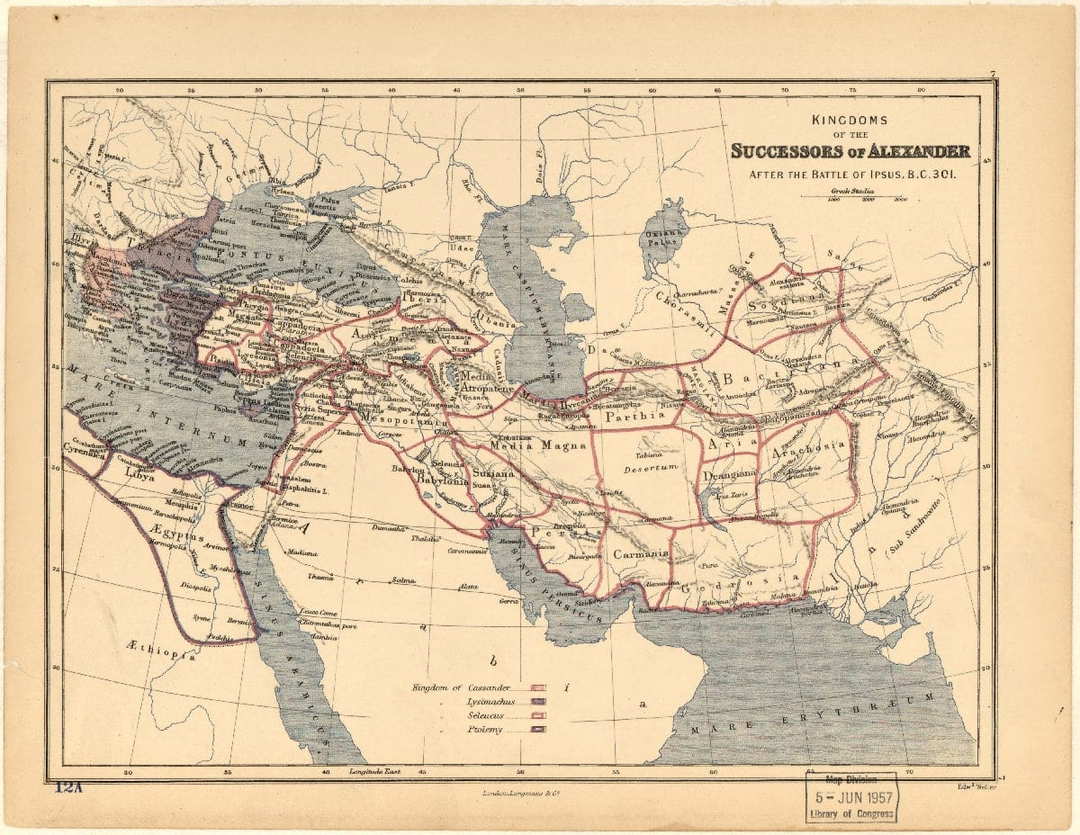
The final showdown was inevitable. Lysimachus, Seleucus, and Cassander formed a final grand alliance to stop Antigonus. In 301 BC, their armies met at the Battle of Ipsus in Phrygia.
The battle was a colossal clash, famous for the use of war elephants on both sides. Seleucus, having campaigned in India, brought nearly 500 elephants, which proved decisive. They were used to neutralize the cavalry of Antigonus's dashing son, Demetrius. Antigonus, now over eighty years old, was surrounded on the battlefield and died fighting.
Test your understanding!
Throughout the Wars of the Diadochi, we see a recurring pattern: as soon as one general (like Perdiccas or Antigonus) becomes powerful enough to threaten to control the whole empire, the others unite to stop him.
Based on your software engineering experience, how is this dynamic similar to the concept of fault tolerance and avoiding a single point of failure in a distributed system?
Show answer
This is a fitting analogy. A distributed system is designed to be resilient by not depending on a single component.
- Single Point of Failure: In our historical context, a single ruler for the entire empire (like Perdiccas or Antigonus aimed to be) represents a single point of failure. If that ruler makes a bad decision or is "brought down," the entire system (the empire) collapses into chaos. The Diadochi instinctively fought against this centralization.
- Decentralization and Redundancy: The eventual outcome—three major independent kingdoms (Ptolemaic, Seleucid, Antigonid)—is like a decentralized system with redundant, independent services. The failure or weakness of one kingdom (e.g., the Seleucids fighting the Parthians) did not automatically bring down the others. Each kingdom could manage its own affairs, successes, and failures independently.
- Load Balancing: The coalitions acted as a form of "load balancing" for power. When too much power accumulated in one place (Antigonus), the others teamed up to redistribute it, preventing the system from becoming dangerously imbalanced. Their wars, though destructive, ultimately led to a more stable, decentralized political architecture for the Hellenistic world.
Conclusion
The succession crisis that began in Alexander's death tent in Babylon was only resolved after decades of brutal conflict. The Wars of the Diadochi were a chaotic, bloody affair that ultimately prevented the preservation of Alexander's unified empire.
Key Takeaways:
- The succession crisis began immediately after Alexander's death, with a failed compromise to establish a joint kingship under the regent Perdiccas.
- The wars were characterized by shifting alliances, with the generals repeatedly forming coalitions to prevent any single one among them from gaining supreme power.
- Key figures like Ptolemy, Seleucus, and Antigonus pursued different strategies, from pragmatic consolidation to ambitious attempts at total conquest.
- The murder of Alexander's heirs and the generals' assumption of the title of king marked the definitive end of a unified empire.
- The Battle of Ipsus in 301 BC was the decisive climax, resulting in the death of Antigonus and the final carving up of the empire, which solidified the foundations of the major Hellenistic kingdoms.
Preview of the Next Lesson:
With the wars largely settled, the era of the great Hellenistic kingdoms began. In our next lesson, we will describe how Alexander's empire was divided into the major Hellenistic kingdoms (Ptolemaic, Seleucid, Antigonid). We'll explore the unique character, structure, and legacy of each of these new global powers.