Hello!
In our last lesson, we delved into the complex and often contradictory character of Alexander the Great. We saw a man who was simultaneously a military genius, a ruthless tyrant, and a megalomaniac who believed himself a god. His sudden death in Babylon in 323 BC left the largest empire the world had ever seen without a ruler.
This lesson addresses the monumental question that follows: What happens when such a force of nature is abruptly removed from the world he created? Our learning outcome is to assess Alexander's immediate impact on the world he conquered. We will explore the chaos, creation, and cultural fusion that erupted in the wake of his death, setting the stage for an entirely new era in history.
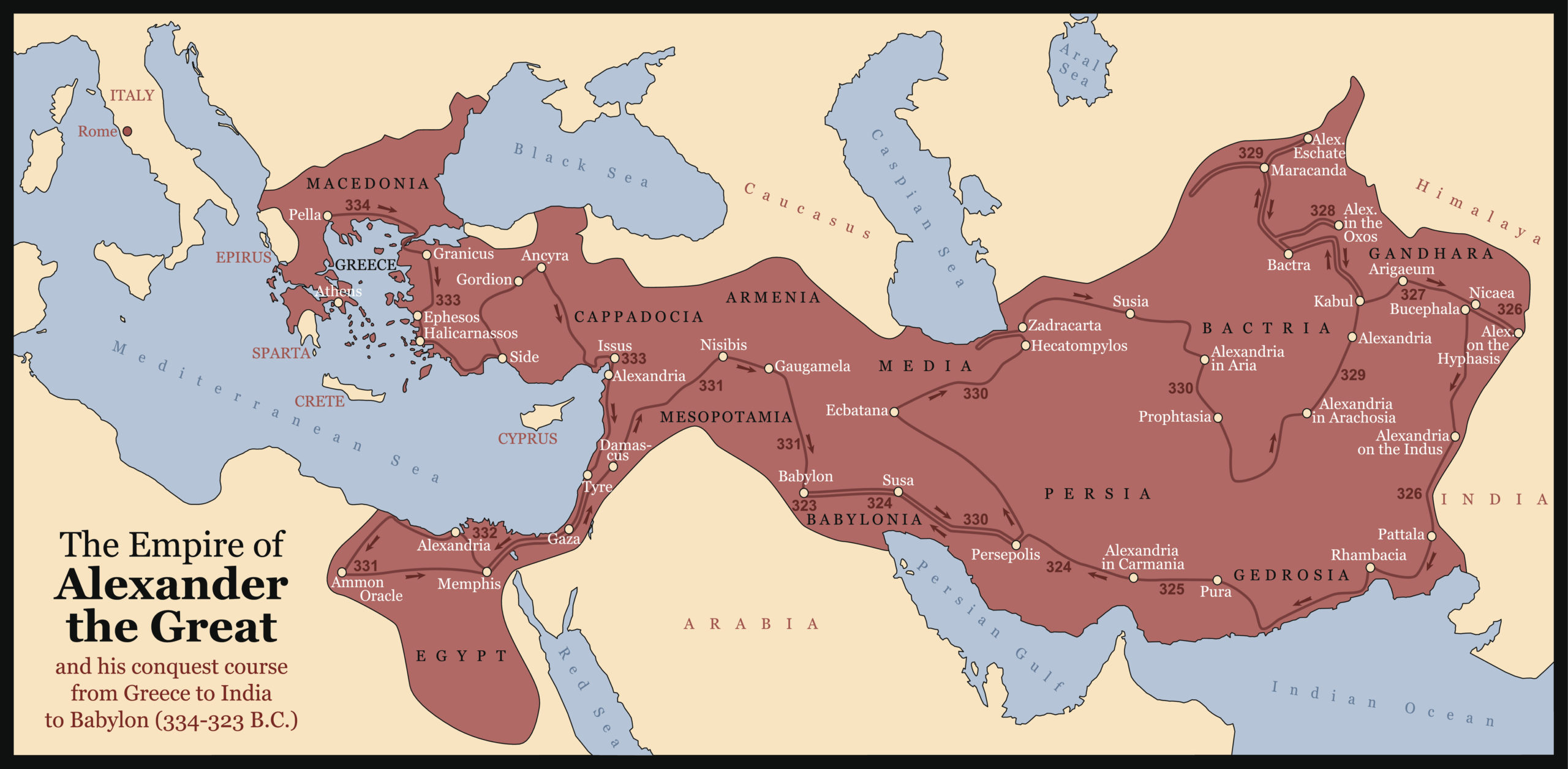
Part 1: The Power Vacuum and the Shattering of an Empire
Alexander's most immediate and disruptive impact was the political chaos he unleashed by dying without a designated heir. His belief in his own invincibility, a core part of the megalomania we discussed, meant he made no viable plans for succession. The fate of his empire rested on a single, fateful deathbed whisper: he supposedly left it 'tôi kratistôi'—"to the strongest."
This was a recipe for disaster. His top generals, the Diadochi (Successors), were ambitious, battle-hardened Macedonian nobles who had carved up the world with him. They were not going to politely hand over power to a regent for Alexander's unborn son.
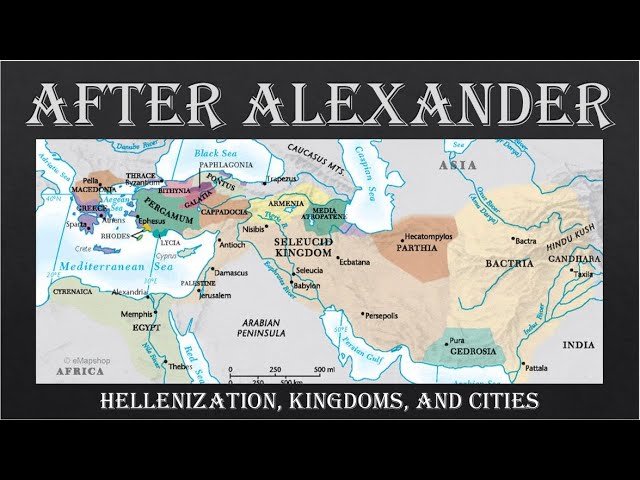
After Alexander: Hellenization, Cities, and Kingdoms
To understand the crisis that unfolded immediately after Alexander's death, let's watch a segment from the video 'After Alexander: Hellenization, Cities, and Kingdoms' by Thersites the Historian. It vividly describes the failure to maintain unity and the beginning of the wars between the generals.
Please watch from 00:58 to 03:03. Focus on how quickly the idea of a unified empire collapsed and why the generals began fighting amongst themselves.
As the video explains, the ambition of Alexander's generals was too great, and the authority of the appointed regent, Perdiccas, was too weak. The empire immediately plunged into a series of brutal civil wars that would last for over 40 years. Alexander had unified this vast space through personal will and military might; without him, it shattered.
His conquest created a single political entity, but his death ensured its fragmentation.
Part 2: The Vision of Fusion
While Alexander's death brought political chaos, it's crucial to understand that his goal was not simply to rule a conquered territory. During his final years, he initiated a deliberate and radical policy of cultural fusion, aiming to create a new, hybrid Hellenic-Persian ruling class to govern his empire.
Chapter 7: The Hellenistic Age
The textbook chapter 'The Hellenistic Age' provides a concise summary of Alexander's intentions after his main conquests were complete.
Please read the short section titled 'Alexander After the Conquest of Persia'. Note his specific actions: marrying Persian noblewomen, maintaining the Persian bureaucracy, and honoring Darius's family.
The most dramatic example of this policy was the "Susa weddings," a mass marriage ceremony where Alexander and about 90 of his senior officers married Persian noblewomen. He also began integrating thousands of Persian soldiers into the Macedonian army.
Alexander's Last Year - Reforms and Plans - Ancient History DOCUMENTARY
Let's watch a segment from the documentary 'Alexander's Last Year' which details these fusion policies and the mixed reactions they provoked.
Please watch from 07:24 to 17:26. The first part (until 12:57) covers the Susa weddings and the debate over Alexander's motives. The second part describes the mutiny at Opis, a direct backlash from his Macedonian veterans against these 'Persianisation' policies.
As you saw, this vision was highly contested.
- Historians debate the motive: Was it a noble, humanistic vision of a "brotherhood of mankind," or a purely pragmatic move to create a loyal, mixed-race elite to control a vast and potentially rebellious population?
- His men resisted: The mutiny at Opis reveals how deeply his Macedonian veterans resented these changes. They saw their king adopting the ways of the conquered and elevating foreigners to their level.
Alexander's impact here was profound but divisive. He set in motion a process of cultural blending but also created deep resentment among his own people, a tension that would shape the kingdoms his successors inherited.
Part 3: The Engine of Change: Hellenization and a New Globalized World
Beyond his explicit policies, Alexander's conquests triggered a much broader and longer-lasting phenomenon: Hellenization. This was the spread of Greek language, culture, political structures (the polis), and thought across the Near East.
The primary engines of this process were the dozens of new cities he founded, most named Alexandria, which served as colonies for his Greek and Macedonian soldiers.
After Alexander: Hellenization, Cities, and Kingdoms
Let's return to the 'After Alexander' video for an excellent explanation of what Hellenization was and how it worked in practice. The presenter draws a very useful analogy to the modern world.
Please watch from 03:03 to 07:16. Pay close attention to the role of new cities, Greek settlers, and the development of a simplified common language, Koine Greek.
The key mechanisms of Hellenization were:
- Urbanization: New cities were built on a Greek model, with theaters, gymnasia, and forums, creating islands of Greek culture in foreign lands.
- Migration: Tens of thousands of Greeks and Macedonians migrated east to settle in these new cities, seeking land and opportunity. They became a new ruling elite.
- Language: Koine ("common") Greek, a simplified dialect, became the language of government, commerce, and intellectual life across the entire region. Much like English today, learning Koine was essential for any local who wanted to get ahead.
This created a more interconnected, "globalized" world. A Greek-speaking merchant, scholar, or official could now travel from Egypt to Bactria (modern Afghanistan) and find familiar laws, customs, and a common language. Alexander's conquests demolished old barriers and created a vast, new cultural and economic space.
Test your understanding!
The video compared the role of Koine Greek in the Hellenistic world to that of English today. Drawing on your background in software development, how might the spread of Koine Greek be analogous to the adoption of a standardized API or a dominant programming language (like Python) across a company's many microservices?
Show answer
This is an excellent analogy. Just as Koine Greek allowed people from different regions (Egyptians, Persians, Syrians) to communicate and interact within the new political and economic system, a standardized API allows different software services, written by different teams and potentially in different languages, to communicate effectively.
- Interoperability: Koine enabled a merchant from Alexandria to do business in Seleucia without a translator. A standard API allows a user authentication service to seamlessly work with a payment processing service.
- Reduced Friction/Overhead: It's much more efficient than having every region/service use its own unique protocol requiring custom "translators" for every interaction.
- Creation of an Ecosystem: The widespread use of Koine fostered a shared intellectual and cultural world (philosophy, literature, science). Similarly, a dominant language and its frameworks (like Python with Django/Flask for web development) creates a huge ecosystem of tools, libraries, and developers, making it easier and faster to build new things. Local elites adopted Koine to gain power, just as developers might adopt a dominant technology to be more effective and marketable.
Part 4: A Lasting Imprint on the Land
The impact of Alexander's conquests was not uniform. The seeds of Hellenism took root in different soils, producing unique results across his former empire.
The Hellenistic World: The World of Alexander the Great
This article from World History Encyclopedia highlights the lasting, widespread influence of Hellenic culture.
First, read the section 'The Diadochi & Hellenization' which focuses on Ptolemy's efforts in Egypt and the creation of the syncretic god Serapis. Then, read the section starting 'As the wars of the Diadochi settled down...' which discusses the broader impact on architecture, literature, religion, and coinage.
Let's look at two specific examples that show the diversity of this impact:
-
In Egypt: Ptolemy, one of Alexander's most cunning generals, created a highly efficient and exploitative state. He established a Greek-Macedonian ruling class to run the country like a massive plantation, with the native Egyptians as the labor force. Yet, at the same time, he made Alexandria the undisputed intellectual and cultural capital of the Mediterranean by founding the great Library and Museum. The culture he fostered was a true blend, or syncretism, as seen in the god Serapis, who combined attributes of Egyptian and Greek deities.
-
In the Far East (Bactria & India): The Greek soldiers Alexander left as garrisons in modern-day Afghanistan and Pakistan were cut off from the Mediterranean by the rise of the Parthian Empire. Against all odds, they founded independent kingdoms—the Greco-Bactrian and Indo-Greek kingdoms. Here, Hellenism blended with local traditions in fascinating ways, most notably with Buddhism. This led to a unique Greco-Buddhist art style, where the Buddha was sometimes depicted in a Greek toga, guarded by Heracles. This easternmost outpost of Hellenism was the last of the successor kingdoms to fall, surviving until around 10 AD.
Conclusion
So, what was Alexander's immediate impact? It was a profound paradox.
- Politically, he left chaos. His failure to plan for succession directly caused the fragmentation of his empire and decades of devastating warfare.
- Culturally and socially, he was a catalyst for creation. His conquests, his founding of cities, and his vision of fusion—however contested—shattered the old world order and laid the groundwork for a new, interconnected Hellenistic civilization. He kicked off a process of globalization that spread Greek language, ideas, and culture across three continents.
He was both a destroyer of an old world and the accidental architect of a new one. The world he left behind was violent and fragmented, but also more connected, more dynamic, and culturally richer than the one he had found.
Preview of the Next Lesson:
The political chaos Alexander unleashed was not resolved overnight. In our final lesson, we will trace the course of the Wars of the Diadochi, the 40-year struggle among his generals. We will see how the three great Hellenistic monarchies—the Antigonids in Macedon, the Ptolemies in Egypt, and the Seleucids in Asia—were officially forged in this crucible of conflict, marking the true dawn of the Hellenistic Age.