Hello!
In our last lesson, we journeyed through the chaotic and bloody Wars of the Diadochi, a nearly 50-year struggle among Alexander's generals. We saw how the ambition of men like Antigonus the One-Eyed to reunite the empire was consistently thwarted by coalitions of his rivals. The conflict culminated in the cataclysmic Battle of Ipsus in 301 BC, which shattered the dream of a unified empire forever.
This lesson focuses on the result of that epic struggle. With the major players having staked their claims, the fluid battle lines of the wars began to harden into the borders of new kingdoms. Our objective is to describe how Alexander's empire was divided into the major Hellenistic kingdoms: the Ptolemaic, Seleucid, and Antigonid. We will explore the founding, geography, and fundamental character of these three new superpowers that would dominate the Eastern Mediterranean and the Near East for the next two centuries.
The New World Map
The Battle of Ipsus was the great watershed moment. The death of Antigonus and the subsequent division of his vast territories created a new, relatively stable balance of power. The world Alexander had conquered was now definitively partitioned.
Take a look at this map, which illustrates the political landscape after the dust from the battle had settled.
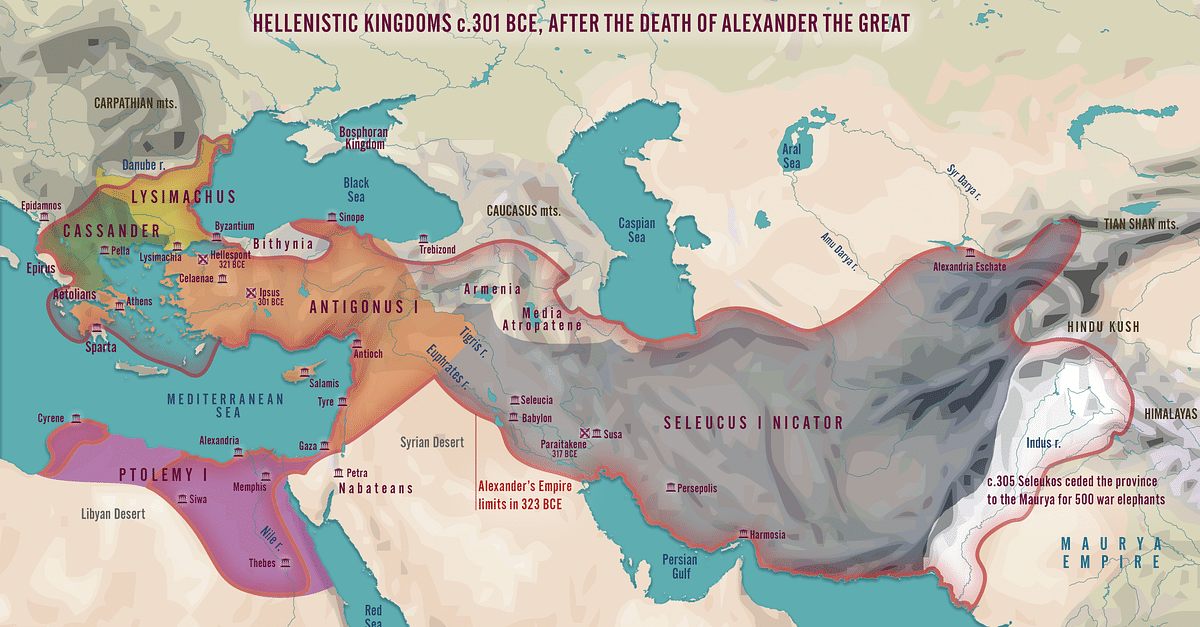
As you can see, the vast expanse of Alexander's conquests coalesced around three primary centers of gravity, each ruled by a different dynasty. Let's explore them one by one.
1. The Ptolemaic Kingdom: The Stable Monolith
Of all the Diadochi, Ptolemy was perhaps the most pragmatic. While others gambled for the entire imperial prize, Ptolemy played a long game, securing the most valuable and defensible province for himself: Egypt.
His strategy was one of consolidation rather than boundless expansion. He had famously hijacked Alexander's funeral procession to bury the conqueror's body in Egypt, a brilliant move that conferred immense legitimacy on his rule. He then fortified his new kingdom and turned it into a personal fiefdom that would be the longest-lasting of all the successor states.
To get a comprehensive overview of the establishment and nature of these kingdoms, we'll watch a video that breaks them down clearly.
How Did Alexander the Great’s Empire End? | The Hellenistic Period
The video 'How Did Alexander the Great’s Empire End?' provides an excellent summary of how each successor state was formed. We'll start with the section on Ptolemaic Egypt.
Please watch the segment from 05:55 to 07:36. Focus on how the Ptolemies ruled Egypt: their relationship with Egyptian traditions (like becoming Pharaohs), the role of the new capital at Alexandria, and the structure of their administration.
As the video explained, the Ptolemaic kingdom was a masterclass in stability and shrewd governance.
- Founder: Ptolemy I Soter ("Savior").
- Territory: Primarily Egypt, with its near-impenetrable desert borders and the life-giving Nile. At various times, it also controlled Cyprus, coastal regions of Anatolia, and the Levant.
- Capital: Alexandria, which quickly became the wealthiest city and the premier intellectual and cultural center of the Hellenistic world.
- Key Characteristic: A fascinating blend of Greek and Egyptian culture. The Ptolemies ruled as absolute Greek monarchs, staffing their administration with a Greek elite. However, to the native population, they presented themselves as traditional Pharaohs, building temples to Egyptian gods and even adopting the pharaonic practice of royal incest. This dual identity was crucial to the dynasty's longevity.
Test your understanding!
In your work as a backend developer, you've likely encountered monolithic architecture. How does Ptolemaic Egypt resemble a "monolithic" system design compared to the other Hellenistic kingdoms?
Show answer
The analogy is quite apt. Ptolemaic Egypt can be seen as a monolithic system:
- Tightly Coupled & Self-Contained: Its power, wealth (from grain), and administration were all tightly integrated within the well-defined and defensible borders of Egypt.
- Stable and Predictable: Like a monolith, it was less flexible but very stable. Its wealth was predictable, its borders were secure, and its internal governance was highly centralized. It didn't have to manage the complexities of dozens of different cultures and remote provinces in the same way the Seleucids did.
- Single, Strong Core: The entire kingdom revolved around the Nile and the capital at Alexandria. This was its powerful, unified core. This contrasts sharply with the "microservices" approach of the Seleucid Empire, which was sprawling and decentralized.
2. The Seleucid Empire: The Sprawling Behemoth
If Ptolemy was the cautious consolidator, his rival Seleucus was the audacious empire-builder. Starting with nothing after being ousted from his initial province of Babylon, he fought his way back and, in the aftermath of Ipsus, secured the lion's share of Alexander's Asian territories.
The empire he founded was by far the largest, most populous, and most ethnically diverse of the successor states.
How Did Alexander the Great’s Empire End? | The Hellenistic Period
Let's return to the same video to learn about the vast empire forged by Seleucus.
Now watch the section from 07:36 to 09:24. Pay attention to the massive scale of the Seleucid Empire, the challenges of administering it, and its strategy of founding new cities.
The Seleucid Empire was a study in contrasts: immensely powerful but inherently fragile.
- Founder: Seleucus I Nicator ("the Victor").
- Territory: An enormous and diverse territory stretching from the Aegean Sea to the borders of India, encompassing modern-day Turkey, Syria, Iraq, Iran, and Afghanistan.
- Capitals: The empire had multiple administrative centers, most notably Antioch in the west and Seleucia-on-the-Tigris in Mesopotamia.
- Key Characteristic: Its defining feature was the challenge of ruling a vast, multicultural population. Following Alexander's example, the Seleucids' primary strategy for control and cultural dissemination was a massive program of urbanization. They founded dozens of new Greek-style cities (poleis) to act as garrisons and centers of Hellenistic administration and culture in a sea of native peoples. This constant struggle to maintain control over its vast and rebellious eastern provinces would be the empire's central dynamic.
3. The Antigonid Kingdom: The Troubled Heartland
The kingdom of Macedonia, Alexander's own homeland, had a more turbulent path. Antigonus the One-Eyed, who had ruled much of Asia, lost both his life and his empire at Ipsus. The Antigonid dynasty wasn't secured by him, but by his tenacious descendants.
After years of chaos, which included invasions by migrating Celts (called Gauls by the Greeks), Antigonus's grandson, Antigonus II Gonatas, finally secured the Macedonian throne and established a stable dynasty.
How Did Alexander the Great’s Empire End? | The Hellenistic Period
Finally, let's look at the third major kingdom, which controlled Alexander's homeland.
Please watch the final segment from 09:24 to 11:29. Note the key differences for the Antigonid rulers: their territory was more ethnically homogeneous (mostly Greek), but their main challenge came from the fiercely independent city-states of southern Greece.
The Antigonid Kingdom was geographically smaller but occupied a position of immense prestige and strategic importance.
- Founder: Antigonus II Gonatas (grandson of Antigonus the One-Eyed).
- Territory: The Macedonian heartland and a constantly challenged hegemony over the city-states of mainland Greece.
- Capital: Pella, the traditional capital of Macedon.
- Key Characteristic: Unlike the Ptolemies and Seleucids, who ruled over vast non-Greek populations, the Antigonids ruled a kingdom that was predominantly Greek. Their main political challenge wasn't cultural integration but political control. The Greek city-states, particularly Athens and Sparta, cherished their independence and constantly chafed under Macedonian oversight, often forming leagues and alliances (frequently funded by the Ptolemies) to resist Antigonid power.
For a more detailed textual summary of these three kingdoms, you can refer to the following article.
Hellenistic Kingdoms: The Worlds of Alexander the Great's ...
The article 'Hellenistic Kingdoms' by The Collector provides a concise written account that reinforces what we've just seen in the video. It offers a great summary of each kingdom's founding and character.
Please read the three main sections: 'Ptolemaic Kingdom: The Hellenistic Kingdom in Ancient Egypt,' 'Seleucid Empire: The Fragile Giant,' and 'Antigonid Kingdom: The Greek Realm.' This will solidify your understanding of the defining features of each of these successor states. You can skim the introductory paragraph as we have covered that context.
Conclusion
The death of Alexander did not lead to the survival of his empire, but rather to its spectacular transformation. The Wars of the Diadochi, for all their destruction, acted as a violent catalyst that forged a new world order. The vision of a single, unified empire was replaced by a dynamic, multipolar system dominated by three great powers, each with its own unique identity and destiny.
Key Takeaways:
- The division of Alexander's empire was finalized after the Battle of Ipsus (301 BC), leading to the rise of three major successor states.
- The Ptolemaic Kingdom in Egypt was the wealthiest and most stable, characterized by a small Greek ruling class governing a large native population, with the rulers adopting the guise of Pharaohs.
- The Seleucid Empire was the largest and most diverse, stretching from Turkey to India. Its rulers attempted to control this vast territory by founding numerous Greek cities as centers of administration and culture.
- The Antigonid Kingdom controlled the Macedonian homeland and struggled to maintain hegemony over the proud and rebellious city-states of Greece.
Preview of the Next Lesson:
Now that we understand the political structure of this new era, we will turn to its cultural landscape. In the next lesson, we will identify the key political and cultural features of the Hellenistic kingdoms, such as the development of ruler cults and the fascinating process of cultural blending known as syncretism. We will see how Greek culture spread and interacted with the ancient traditions of Egypt and the Near East.