Hello! Welcome back to our study of the Greco-Persian Wars.
In our last lesson, we saw how Themistocles's brilliant naval strategy at Salamis shattered the Persian fleet and forced Xerxes to retreat to Asia. It was a stunning victory that saved Greece from immediate conquest. However, the war was not over. Xerxes left behind his brother-in-law and most capable general, Mardonius, with a large, elite land army tasked with finishing the job in the spring. The final, decisive confrontation of the war was yet to come.
Today's lesson focuses on that confrontation. Our learning outcome is to describe the Battle of Plataea and the final defeat of the Persian land army. We will trace the intricate maneuvers that led to the battle, witness the brutal clash of arms that decided it, and understand how this victory finally ended the Persian threat on Greek soil.
1. The Diplomatic Prelude
After wintering in northern Greece, Mardonius knew that his best chance of victory lay not in brute force alone, but in breaking the fragile Greek alliance. His primary target was Athens. He sent an envoy with a tempting offer: a full pardon, repair of all damages to their city, and an expansion of their territory, all in exchange for leaving the war.
The Athenians, who had twice seen their city sacked and burned, faced immense pressure. However, they stood firm. They also used this moment to force Sparta's hand. If the Spartans and their Peloponnesian allies remained hidden behind their wall at the Isthmus of Corinth, the Athenians warned, they would be forced to "find some other way out of their predicament"—a clear threat to accept Mardonius's offer.
The video below explains these tense negotiations and Sparta's ultimate decision to march.
Plataea 479 BC - Greece's Bloodiest battle - 2nd Persian invasion
The HistoryMarche channel provides an excellent animation of the Plataea campaign. This first segment covers Mardonius's political maneuvering and how the Greeks assembled the largest army they had ever fielded.
Watch from 03:27 to 09:07. Focus on three key events: Mardonius's offer to Athens, the Athenian reply, and the Spartan's eventual mobilization and march north.
Faced with the potential collapse of the alliance and the loss of the Athenian fleet, the Spartans finally committed. They mobilized an unprecedented force of 5,000 Spartiates, supplemented by thousands of other troops, under the command of the regent Pausanias. This army marched north to join the Athenians and other allies, setting the stage for the final battle.
2. Maneuvers and First Blood
Understanding Mardonius's strategy is key. He was a skilled general who knew his army's main advantage was its superb cavalry. The hilly terrain of Attica was unsuitable for horsemen. So, upon learning of the approaching Greek army, he withdrew north into the flatter plains of Boeotia, near the small city of Plataea. This was the ground he wanted.
The allied Greek army, now nearly 100,000 strong, followed. Pausanias, however, was cautious. He established his army on the high ground in the foothills of Mount Kithaeron, refusing to be lured onto the plain where Mardonius's cavalry could dominate.

The two armies faced each other in a tense standoff. Mardonius broke the deadlock by sending his cavalry to harass the Greek lines. This led to the first significant engagement of the campaign.
Plataea 479 BC - Greece's Bloodiest battle - 2nd Persian invasion
Let's return to the HistoryMarche video to see the initial deployments and the crucial first skirmish.
Watch from 09:07 to 16:51. Pay attention to the initial positions of the armies and the fight for the body of the Persian cavalry commander, Masistius.
The death of Masistius was a significant morale boost for the Greeks. They had faced the feared Persian cavalry and won, proving the invaders were not invincible. Emboldened, Pausanias moved his army to a new position closer to the plain, securing a key water source at the Gargaphia spring. For eight days, the armies stared each other down, neither willing to risk an attack on the other's terms.
3. The Fateful Withdrawal
Mardonius knew time was not on his side. The Greek army was growing daily as more reinforcements arrived, while his own supply situation was becoming strained. He once again unleashed his cavalry, but this time with a more strategic goal: to disrupt the Greek rear. His horsemen successfully attacked a Greek supply convoy and, most critically, captured and fouled the Gargaphia spring, the Greeks' primary source of water.
This act forced Pausanias's hand. Deprived of water and supplies, he had to move his army again. He planned a complex night withdrawal to a new position closer to Plataea. The execution, however, was chaotic.
Plataea 479 BC - Greece's Bloodiest battle - 2nd Persian invasion
This next segment from HistoryMarche details the logistical crisis that forced the Greek withdrawal and the chaos that ensued. This 'mistake' is what triggered the main battle.
Watch from 16:51 to 22:49. Focus on why Pausanias had to move and how the night withdrawal resulted in the Greek army becoming fragmented and scattered by dawn.
At daybreak, Mardonius looked across the plain and saw what he believed to be a retreating, disintegrating army. The Greeks appeared to be broken and fleeing. Overruling the cautious advice of his commanders and ignoring unfavorable omens, he ordered a general attack. He would not let them escape.
4. The Final Reckoning
The Persian army surged across the Asopus River in a disorganized charge, eager to crush their fleeing enemies. They were not met by a fleeing mob, but by the most formidable heavy infantry in the world.
The battle unfolded in two main sectors:
- On the Greek left, the Athenians were intercepted and locked in a brutal hoplite-versus-hoplite struggle against the pro-Persian Thebans.
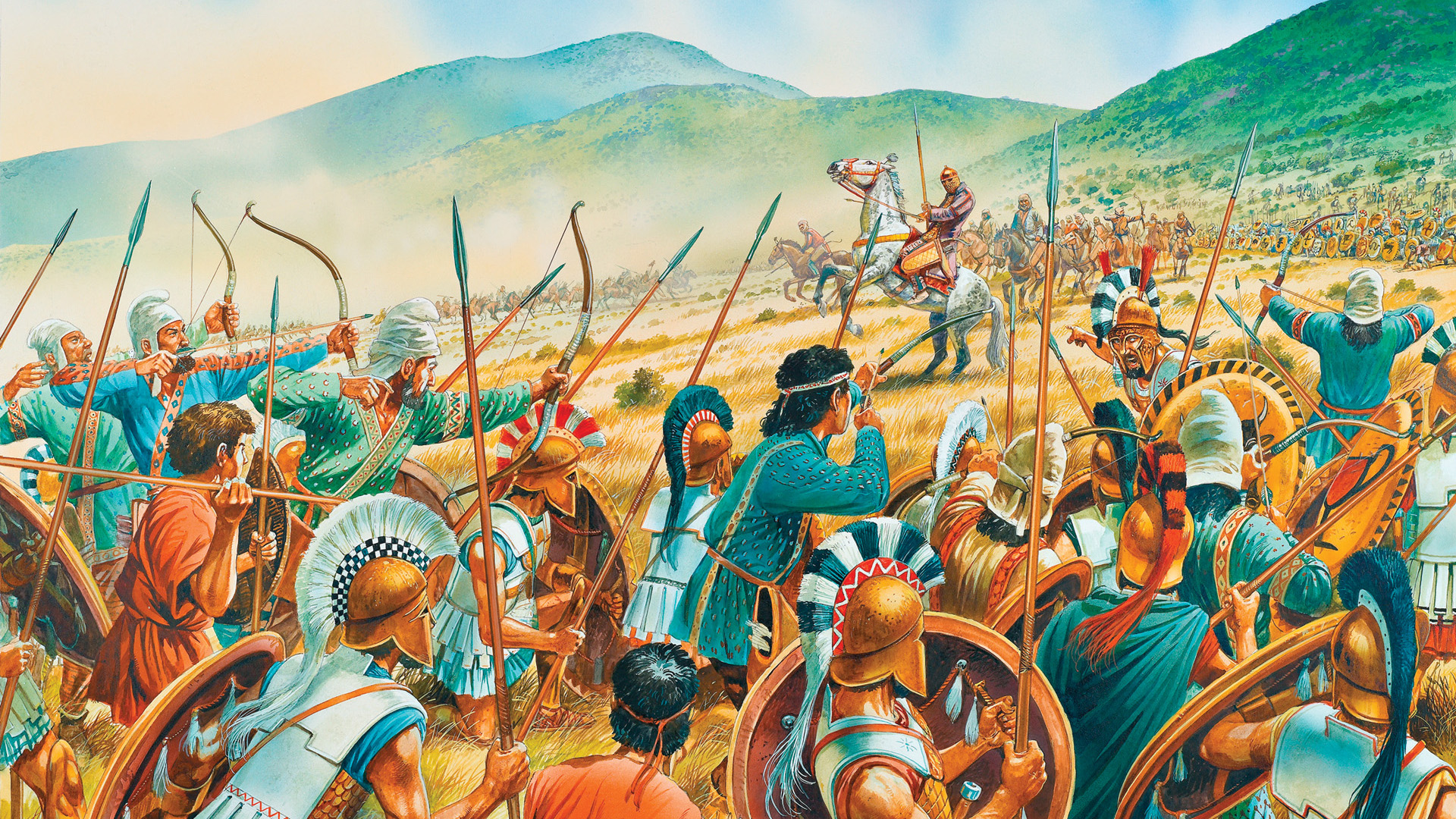
- On the Greek right, the Spartans and their allies from Tegea found themselves isolated and facing the main body of the Persian infantry, including the elite Immortals.
The fighting was savage. The Persians planted their large wicker shields to form a defensive wall and showered the Spartans with arrows. Pausanias waited for favorable sacrificial omens, and for long minutes, the Spartans endured the missile storm, taking heavy casualties. Then, the Tegeans charged, and the omens turned. The Spartans advanced.
Plataea 479 BCE: How Sparta Took Revenge for the 300
The channel 'The Dark Age Record' provides a powerful, narrative-driven account of the battle's climax. This clip vividly describes the clash between the Spartan phalanx and the Persian line.
Watch from 14:02 to 25:20. This is the heart of the battle. Notice the contrast in equipment and tactics, and listen for the description of the turning point: the death of Mardonius.
As you saw, the Spartan phalanx was unstoppable. Their superior bronze armor, heavy shields, and longer spears were devastating against the lightly armed Persians in close combat. The turning point came when Mardonius, conspicuous on his white charger, was killed by a Spartan warrior named Arimnestus. With their leader's death, Persian morale shattered. The command structure collapsed, and what had been a fight became a rout.
5. Annihilation at the Camp
The surviving Persians fled back to the safety of their wooden-walled camp. The Spartans pursued but, being unskilled in siege warfare, could not breach the defenses.
Soon after, the Athenians arrived. Having defeated the Thebans on their flank, they brought their experience in assaulting fortifications to bear. They tore down a section of the palisade, creating a breach. The Greeks poured into the camp. What followed was not a battle, but a massacre. Trapped and leaderless, the Persian army was annihilated. The invasion of Greece was over.
Plataea 479 BC - Greece's Bloodiest battle - 2nd Persian invasion
Let's watch the conclusion of the battle from HistoryMarche, showing the assault on the Persian camp.
Watch from 26:36 to 29:51. This section covers the final storming of the camp and the simultaneous naval victory at Mycale, which truly ended the war.
Test your understanding!
In our last lesson, we saw that the victory at Salamis was a masterpiece of strategic planning and deception by the general Themistocles.
Was the victory at Plataea also the result of a brilliant pre-battle strategy by the Greek commander Pausanias? Or was it due to other factors?
Show answer
While Pausanias showed good leadership, the victory at Plataea was less about a brilliant pre-conceived plan and more about what happened when things went wrong. The battle was actually triggered by a chaotic and failed Greek withdrawal. The victory was ultimately won by the superior equipment, discipline, and fighting prowess of the individual Greek hoplite, especially the Spartans and Tegeans, in a brutal, close-quarters melee. It was a soldier's victory, born of grit and discipline, rather than a general's victory, born of grand strategy.
Conclusion
The Battle of Plataea was the final, bloody act of the great Persian invasion. While Salamis had broken the Persian navy and turned the strategic tide, Plataea destroyed its land army and ended the threat once and for all. On the same day, the Greek fleet won another victory over the remnants of the Persian navy at Mycale on the Ionian coast, confirming Greek dominance. The freedom of the Greek city-states was secured.
Key Takeaways:
- A Soldier's Victory: Unlike the strategic finesse of Salamis, Plataea was a brutal, grinding infantry battle won by the superior discipline, training, and armor of the Greek hoplite.
- The Spartan Phalanx: The battle was the ultimate vindication of the Spartan military system. The phalanx held firm under a massive missile barrage and then advanced to smash the Persian line.
- Decisive Leadership: While Mardonius's decision to charge a seemingly broken army was a gamble, his death was the pivotal moment that caused the Persian will to collapse.
- End of the Invasion: The annihilation of Mardonius's army at Plataea marked the definitive end of Xerxes's ambition to conquer Greece. Never again would a Persian king attempt a full-scale invasion of the Greek mainland.
Preview of the Next Lesson:
With the existential threat from Persia removed, a new chapter began for Greece. The question shifted from "How do we survive?" to "What comes next?". In the aftermath of the war, the Greek cities of the Aegean, liberated but still fearful of Persia, needed a protector. Sparta was reluctant to commit to long-term overseas operations. Athens, with its powerful navy and newfound prestige, was ready to step into that role. This will lead us directly to the formation of the Delian League, the subject of our next lesson.