Hello! Welcome back to our journey through the Greco-Persian Wars.
In our last lesson, we witnessed the heroic but ultimately tragic defeat at Thermopylae. The strategic stand in the "Hot Gates" served its purpose as a delaying action and a powerful symbol, but it could not stop the Persian advance. With the land route open and the Greek fleet having withdrawn from Artemisium, nothing stood between Xerxes' army and Athens. The city was evacuated, and its citizens watched from the nearby island of Salamis as the Persians put Athens to the torch. For many in the Greek alliance, the war seemed lost.
Today, we will see how one man’s strategic brilliance turned this moment of desperation into the war’s most decisive turning point. Our learning outcome is to explain Themistocles' naval strategy and the decisive Greek victory at the Battle of Salamis. We will explore how foresight, a deep understanding of naval warfare, and a magnificent deception combined to save Greece.
1. The Strategist and His Vision
To understand Salamis, we must first understand its architect: Themistocles of Athens. In an era that produced many great generals, Themistocles stands out as a true strategos—a master of grand strategy who could connect long-term political goals with battlefield tactics.
The Battle of Salamis: Themistocles and the Birth of Strategy
This article from The Strategy Bridge, 'The Battle of Salamis: Themistocles and the Birth of Strategy', provides an excellent profile of Themistocles. It frames him not just as a general, but as a visionary who saw the long-term picture.
Read the first part of the article, from the beginning down to the paragraph ending '...Themistocles spoke for Athens.' Focus on how Themistocles' early actions, like fortifying the Piraeus port, demonstrate his long-term strategic thinking.
Themistocles' greatest act of foresight came years before Xerxes' invasion. A massive lode of silver was discovered in the Laurion mines near Athens. While others wanted to distribute the windfall to the citizens, Themistocles persuaded the Athenian assembly to make a far more difficult investment: funding the construction of a new fleet of 200 warships. This decision would not just save Athens; it would save Greece.
Let's look at the "weapon system" that this silver bought.
Salamis 480 BC: The Battle for Greece
The video 'Salamis 480 BC' from Epic History provides a superb overview of the trireme, the state-of-the-art warship that formed the backbone of the Athenian navy.
Watch from 07:15 to 10:25. The first part (until 08:00) explains the crucial decision to build the fleet. The second part details the design of the trireme, its crew, and its primary tactic: ramming.
The trireme was a specialized tool built for a specific job. Light, fast, and agile, it was essentially a water-borne missile, with 170 rowers providing the engine to drive a bronze-sheathed ram into an enemy hull. Understanding this ship is key to understanding Themistocles' strategy.
2. Setting the Trap: Strategy, Persuasion, and Deception
Following the fall of Thermopylae, the Greek fleet retreated to the island of Salamis, where the population of Athens had been evacuated. The situation was grim. Athens was burning. The Peloponnesian allies, led by the Spartan commander Eurybiades, wanted to withdraw the fleet to the Isthmus of Corinth and make a last stand there.
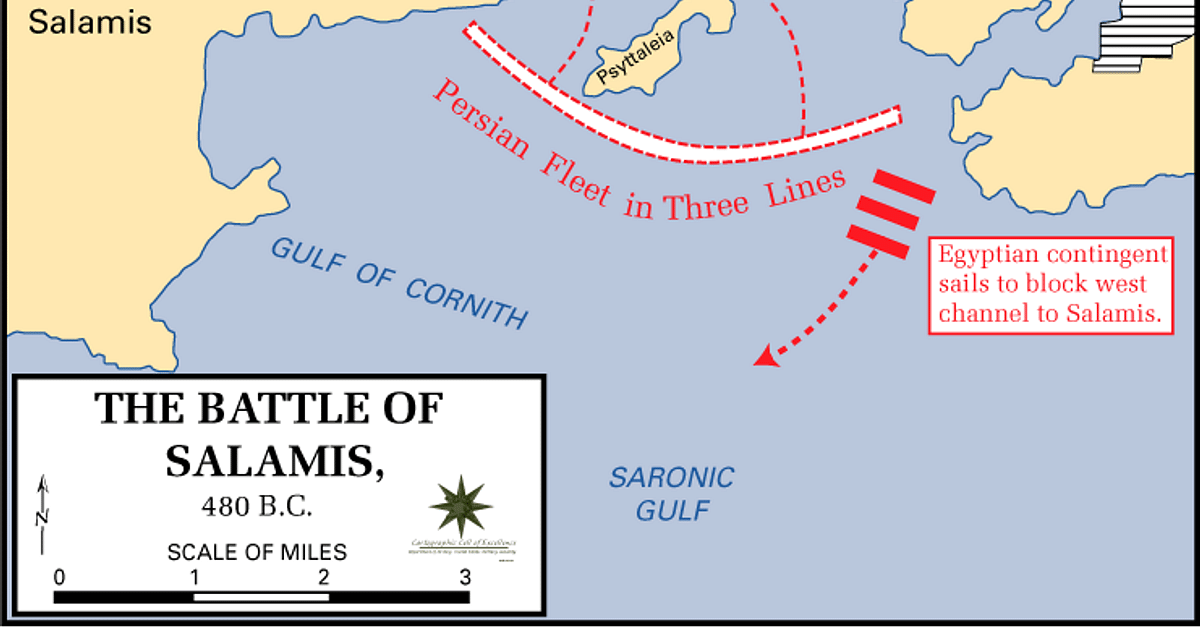
Themistocles argued fiercely against this. He knew that in the open sea, the larger and more numerous Persian fleet would easily outmaneuver and annihilate the Greeks. His strategy was a naval version of Thermopylae: use geography as a force multiplier. He insisted they fight in the narrow straits between the island of Salamis and the mainland. Here, the Persians' numbers would become a disadvantage, leading to confusion and preventing them from bringing their full force to bear.
Persuading his panicked allies was one of his greatest challenges.
The Battle of Salamis: Themistocles and the Birth of Strategy
Let's return to the Strategy Bridge article to see how Themistocles held the wavering alliance together and set his plan in motion.
Read the sections beginning 'Even though Athens thus far had been a leader...' and ending '...she was overruled.' Notice the two critical arguments Themistocles used: first, the threat to withdraw the entire Athenian fleet, and second, the act of deception.
This act of deception was Themistocles' masterstroke. Fearing the Peloponnesians might still flee during the night, he sent a trusted servant to Xerxes with a secret message. The message claimed the Greeks were terrified and planned to flee at dawn. It advised Xerxes to block the straits immediately to trap them.
The ruse worked perfectly because it told Xerxes exactly what he wanted to believe. He took the bait.
3. The Battle: Chaos in the Narrows
At dawn, the Persian fleet entered the straits, their crews already tired from a night of rowing. They expected to hunt down a fleeing, disorganized enemy. Instead, they were greeted by the sight of the Greek fleet, fresh and in battle formation, singing their paean (battle hymn) as they rowed to meet them. Xerxes, watching from a golden throne on the mainland, was about to witness the systematic destruction of his navy.
Salamis 480 BC: The Battle for Greece
This clip from Epic History masterfully narrates the course of the battle, showing exactly how Themistocles' strategy unfolded.
Watch from 17:12 to 22:48. Pay close attention to how the narrow space caused the Persian ships to become a liability to each other and how the heavier Greek triremes dominated the engagement.
As you saw, the battle was a scene of utter chaos for the Persians.
- Constrained Space: The narrow straits prevented them from using their numbers or superior speed.
- Disorganization: Ships trying to advance collided with ships trying to retreat, all under the watchful eye of their king, which likely prompted reckless charges.
- Superior Tactics: The Greeks, likely feigning a brief retreat to draw the Persians in further, used their heavier ships and superior seamanship to ram and board the enemy vessels. The changing wind and sea conditions, familiar to the Greeks, also worked against the Persians.

Test your understanding!
The Greek victory at Salamis was not a matter of luck. It was the result of a deliberate strategy. Can you list the three main pillars of Themistocles' strategy that led to this victory?
Show answer
- The Right Tool (The Fleet): Years of foresight gave Athens a large, modern fleet of triremes perfectly designed for ramming tactics.
- The Right Location (The Straits): Choosing to fight in the narrow straits of Salamis negated the Persian numerical advantage and turned it into a weakness.
- The Right Circumstances (The Ruse): Using deception, Themistocles tricked Xerxes into initiating the battle on Greek terms and ensured the reluctant Greek allies had no choice but to fight.
4. The Aftermath: A Decisive Victory
The Persian losses were catastrophic: around 200 ships and thousands of men lost, compared to only about 40 Greek ships. More importantly, the battle was a decisive strategic victory. Xerxes' navy was shattered.
Fearing that the victorious Greek fleet might now sail to the Hellespont and destroy his bridge of boats, cutting off his army's line of retreat, Xerxes made a fateful decision. He took the bulk of his army and returned to Asia. The immediate threat of the conquest of all of Greece was over.
Salamis 480 BC: The Battle for Greece
Let's watch the final segment from Epic History to understand the immediate consequences and historical significance of the battle.
Watch from 22:30 to 25:37. This part summarizes the outcome and explains why Salamis is considered one of the most decisive battles in history.
Conclusion
The Battle of Salamis stands as a masterclass in naval strategy. Faced with a seemingly hopeless situation, Themistocles refused to yield to despair. He leveraged his tools (the triremes), his environment (the straits), and his understanding of his enemy's psychology (the ruse) to engineer a victory that changed the course of the war and, arguably, of history.
Key Takeaways:
- Themistocles' Strategic Vision: His genius lay in his long-term planning (building the fleet), his ability to identify the decisive point (the straits), and his willingness to use deception to achieve his goals.
- Geography as a Weapon: Like at Thermopylae, the Greeks used terrain to turn their weakness in numbers into a strength. Salamis shows that this principle applies as much at sea as it does on land.
- A Decisive Victory: Salamis crippled the Persian navy, eliminating its ability to support the land army and threatening Xerxes' line of retreat. This forced the Great King to withdraw, fundamentally altering the strategic situation and shifting the momentum of the war in favor of the Greeks.
Preview of the Next Lesson:
While Xerxes retreated to Asia, he did not abandon the war entirely. He left his top general, Mardonius, in charge of a large, elite land army with orders to finish the conquest the following year. The final, bloody chapter of the Persian invasion of Greece would be written not at sea, but on the plains of a place called Plataea.