Hello!
In our last lesson, we dissected the three epic field battles—Granicus, Issus, and Gaugamela—where Alexander's tactical genius shattered the main armies of the Persian Empire. Despite these stunning victories, King Darius III was still at large, and a significant portion of his empire's power remained intact. Alexander, ever the strategist, knew that chasing Darius deep into Asia while leaving a major threat in his rear would be a catastrophic mistake.
This lesson focuses on how Alexander addressed that threat. We'll shift our focus from open-field battles to siege warfare, another critical component of your interest in military history. We will analyze the strategic importance of two legendary sieges: Tyre and Gaza. You'll see how Alexander solved a seemingly impossible strategic problem—how to defeat a superior navy from land—through sheer will, brilliant engineering, and calculated brutality. This campaign along the Mediterranean coast was essential for securing his conquests and enabling his future advance into the heart of Persia.
The Strategic Dilemma: Winning the Sea from the Land
After the Battle of Issus, Alexander had a choice: pursue the fleeing Darius eastward or secure the Mediterranean coast behind him. He chose the latter. Why? The Persian Empire still controlled the seas. Their powerful fleet, largely crewed by the skilled mariners of the Phoenician cities (like Tyre), Cyprus, and Egypt, roamed the Aegean. This fleet posed a direct threat to Alexander's supply lines and could potentially foment rebellion back in Greece.
Alexander's own navy was small and no match for the combined Persian fleet in a head-on naval battle. His solution was as elegant as it was audacious: if you can't defeat an enemy's fleet at sea, take away the ports they need to operate.
Siege of Tyre: Alexander the Great's Assault on the Persians
This article from Warfare History Network provides an excellent summary of Alexander's strategic predicament after Issus and the logic behind his coastal campaign. It sets the stage perfectly for the events to come.
Please read the beginning of the article, up to the subheading 'Tyrians Deny Macedonians Entry'. Focus on the section that explains why Alexander dared not venture into the interior while the Mediterranean seaboard was still controlled by forces loyal to the Persian king.
As the article explains, Alexander's grand strategy was to win control of the seas by winning control of the coastline. By capturing every major naval base along the eastern Mediterranean, he would effectively strand the Persian fleet, which could not stay at sea indefinitely without places to re-supply, repair, and shelter. This plan led him south along the coast of Phoenicia, where most cities, awed by his victory at Issus, surrendered. But one city would not: Tyre.
The Siege of Tyre (332 BC): An Engineering Marvel
Tyre was the jewel of Phoenicia. A wealthy trading hub, it was built on an island half a mile offshore, protected by walls that were reportedly 150 feet high in places. Its inhabitants were proud, confident in their island's defenses, and masters of the sea. They had famously withstood a 13-year siege by the Babylonian king Nebuchadnezzar. They believed they could outlast Alexander, too.
Let's watch a video that provides a comprehensive narrative of this incredible siege. It captures the back-and-forth struggle and the immense scale of the undertaking.
Siege of Tyre 332 BC - Alexander the Great DOCUMENTARY
This documentary from Kings and Generals covers the entire seven-month Siege of Tyre, from the initial strategic decision to the final, brutal assault. It's a fantastic visual story that complements the reading.
Watch the entire video (approximately 24 minutes). As you watch, pay attention to the escalating series of problems and solutions: The Cause (00:02:01): Why Alexander needed to take Tyre. The Refusal (00:04:09): The diplomatic exchange that triggered the siege. The Mole (00:06:49): The initial engineering plan and the Tyrian counter-attacks, including the fireship. The Fleet (00:11:34): Alexander's crucial decision to build his own navy. The Assault & Aftermath (00:16:54): The final breach and the fall of the city.
The siege was a step-by-step exercise in overcoming immense obstacles, a process that might resonate with the iterative problem-solving involved in a complex engineering project.
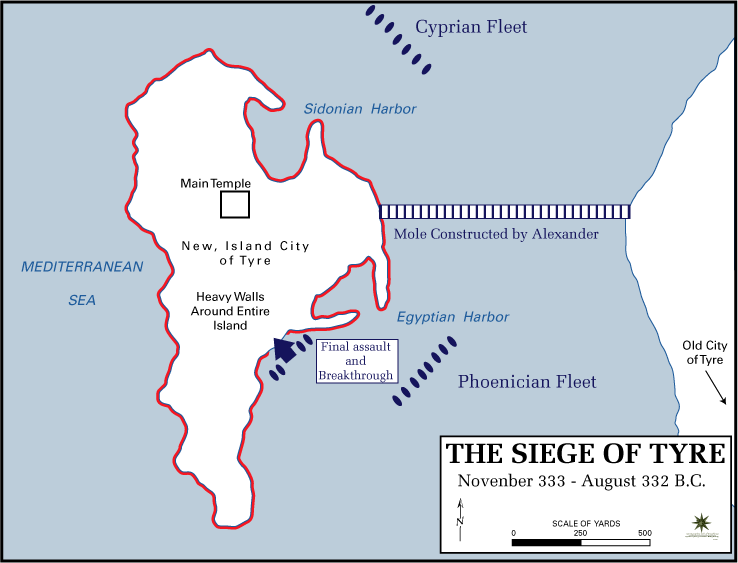
Let's break down the key strategic phases:
- The Mole: Alexander's initial plan was to build a 200-foot-wide land bridge across the sea to the island. This was an unprecedented feat of military engineering. Materials were sourced by dismantling the old city of Tyre on the mainland. Initially mocked by the Tyrians, the mole's steady progress soon turned derision into alarm.
- Tyrian Resistance: The Tyrians didn't just wait. They used their naval superiority to harass the workers on the mole with missile fire from ships. Alexander built siege towers to protect his men, but the Tyrians responded with a brilliantly executed attack, using a "fire ship" to set the towers and the mole ablaze. This was a major setback.
- The Strategic Shift: Alexander recognized that he could not take Tyre without challenging its control of the sea. Leaving his generals to rebuild the mole even wider than before, he went north to Sidon. There, his fortunes turned. The kings of the other Phoenician cities and Cyprus, seeing which way the war was going, defected from the Persians and brought their fleets—some 200 warships in total—to Alexander's side.
- The Final Assault: With his new fleet, Alexander now controlled the sea. He blockaded Tyre's harbors, cutting the city off completely. The mole was completed, and after weeks of relentless assaults by siege engines on the mole and from ships, a breach was finally made in the southern wall. Alexander himself led the charge into the city.
The fall of Tyre was followed by a brutal sack. Thousands were killed, and an estimated 30,000 survivors were sold into slavery. The victory was strategically decisive. It didn't just remove a single base; it broke the back of Persian naval power. With the Phoenician fleet now on his side, the Persian threat in the Aegean Sea evaporated.

The Siege of Gaza (332 BC): Clearing the Path to Egypt
With Tyre conquered, only one major obstacle remained between Alexander and the prize of Egypt: the fortified city of Gaza. Built on a high mound, it was the last Persian stronghold in the region and controlled the main coastal road. Its governor, a eunuch named Batis, was loyal to Darius and refused to surrender.
Siege of Tyre: Alexander the Great's Assault on the Persians
The article from Warfare History Network also covers the subsequent Siege of Gaza. This section highlights its importance and the brutality of its conclusion.
Read the final section titled 'Taking Gaza, Last Obstacle To Egypt'. Note how this siege, though shorter, was still a significant undertaking and how Alexander's fury at the resistance manifested.
The two-month siege of Gaza was another difficult affair. Alexander was wounded during the fighting, which only fueled his rage. When the city finally fell, the male population was slaughtered, and the women and children were sold into slavery. In a shocking act of cruelty mirroring a scene from his beloved Iliad, Alexander had the governor Batis dragged behind his chariot until he was dead.
The fall of Gaza was strategically important because it cleared the last hurdle on the path to Egypt. The Persian governor of Egypt, seeing no hope of reinforcement, surrendered the entire province without a fight. Alexander was welcomed as a liberator and crowned Pharaoh, gaining control of Egypt's immense wealth and grain resources.
Test your understanding!
Alexander could have pursued Darius immediately after the Battle of Issus. Instead, he spent over a year securing the Mediterranean coast. From a strategic perspective, what catastrophic risk did he mitigate by undertaking the difficult sieges of Tyre and Gaza first?
Show answer
By securing the coast, Alexander mitigated the risk of being cut off from his home base in Macedonia and Greece. The powerful Persian navy, based in cities like Tyre, could have disrupted his supply lines, transported enemy troops to his rear, and supported anti-Macedonian revolts in Greece. Capturing the naval bases neutralized the Persian fleet without needing to defeat it in a major sea battle. This secured his strategic rear, allowing him to march into the heart of Persia with confidence that his empire was safe behind him.
Conclusion
The sieges of Tyre and Gaza were not mere side-shows; they were fundamental to the success of Alexander's entire campaign. They showcase a different facet of his military mind—not the lightning-fast cavalry charges of the open field, but a relentless, problem-solving determination in the face of incredible engineering and logistical challenges.
Key Takeaways:
- Strategic Priority: Alexander understood that securing his lines of communication and neutralizing the enemy's naval power was more important than immediately pursuing the defeated Persian king.
- Winning the Sea from Land: His coastal campaign was a brilliant strategic concept to defeat a navy by capturing its essential land bases.
- The Fall of Tyre: This seven-month siege was a triumph of engineering, persistence, and strategic adaptation (acquiring a fleet mid-siege). Its capture effectively broke Persian sea power in the Mediterranean.
- The Fall of Gaza: This victory removed the final obstacle to conquering Egypt, a vital source of wealth and a cornerstone of his new empire.
Preview of the Next Lesson:
With the entire Mediterranean coast secured and the wealth of Egypt at his disposal, Alexander was finally ready to turn east and settle his account with Darius III. In our next lesson, we will follow the dramatic pursuit and death of the last Achaemenid king and explore how Alexander began the complex task of ruling his vast, new, multicultural empire.