Hello!
In our last lesson, we examined the brutal but strategically vital sieges of Tyre and Gaza. By conquering the Eastern Mediterranean coastline, Alexander neutralized the Persian navy and secured his lines of communication back to Greece. With his rear protected and the vast wealth of Egypt now under his control, he was finally free to turn his full attention eastward and deal with King Darius III.
This lesson picks up after the decisive Battle of Gaugamela. We'll follow the final, dramatic chapter in the life of Darius—a thrilling cross-country pursuit that ends in betrayal and death. Then, we will analyze the brilliant political strategy Alexander employed to transition from foreign conqueror to the legitimate Great King of Persia. This story combines the high-stakes military action you're interested in with the deep analytical statecraft that defines Alexander's genius.
The Conqueror in the Capitals
After his crushing defeat at Gaugamela, Darius fled eastward into the mountains of Media, hoping to raise a new army in the empire's vast eastern provinces. Alexander, however, did not give immediate chase. Instead, he made a calculated decision to march on the political and economic centers of the Persian Empire: Babylon and Susa.
This phase of the campaign was as much about politics as it was about military conquest. To understand Alexander's actions after Gaugamela and his initial steps toward becoming the new king, please watch the beginning of this documentary.
Battle of the Persian Gate 330 BC - Alexander the Great DOCUMENTARY
This video from Kings and Generals, 'Battle of the Persian Gate 330 BC', opens by detailing Alexander's moves after Gaugamela. It shows how he immediately began the process of winning over his new subjects and consolidating his power.
Watch the first four minutes of the video (00:00 - 04:18). Pay close attention to Alexander's reception in Babylon and his decision to allow the Persian satrap, Mazaeus, to retain his post. This is a key indicator of his future policy.
As you saw, Alexander was welcomed as a liberator in Babylon. His decision to keep Mazaeus, a Persian who had fought against him at Gaugamela, in power was a masterful political stroke. It signaled to the Persian aristocracy that their future was not necessarily one of destruction; cooperation with the new power could be beneficial. After securing Babylon and the immense treasury at Susa (some 50,000 talents of gold and silver), Alexander set his sights on the ceremonial heart of the empire: Persepolis.
The march to Persepolis was not unopposed. In a narrow pass known as the Persian Gate, a small Persian force under the satrap Ariobarzanes mounted a heroic last stand. The battle was a stark reminder that pockets of fierce resistance remained.
Battle of the Persian Gate 330 BC - Alexander the Great DOCUMENTARY
Let's continue with the same video to see the dramatic battle at the Persian Gate and the controversial events that followed in Persepolis.
Watch from 04:18 to 17:07. This section covers the difficult mountain crossing, the ambush at the Persian Gate, and the eventual capture and burning of Persepolis. Note the conflicting accounts of why the palace was destroyed.
The burning of the great palace at Persepolis remains one of history's great debates. Was it a drunken act of vandalism, as some ancient sources claim, sparked by an Athenian courtesan named Thais? Or was it a calculated act of political theater—the ultimate revenge for the Persian burning of Athens 150 years earlier, meant to signal the definitive end of the Achaemenid dynasty?
Regardless of the motive, the message was clear: the old empire was finished. After four months in Persepolis, Alexander turned north. The time had come to find Darius.
The Great Pursuit
What followed was one of the most relentless pursuits in military history. This part of the story is less about grand battles and more about sheer endurance, speed, and determination—a manhunt across hundreds of miles of unforgiving terrain.
To get a feel for the incredible pace and logistics of this chase, the following blog post provides a vivid, step-by-step account.
Alexander in hot pursuit of Darius
This post, 'Alexander in hot pursuit of Darius', provides an excellent narrative of the chase, breaking it down into geographical stages and highlighting the logistical challenges. Its storytelling approach will give you a real sense of the drama.
Please read the sections detailing the pursuit, starting from when Alexander leaves Ecbatana up to the point where Darius is killed. Focus on the incredible distances covered and Alexander's decision to press on with a lightened, faster force.
Now, let's watch the cinematic conclusion of this epic chase.
Battle of the Persian Gate 330 BC - Alexander the Great DOCUMENTARY
The 'Battle of the Persian Gate' documentary also covers this final phase, perfectly complementing the reading.
Watch from 17:07 to 21:20. This segment vividly portrays the conspiracy against Darius, Alexander's breakneck final pursuit, and the discovery of the dying king.
The scene is heavy with historical irony. Darius III, the Great King, ruler of the largest empire the world had ever seen, was not killed by his conqueror, but by his own treacherous subjects. Bessus, his kinsman and satrap of Bactria, had him arrested and, when Alexander's rescue force closed in, ordered him stabbed and left for dead in a wagon.

Alexander's reported grief was likely genuine, but it was also politically astute. By honoring his fallen enemy, he positioned himself not as a destroyer, but as a dignified successor.
Becoming the King of Kings
With Darius dead, Alexander faced a new challenge. His original mission—the pan-Hellenic war of revenge against Persia—was complete. Many of his soldiers expected to go home. But Alexander's ambition was now far greater. He didn't just want to defeat Persia; he wanted to rule it. To do this, he needed to establish his legitimacy in the eyes of his new subjects. This required a multi-pronged political strategy.
1. The Avenger of the Rightful King
Darius's murder gave Alexander the perfect justification to continue his campaign. Bessus declared himself the new Great King, Artaxerxes V. Alexander could now frame his continued war not as a foreign conquest, but as a righteous mission to hunt down and punish a usurper and regicide. This transformed him from the enemy of the Persian king into the avenger of the legitimate Persian dynasty.
2. The Adoption of Persian Customs ("Persianization")
To be accepted as the new king, Alexander began to adopt the symbols and ceremonies of Persian royalty. This was a radical and controversial move.
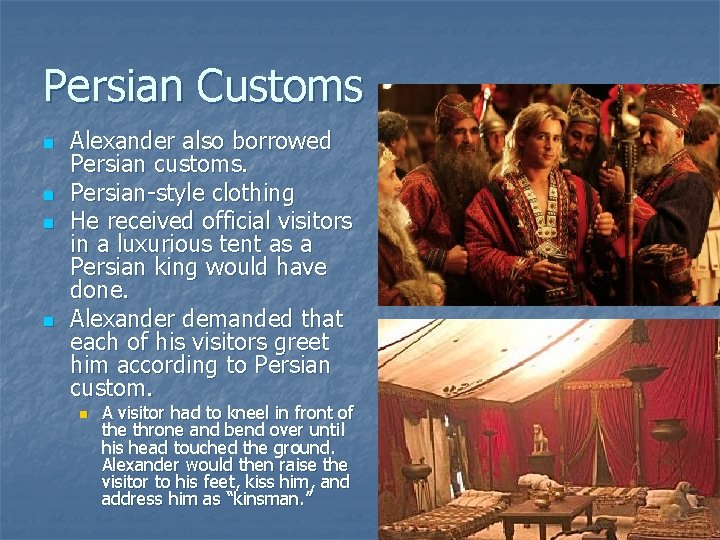
This "Persianization" was a delicate balancing act. While it helped him win over the Persian elite, it caused significant friction with his own Macedonians. For a Greek, proskynesis was an act reserved for a god, and they saw Alexander's demand for it as a sign of him becoming a "barbarian" tyrant.
To explore this complex process of cultural fusion and political maneuvering, let's turn to a video dedicated to the topic.
Persianization of Alexander the Great - Ancient History DOCUMENTARY
The Kings and Generals documentary 'Persianization of Alexander the Great' examines how he blended Greek and Persian traditions to solidify his rule. It explains the purpose behind these controversial actions.
Watch the segment from 04:50 to 15:13. This covers his appeal to local traditions, his vision of being 'King of Asia', his engagement with Zoroastrianism, and his continuation of the Achaemenid administrative system.
3. The Continuation of Achaemenid Administration
As the video and other sources highlight, Alexander was not an anarchist. He was a state-builder. He understood that the vast Persian Empire had a sophisticated and effective administrative system that had worked for centuries.
How Alexander the Great Conquered the Persian Empire
To understand the political theory behind Alexander's strategy, this analytical article, 'How Alexander the Great Conquered the Persian Empire,' is very insightful. It frames his entire campaign as a political project to replace Darius.
Read the section titled 'Alexander’s Politics and the Clausewitzian Trinity'. It explains his policy of retaining existing political structures, like the satrapy system, to ensure a quick and peaceful transition of power.
By keeping the satrapy system and even re-appointing Persian nobles who swore allegiance to him, Alexander ensured the empire continued to function. Taxes were collected, order was maintained, and the machinery of government kept running, but now it all served him. This policy, which historian Pierre Briant called making Alexander "the last of the Achaemenids," was crucial for a stable transition of power.
Test your understanding!
Alexander used a three-part strategy to assume the title of Persian King. He acted as the "Avenger," the "Successor," and the "Administrator." Which of these three roles do you think was most crucial for securing the loyalty of the Persian ruling class, and why?
Show answer
While all three were important, the role of "Administrator" was likely the most crucial for securing the loyalty of the Persian ruling class on a practical level. By keeping the satrapy system and allowing Persian nobles to retain their power, wealth, and status in exchange for loyalty, he gave them a powerful incentive to support his regime. It demonstrated that his rule was not a revolution that would destroy their way of life, but a change of leadership at the top. The "Avenger" role provided immediate justification, and the "Successor" role provided symbolic legitimacy, but the "Administrator" role provided the concrete self-interest that underpins most political allegiance.
A Reassessment of Darius
History is often written by the victors, and Darius III is frequently portrayed as a weak and cowardly king who fled from two major battles. However, modern historians have begun to challenge this simplistic view.
Battle of the Persian Gate 330 BC - Alexander the Great DOCUMENTARY
Before we conclude, let's briefly revisit the character of Darius with a more balanced perspective.
Watch the short analysis of Darius's reign from 21:20 to 24:14. It offers a counter-argument to the traditional narrative of his incompetence.
As the analysis points out, Darius was a competent ruler who faced an extraordinary opponent. His retreats at Issus and Gaugamela were arguably the only sound strategic choices when faced with the collapse of his lines. His ability to raise two massive armies in a short time speaks to considerable organizational skill. He was not a military genius on par with Alexander, but he was far from the incompetent coward of popular legend.
Conclusion
This lesson traced the end of one empire and the true beginning of another. The pursuit of Darius was a testament to Alexander's indomitable will and the incredible endurance of his army. The king's pathetic death, at the hands of his own men, provided Alexander with the perfect opportunity to pivot.
Key Takeaways:
- The Pursuit: Alexander's chase after Darius was a masterpiece of speed and logistics, demonstrating his relentless drive.
- The End of Darius: Darius's murder by his own satrap, Bessus, gave Alexander a legitimate reason (casus belli) to continue his campaign as the avenger of the rightful king.
- Assumption of Kingship: Alexander became the new Great King through a brilliant combination of strategies:
- Vengeance: Hunting down the usurper Bessus.
- Cultural Adoption: Using Persian royal customs and symbols to appear as a legitimate successor.
- Administrative Continuity: Maintaining the Persian satrapy system to ensure stability and co-opt the ruling elite.
- A New Vision: Alexander's goal shifted from simply defeating Persia to ruling it and creating a new, fused Hellenic-Persian empire.
Preview of the Next Lesson:
The war was not over. Bessus, the murderer of Darius, had fled to the far eastern provinces of Bactria and Sogdiana (modern Afghanistan and Uzbekistan). Alexander now had to march into this wild, mountainous territory to eliminate his rival and subdue the fiercely independent tribes who lived there. In our next lesson, we will cover the grueling campaigns in the east and Alexander's push towards the very edge of the known world: India.