Hello!
In our last lesson, we witnessed the dramatic end of Darius III and explored how Alexander masterfully positioned himself as the legitimate successor to the Persian throne. By hunting down Darius's murderer, honoring his fallen rival, and beginning to adopt the customs of a Persian king, he laid the political groundwork for his new role. But this was just the beginning.
This lesson delves into the grand strategy behind Alexander's state-building: his policies for unifying and controlling his vast, multicultural empire. We will explore two key pillars of his vision: the founding of new cities across Asia and his deliberate attempts to fuse Greek and Persian cultures. This is where Alexander transitions from conqueror to architect of a new world, a process that perfectly blends military pragmatism with ambitious cultural engineering.
Part 1: Founding Cities – Beacons of a New Empire
With the Persian heartland secured, Alexander faced the immense challenge of governing an empire stretching from Greece to the Hindu Kush. A purely military occupation would be unsustainable. His solution was a massive campaign of urbanization, founding dozens of cities, most named Alexandria, throughout his new domains.
These cities were not just vanity projects; they were multifunctional strategic assets designed to secure his conquest for the long term.
- Military Strongholds: Many cities were founded in strategic locations to serve as permanent garrisons. They housed veterans from his campaigns who, in exchange for land, provided a loyal military presence to quell local rebellions and defend the frontiers against outside threats.
- Administrative Hubs: The cities became centers of the new administration, where taxes were collected, justice was dispensed, and trade was regulated. They were the nodes in the network that held the empire together.
- Cultural Transmitters: Each Alexandria was designed as a miniature Greek polis, complete with a gymnasium for education and athletics, a theater for drama, and an agora for public life. They were intended to project Hellenic (Greek) culture deep into Asia.
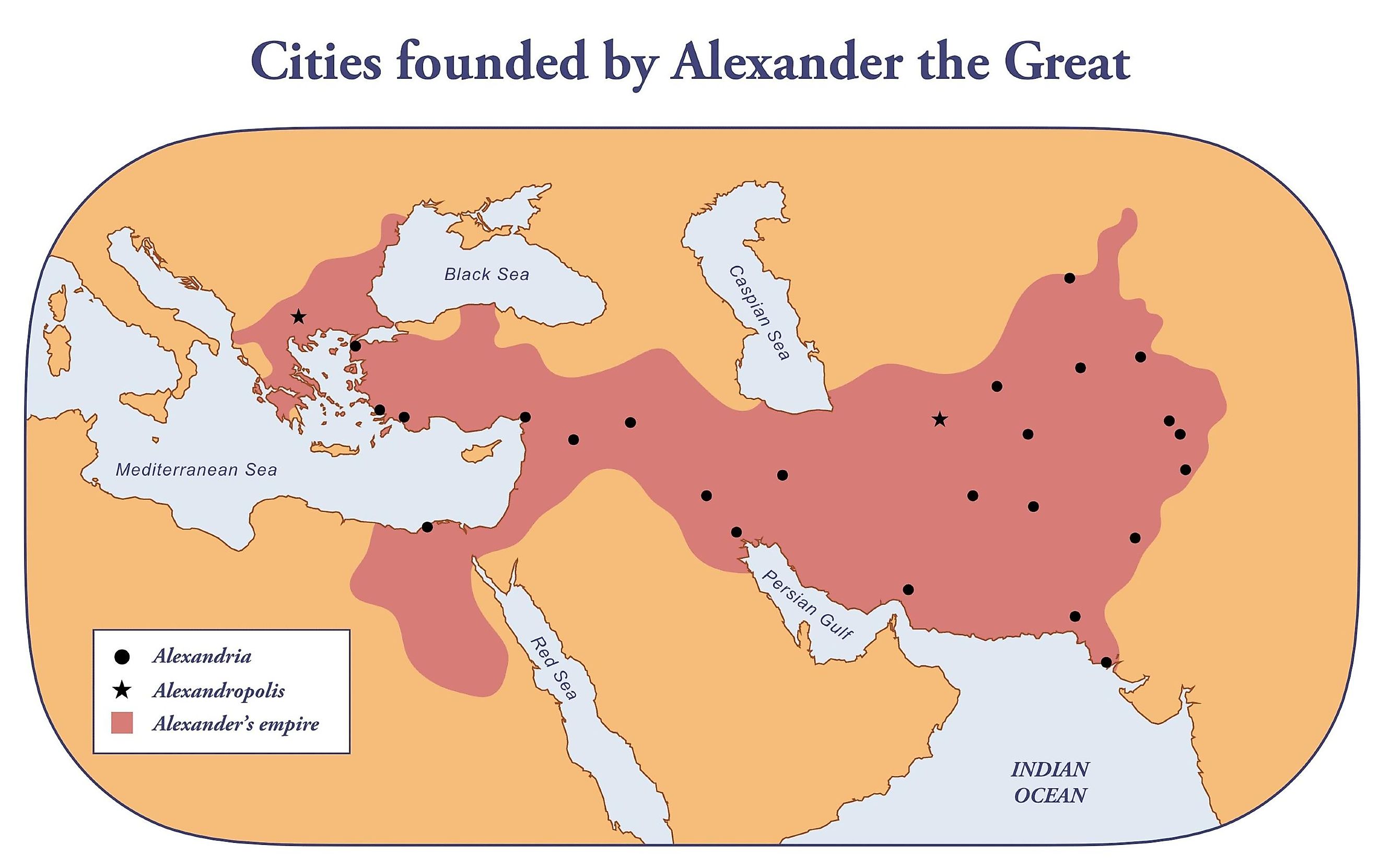
These new urban centers were envisioned as bustling hubs of activity, where Greek colonists and the local population would interact and, ideally, integrate.

A Critical Look at City-Founding
The traditional narrative is that Alexander built these great cities from the ground up. However, historical and archaeological evidence suggests a more pragmatic approach, which would likely resonate with your experience in building complex systems. Often, it's more efficient to adapt and build upon an existing foundation than to start from scratch.
To explore this more nuanced view, please watch the following segments.
How Did Alexander The Great Conquer Ancient Afghanistan? | Alexander's Lost World | Odyssey
This documentary, 'Alexander's Lost World,' offers a critical perspective on Alexander's city-founding. It travels to the region and questions the traditional narrative.
Watch the two short clips from 10:25-11:09 and 24:59-25:49. The host argues that in many cases, Alexander simply conquered, renamed, and fortified existing settlements rather than building entirely new cities.
This doesn't diminish the achievement. By identifying key strategic locations—many of which were already settlements—and infusing them with Greek colonists, institutions, and architecture, Alexander effectively "Hellenized" them, transforming them into loyal power bases. This policy was continued by his successors, the Seleucids, who also founded numerous cities to encourage Greek settlement and maintain control.
Part 2: Fusing Cultures – Creating a New Elite
Founding cities was a way to plant Greek culture in Asia. But Alexander knew he couldn't rule an empire of millions with only his Macedonians. He needed the cooperation of the local elites. His second major policy was a deliberate attempt at cultural fusion, creating a blended Greco-Persian ruling class that would be loyal to him.
This went far beyond simply wearing Persian clothes, as we discussed in the last lesson. It involved three major initiatives.
1. The Policy of Proskynesis and the Epigonoi
As you'll recall, Alexander adopted Persian court ceremonies, most controversially proskynesis (prostrating before the king). While this alienated his Macedonian comrades who saw it as treating a mortal like a god, it was a familiar sign of respect to the Persians.
Even more significant was the creation of the Epigonoi ("the Successors"). This was a unit of 30,000 young Persian noblemen who were trained and equipped in the Macedonian style of warfare. This was a masterstroke of foresight. For his own troops, it was a source of anxiety, as they feared being replaced. For the Persian aristocracy, it was a profound honor, showing that their sons had a future and a place of privilege in the new empire.
The Persian policies of Alexander the Great
To understand the strategic thinking behind these moves, let's turn to an academic analysis. The following text examines how Alexander manipulated perceptions to solidify his rule.
Please read Chapter 5, 'Manipulating Perception' (starts on page 55). It details his adoption of Persian dress and, crucially, discusses the significance of proskynesis and the creation of the Epigonoi as tools for engendering loyalty.
2. Marriage as State Policy: Roxane and the Susa Weddings
Alexander's most personal and dramatic attempt at fusion was his use of marriage as a tool of statecraft.
His first major political marriage was to Roxane, the daughter of a powerful chieftain from the rebellious eastern province of Sogdiana. This was not just a romance; it was a strategic alliance that helped pacify a fiercely independent region.
The following video tells this story with the narrative flair you enjoy, placing it within the context of his brutal campaign in Central Asia.
How Did Alexander The Great Conquer Ancient Afghanistan? | Alexander's Lost World | Odyssey
Let's return to 'Alexander's Lost World' to see the story of his marriage to Roxane.
Watch the segment from 34:02 to 39:49. It frames the marriage as a 'carefully calculated political alliance' to turn an unruly enemy into kin, a far more effective method of securing peace than endless war.
The culmination of this policy came in 324 BC with the Susa Weddings. In a single, extraordinary ceremony, Alexander married Darius's daughter, Stateira. At the same time, he had about 90 of his senior commanders and thousands of his soldiers marry noble Persian women. It was a mass political statement, an attempt to literally breed a new, unified aristocracy.
Persianization of Alexander the Great - Ancient History DOCUMENTARY
The documentary 'Persianization of Alexander the Great' provides a concise overview of this event and its strategic importance.
Watch from 13:35 to 17:40. This section covers the Susa weddings and Alexander's marriage to Roxane, explicitly connecting these acts to his broader policy of integrating the Greek and Persian nobility.
Test your understanding!
Alexander used both city-founding and cultural fusion (like the Susa weddings) to unify his empire. In the context of long-term stability, which policy do you think was more radical and potentially riskier? Why?
Show answer
Both were radical, but the policy of cultural fusion was arguably riskier. City-founding, while ambitious, was an extension of a traditional Greek practice (colonization). It created pockets of Greek culture but could be seen as a form of occupation.
Cultural fusion, on the other hand, directly challenged the core identities of both the Macedonians and the Persians. It required Alexander's own men to abandon their deep-seated prejudice against "barbarians," and it asked the Persian elite to accept their conquerors as equals and family. This policy generated immense friction and resentment within Alexander's own army, as seen in the mutiny at Opis, making it a high-risk, high-reward strategy for creating a truly integrated empire.
The Legacy: A Hellenized World
Historians have long debated Alexander's ultimate motivation. Was he a visionary idealist who dreamed of a "brotherhood of man," a concept the Greeks called homonoia (oneness of mind)? Or was he a hard-nosed pragmatist who simply realized he couldn't rule Persia without the Persians?
This debate mirrors a common dynamic in complex projects: the tension between a grand, unified design and pragmatic, iterative solutions to immediate problems. Whatever his intent, the consequences of his policies were world-altering.
His conquests and the policies of city-founding and cultural fusion shattered the boundaries between the Greek world and the East. The result was Hellenism—the blending of Greek language, art, and philosophy with the cultures of Egypt, Persia, and even India. This cultural syncretism would define the entire region for the next 300 years, long after his empire had fractured. A powerful example is Greco-Buddhism, where Greek artistic styles were used to create the first human-form statues of the Buddha.
Conclusion
In this lesson, we moved beyond Alexander the conqueror to meet Alexander the state-builder. His strategies were audacious, combining pragmatic solutions with a vision of a new kind of empire.
Key Takeaways:
- City-Founding: Alexander founded numerous cities as strategic tools for military control, administrative organization, and the projection of Greek culture throughout Asia.
- Cultural Fusion: Through his personal adoption of Persian customs, the integration of Persians into his army (Epigonoi), and a policy of mass political marriages, Alexander tried to create a single, loyal Greco-Persian ruling class.
- Pragmatism and Vision: While his ultimate motives are debated, these policies were a practical response to the challenge of ruling a vast, diverse empire.
- Hellenistic Legacy: The most enduring result of Alexander's policies was Hellenization, a vibrant cultural blending that shaped the world from the Mediterranean to India for centuries.
Preview of the Next Lesson:
With the eastern provinces of the former Persian Empire subdued, Alexander's ambition drove him still further east. In our next lesson, we will follow him across the Hindu Kush and into a land the Greeks knew only through myth: India. We will cover his challenging campaigns there, the epic Battle of the Hydaspes against King Porus, and the moment when his own weary army finally refused to go any further.