Hello!
In our last lesson, we witnessed a young Alexander secure his throne and pacify Greece with a mix of brutal force and shrewd pragmatism. In the spring of 334 BC, he crossed the Hellespont into Asia, gambling his kingdom's future on a war of conquest against the largest empire the world had ever known. Now, the real test begins.
This lesson dives straight into the heart of your interest in military history. We will analyze the three pivotal battles that shattered Persian power and cemented Alexander's reputation as a military genius: the Granicus, Issus, and Gaugamela. For each battle, we'll examine the unique tactical problem Alexander faced and dissect the brilliant, and often audacious, solution he devised. This is where the legend of Alexander the Great was forged—not just by courage, but by a masterful understanding of the art of war.
The Battle of the Granicus (334 BC): A Shocking Start
Upon entering Asia Minor, Alexander was immediately confronted by an army of Persian satraps (provincial governors). They chose to make their stand at the Granicus River, deploying their forces along the high, steep eastern bank. Their plan was simple: use the river and high ground to stop the Macedonian advance in its tracks. The veteran Macedonian general, Parmenion, advised caution and a dawn crossing. Alexander chose otherwise.
Let's begin with a video that provides an excellent narrative and visual overview of this first, crucial encounter.
The Greatest General in History? Alexander the Great (All Parts)
This video from Epic History TV will set the scene for the Battle of the Granicus. It quickly recaps the army compositions and then walks through the key phases of the battle.
Watch the section on the Battle of the Granicus, which begins at 08:56 and ends at 15:44. Pay close attention to the Persian deployment—placing their cavalry in the front line—and how Alexander initiates his attack despite the terrain disadvantage.
As you saw, the Persians made a critical tactical error by placing their cavalry on the riverbank and their experienced Greek mercenary infantry in the rear. Cavalry is a shock weapon, best used for charging on open ground, not for holding a defensive line from a stationary position. Alexander spotted this weakness and decided to exploit it immediately.
To understand the genius of his attack in more detail, let's look at another video that breaks down the tactical execution of his charge.
Battle of Granicus 334 BC - Alexander's Conquests DOCUMENTARY
The channel Kings and Generals offers a more granular analysis of the battle's opening stages. This will clarify how Alexander used a feint to create the opening he needed.
Watch the clip from 15:16 to 19:20. This section details the vanguard's initial assault, which acted as a feint. Notice how this drew the Persian cavalry out of position, and how Alexander then led the main charge of the Companion Cavalry into the resulting disorder.

Alexander's genius at the Granicus lay in his audacity and his ability to create and exploit a tactical flaw.
- Rejection of convention: He ignored sound advice to attack immediately, relying on the shock and speed of his professional army to overwhelm the enemy.
- The sacrificial vanguard: He sent a smaller force across the river first. This wasn't the main attack; it was a feint designed to provoke the Persians. As expected, the Persian cavalry units converged on this small force, breaking their own battle line in the process.
- The decisive charge: With the Persian line in disarray, Alexander led his elite Companion Cavalry in a wedge formation, charging at an oblique angle into the gap. This allowed him to gain a foothold on the bank and shatter the enemy's formation before they could recover.
The victory was total. Alexander had routed a Persian army on his first attempt, proving his personal courage by fighting in the heart of the action and signaling to the entire Persian Empire that he was a force to be reckoned with.
The Battle of Issus (333 BC): Trapped and Triumphant
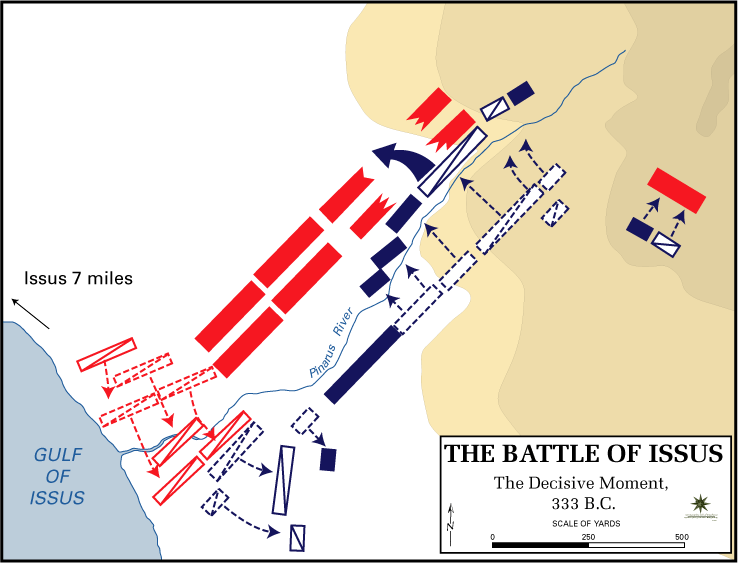
A year and a half later, Alexander faced a much graver threat. The Persian King, Darius III, had personally mustered a massive royal army. In a brilliant strategic move, Darius marched around Alexander's army and seized the town of Issus, cutting the Macedonian supply lines and trapping them against the sea. Alexander was forced to turn back and fight on ground of Darius's choosing: a narrow coastal plain bisected by the Pinarus River.
The narrow battlefield neutralized Persia's vast numerical superiority. However, it also meant Alexander couldn't easily outflank the Persians, and he himself was at risk of being enveloped.
The Greatest General in History? Alexander the Great (All Parts)
Let's return to the Epic History TV video for a clear depiction of the Battle of Issus.
Watch the section from 17:18 to 23:30. Focus on how the terrain dictated the strategy for both sides. Note Alexander's deployment: strengthening his right wing for the attack while tasking his left wing under Parmenion with a difficult defensive holding action.
At Issus, Alexander demonstrated his tactical flexibility and his grasp of psychological warfare.
- Adapting to Terrain: He recognized the battlefield's constraints. He packed his formations onto the narrow plain, with his left flank anchored to the sea.
- Asymmetrical Force Deployment: He entrusted his left flank to his reliable general Parmenion with orders to simply hold against the best of the Persian cavalry. This was a critical holding action. Meanwhile, he massed his elite units—the Companion Cavalry and Hypaspists—on his right flank, where he would lead the decisive attack.
- Targeting the King: Alexander didn't just attack the enemy line; he charged directly at the Persian left-center with the specific goal of reaching Darius III. He understood that the Persian army's command structure was centralized. By threatening the king himself, he could demoralize the entire force.
When Darius saw Alexander's seemingly unstoppable charge carving through his own bodyguards, he panicked and fled. The flight of the king triggered the collapse of the entire Persian army. The battle was a stunning demonstration of how to win when trapped, by using a holding force on one flank while achieving a decisive breakthrough on the other.
The Battle of Gaugamela (331 BC): The Tactical Masterpiece
After his defeat at Issus, Darius spent two years raising another, even larger army. This time, he would not be caught in a narrow pass. He hand-picked a wide, flat plain near Gaugamela for the final showdown, intending to use his overwhelming superiority in cavalry and his scythed chariots to envelop and crush Alexander's smaller force. This was the ultimate tactical challenge Alexander would face. How could his small army survive on an open field against an enemy that could potentially surround it?
The Greatest General in History? Alexander the Great (All Parts)
First, let's watch the overview from Epic History TV to get a sense of the battle's scale and flow.
Watch the segment on Gaugamela from 28:20 to 34:18. Notice Alexander's strange diagonal advance and how he counters the Persian flanking attempts.
The video gives you the narrative, but to truly appreciate the genius behind Gaugamela, we need to analyze the intricate design of Alexander's plan. This was far more than a simple charge; it was a sophisticated system designed to turn Darius's greatest strength—his numbers—into a fatal weakness.
The Battle of Gaugamela, 1 October 331 BC
The following article from 'The Past' provides a superb analysis of Alexander's plan. It breaks down the components of his formation and explains the strategic purpose behind each one.
Please read the sections titled 'Alexander’s plan', 'What happened?', and 'The crisis of the battle'. Focus on understanding the four key elements of his plan: the oblique approach, the echeloned formation, the refused flanks, and the strong reserves. Think of his army not as a line, but as a flexible, multi-layered trap.
Gaugamela showcases Alexander as a master of combined-arms tactics and grand strategy. His plan was a brilliant, calculated response to a seemingly impossible problem:
- The Oblique Advance: By advancing diagonally to the right, Alexander forced the Persian line to move with him. This had two effects: it moved his army away from the ground Darius had cleared for his chariots, and it forced the Persian line to stretch and thin out as it tried to prevent being outflanked.
- Refused Flanks and Reserves: Alexander angled his flanks backward and had a second line of infantry ready. He anticipated being surrounded. This formation could essentially form a defensive square, protecting his army from all sides. He was willing to let the Persians try to envelop him.
- Creating the Gap: The core of the plan was to use the Persian flanking maneuvers against them. As more and more Persian cavalry moved from the center to their own left flank to try and encircle Alexander's right, they inevitably created a weakness—a gap—in their own line near the center, right where Darius was stationed.
- The Decisive Blow (Schwerpunkt): Alexander waited for the precise moment when the gap was exploitable. Then, just as he had at Granicus and Issus, he led the Companion Cavalry in a decisive charge straight into the breach, heading for Darius.
Even though his left flank under Parmenion was nearly overwhelmed, Alexander's central charge once again caused Darius to flee, shattering the Persian army's will to fight. Gaugamela was not a reckless charge, but a masterpiece of battlefield engineering, designed to bait the enemy, absorb pressure, and deliver a concentrated blow at the decisive point.
Test your understanding!
Across the three battles—Granicus, Issus, and Gaugamela—the tactical problem Alexander faced became progressively more difficult. Briefly describe the main challenge in each battle and the core of Alexander's tactical solution.
Show answer
-
Granicus: The challenge was a frontal assault across a river against an enemy on high ground. The solution was an immediate, audacious charge that used a feint to disrupt the enemy's flawed cavalry-first formation, creating an opening for a decisive breakthrough.
-
Issus: The challenge was being trapped in a narrow pass by a larger army that had cut his supply lines. The solution was to use the terrain to his advantage, fighting a holding action on one flank while concentrating his best forces for a decisive charge on the other, aimed directly at the enemy king to break his army's morale.
-
Gaugamela: The challenge was facing a numerically superior army on a wide, open plain designed for envelopment. The solution was a complex combined-arms system: an oblique advance and refused flanks to bait the enemy into stretching their line, creating a gap that he could exploit with a concentrated charge at the decisive point.
Conclusion
Through these three monumental victories, we see the evolution of Alexander's tactical genius. He was not a one-trick pony who simply charged recklessly. He was a master analyst who tailored his approach to the specific problem at hand.
Key Takeaways:
- At the Granicus, he demonstrated sheer audacity and the ability to ruthlessly punish a tactical mistake.
- At Issus, he showed tactical flexibility, adapting his plan to the terrain and using psychological warfare by targeting the enemy commander.
- At Gaugamela, he proved himself a grandmaster of strategy, orchestrating a complex, multi-layered plan to turn an enemy's overwhelming strength into a decisive weakness. This battle is considered an enduring tactical masterpiece.
Preview of the Next Lesson:
With the Persian field armies shattered and Darius III a fugitive, the military conquest of the Persian Empire was essentially complete. But winning the war is one thing; winning the peace is another. In our next lesson, we will follow Alexander's pursuit of the last Persian king and begin to analyze his policies for ruling his vast, multicultural new empire, including the founding of cities and his controversial attempts at cultural fusion.