Hello again!
In our last lesson, we traced the strategic moves that brought the Persian invasion force to the shores of Greece. Having made a brutal example of Eretria, the fleet under Datis and Artaphernes has now landed at the bay of Marathon, just 26 miles from an undefended Athens. An Athenian army, small but determined, has marched out to block them. The stage is set for a confrontation that will echo through history.
Today, we will move from grand strategy to battlefield tactics. Our focus is to describe the opposing forces and the tactical decisions at the Battle of Marathon (490 BC). We will dissect the two armies, compare their strengths and weaknesses, and then walk through the ingenious and daring plan that allowed a small force of citizen-soldiers to challenge the greatest empire on Earth.
1. The Opposing Forces: A Study in Contrasts
The two armies that faced each other across the plain of Marathon could not have been more different in their composition, equipment, and philosophy of war.
The Persian Expeditionary Force
The Persian army was a professional, multinational force drawn from across a vast empire. It was designed for conquest and accustomed to victory.
To understand the scale and nature of this force, let's watch a short segment from a documentary.
The Battle That Saved a Civilization: Marathon (Full Documentary)
The video 'The Battle That Saved a Civilization: Marathon' provides an excellent overview of the Persian army that landed at Marathon. It details their elite units, their command, and their strategic objectives.
Please watch from 16:22 to 21:59. As you watch, note the different types of troops in the Persian army and the specific advantages the Marathon plain offered them.
To summarize the key points about the Persian force:
- Composition: A diverse, combined-arms army. Its primary components were:
- Heavy Infantry: Including the elite 10,000 Immortals, disciplined and well-armed with spears and bows, but protected by lighter wicker shields.
- Archers: Thousands of archers, including the feared Scythian horse archers, capable of delivering devastating volleys from a distance.
- Cavalry: Perhaps 1,000-2,000 horsemen. This was their decisive tactical advantage over the all-infantry Greek armies, and the flat plain of Marathon was chosen specifically to leverage it.
- Numbers: Around 25,000 fighting men in total. While not the million-man horde described in some exaggerated later accounts, it was an enormous army by Greek standards, outnumbering the defenders by more than two to one.
- Command: Led by Datis, an experienced Median general, and Artaphernes, the Great King's nephew. This was a serious, top-tier command structure.
The Greek Defenders
Facing this imperial juggernaut was a much smaller, more homogenous force of citizen-soldiers.
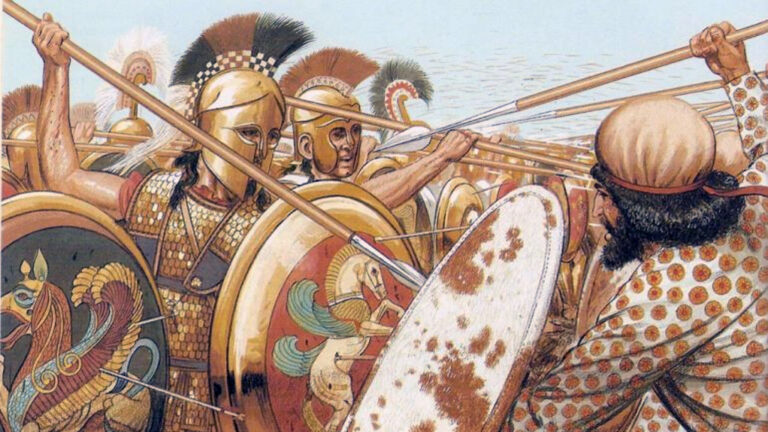
Let's continue with the same documentary to get a sense of the Athenian army and its unique command challenges.
The Battle That Saved a Civilization: Marathon (Full Documentary)
This next segment describes the Athenian and Plataean forces, their hoplite equipment, and the problematic democratic command structure they operated under.
Please watch from 21:59 to 25:56. Focus on the description of the hoplite panoply and the daily rotation of command among the ten generals (strategoi).
Here's a breakdown of the Greek force:
- Composition: Almost exclusively heavy infantry known as hoplites.
- They fought in a dense block formation called the phalanx, presenting a wall of overlapping shields and a forest of spears.
- Their equipment, the panoply, consisted of a bronze helmet, breastplate, greaves (leg armor), and the large, concave wooden shield called an aspis or hoplon. This heavy armor offered superb protection in a frontal clash but made them slow and vulnerable on the flanks.
- Numbers: Approximately 9,000 Athenian hoplites, joined by 1,000 hoplites from the small, loyal city of Plataea. Their total of 10,000 was dwarfed by the Persian host.
- Command: This was a significant weakness. Command rotated daily among a board of ten elected generals (strategoi). This system, designed for political equality, courted disaster on a multi-day battlefield. However, one general, Miltiades, had direct experience serving with the Persians and understood their tactics—a piece of knowledge that would prove invaluable.
2. The Stalemate and the Decisive Moment
After arriving, the two armies settled into a tense stalemate that lasted for several days.
- The Athenians took up a strategic position in the foothills, blocking the main roads to Athens. They were unwilling to descend onto the open plain, where the Persian cavalry would annihilate them. They were also stalling, hoping the promised Spartan army would arrive.
- The Persians were confident in their cavalry advantage and were reluctant to attack the Greeks' strong, uphill position, which would have negated the effectiveness of their horsemen and forced a difficult frontal assault on the phalanx.
The deadlock was broken by a critical piece of intelligence. Ionian Greek deserters from the Persian camp brought Miltiades news: the Persian cavalry was gone.
Historians debate the exact reason. Were they being loaded back onto ships for a direct sea assault on Athens? Were they simply foraging for supplies? Whatever the cause, Miltiades recognized this as a fleeting window of opportunity. With the Persians' main tactical advantage temporarily neutralized, he forcefully argued for an immediate attack, ultimately persuading the titular commander, the Polemarch Callimachus, to cast the tie-breaking vote for battle.
3. Miltiades' Gamble: A Radical Battle Plan
Knowing that a conventional, head-on attack would still fail against superior numbers, Miltiades devised a brilliant and highly unorthodox plan that played to his army's strengths and exploited Persian weaknesses.
This plan involved two revolutionary tactical decisions.
The Battle That Saved a Civilization: Marathon (Full Documentary)
The final video segment details Miltiades' ingenious and risky battle plan. It breaks down the logic behind weakening his center, reinforcing his flanks, and ordering the unprecedented charge at a run.
Please watch from 37:04 to 41:48. Pay close attention to the two core components of the plan: the formation and the charge.
Let's break down Miltiades' tactical script:
-
The Formation: Weak Center, Strong Flanks.
- Standard Greek practice was to make the phalanx uniformly deep, usually 8 ranks of men. Miltiades did the opposite. He thinned his center to just 4 ranks deep, making it dangerously weak.
- He then used those extra men to massively strengthen his flanks (or wings), making them exceptionally deep and powerful.
- The goal was to set a trap. He anticipated the weak center would bend and give way, luring the best Persian troops forward into a pocket. His powerful flanks could then turn inward and attack the enemy from both sides.
-
The Attack: Charge at a Run.
- The phalanx traditionally advanced at a slow, deliberate walk to maintain cohesion. Miltiades ordered his men—weighed down by 70 pounds of armor—to charge at a full run across the nearly one-mile gap separating the armies.
- This was a calculated risk to solve a specific problem: the Persian archers. Miltiades knew the archers were most deadly at medium range. By running, his hoplites would cross this "killing zone" so quickly that the archers would have time for only one or two inaccurate volleys before the Greeks were upon them.
Test your understanding!
Miltiades' plan was brilliant, but it involved two enormous risks. Based on the description, what were the two main ways his strategy could have gone disastrously wrong?
Show answer
- The thinned center could have broken completely instead of just bending. If it routed, the Persian breakthrough would have shattered the entire Greek army before the flanks could react.
- The charge at a run could have failed. If the hoplites became exhausted or their formation disintegrated during the mile-long run, they would have arrived at the Persian line disorganized and out of breath, making them easy targets.
4. The Battle: Execution of a Masterpiece
On the morning of the battle, the Athenians charged. The Persians, seeing a small force of infantry running toward them without cavalry or archer support, reportedly thought them mad.
The battle unfolded exactly as Miltiades had envisioned.

The execution can be summarized in three phases:
-
The Center Bends: The charge successfully minimized casualties from arrows. As the lines crashed together, the elite Persian infantry in the center easily pushed back the thin line of Greek hoplites, who conducted a fighting withdrawal. From the Persian perspective, the battle was going to plan.
-
The Flanks Shatter: On the wings, it was a different story. The heavily armored, deep Greek phalanxes smashed into the lighter-equipped Persian flanks. The superior Greek armor and the weight of their formation were decisive. The Persian wings broke and fled.
-
The Trap is Sprung: Here came the crucial moment of discipline. Instead of chasing the fleeing enemies—the natural instinct in battle—the Greek wings halted, reformed, and turned inward. They slammed into the exposed flanks and rear of the elite Persian center, which was still pushing forward. The hunters became the hunted, caught in a three-sided box of bronze and iron with the sea at their back.
The organized Persian army dissolved into a panicked mob, fleeing for the safety of their ships. The Athenians pursued them relentlessly, slaughtering them on the plain and fighting them in the surf of the bay itself.
Conclusion
The Battle of Marathon was not merely a victory of courage; it was a triumph of tactical genius. Miltiades, facing a superior opponent, refused to fight on their terms. He changed the rules of the engagement to maximize his own advantages and exploit his enemy's weaknesses.
Key Takeaways:
- Opposing Forces: The battle pitted a numerically superior, professionally diverse Persian army (strong in cavalry and archers) against a smaller, homogenous Greek force of heavily armored citizen-hoplites.
- Decisive Factor: Miltiades seized the opportunity presented by the temporary absence of the Persian cavalry to launch an attack.
- Tactical Masterpiece: The victory was engineered by two unconventional decisions:
- A full-speed charge to negate the threat of Persian archers.
- A weak-center, strong-flank formation to lure the Persian elite into a deadly double envelopment.
The Persians lost around 6,400 men; the Athenians, a mere 192. But the impact of this battle went far beyond the numbers.
Preview of the Next Lesson:
The surviving Persian ships sailed away in defeat. The legend of Persian invincibility was shattered. In our next lesson, we will explore the profound and lasting significance of this victory. We will analyze how the triumph at Marathon shaped Greek morale for the even greater war to come and how it became a foundational element of Athens's identity, fueling its confidence and its democratic and imperial ambitions.