Hello again!
In our last lesson, we were on the battlefield, dissecting the audacious tactics Miltiades used to lead a small Athenian force to a stunning victory over the Persian army. We saw how a combination of a weak center, strong flanks, and an unprecedented charge at a full run dismantled a force that had seemed invincible.
Today, we step away from the battlefield to explore the aftermath. The immediate result was clear: some 6,400 Persians lay dead, compared to just 192 Athenians. But the true impact of this battle was not measured in casualties. It was measured in the minds and hearts of the Greeks, and particularly in the identity of Athens itself. Our goal for this lesson is to explain the significance of the Athenian victory at Marathon for Greek morale and Athenian identity. We will uncover why this single battle became more than a military victory—it became a foundational myth for a city and a civilization.
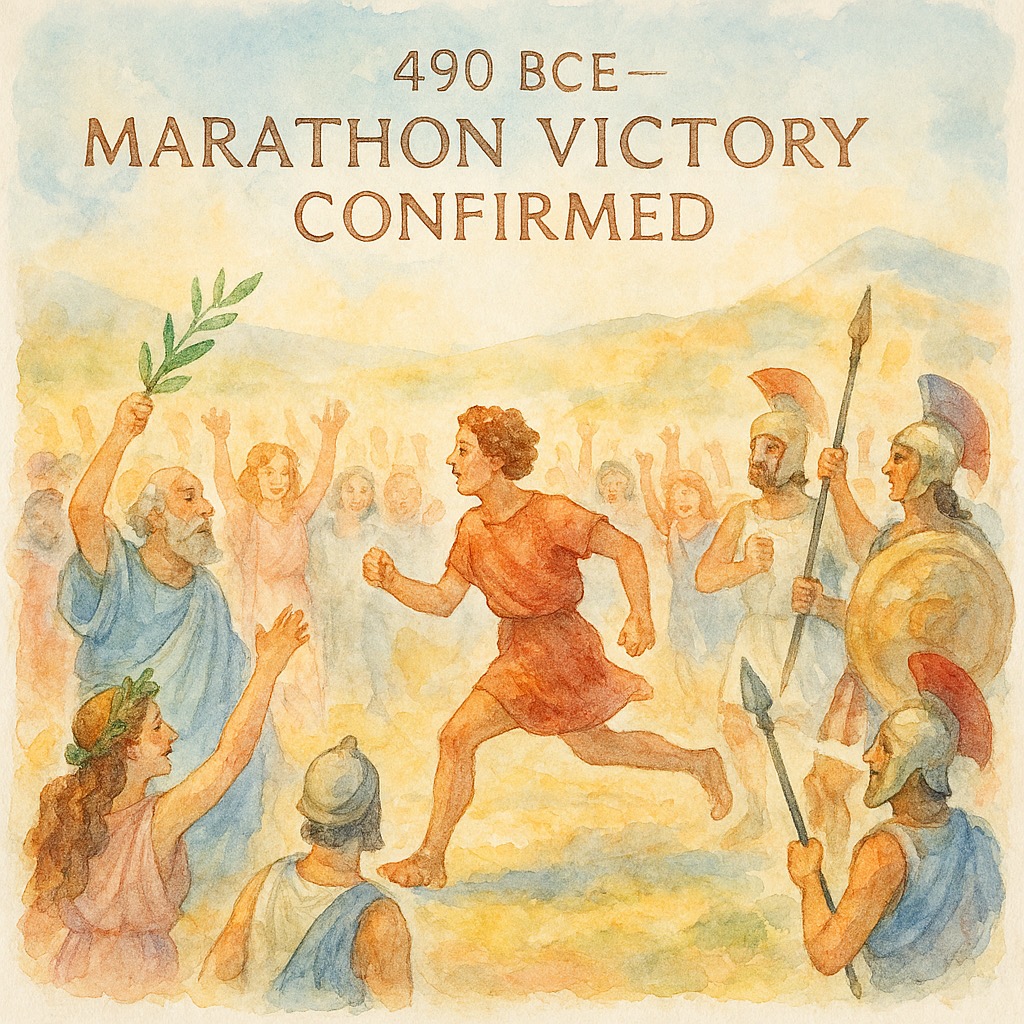
1. Shattering the Myth of Invincibility
For decades, the Persian Empire had been an unstoppable force, swallowing kingdoms from India to Egypt. To the Greeks, the name "Mede" (their term for Persians) was, as Herodotus tells us, "a fearful thing for Greeks to hear." Most city-states assumed that resisting the Great King was futile. Marathon changed that in a single morning.
To grasp the immediate psychological shockwave sent by the victory, let's turn to a documentary that captures this turning point.
The Battle That Saved a Civilization: Marathon (Full Documentary)
The documentary 'The Battle That Saved a Civilization: Marathon' vividly describes the immediate aftermath of the battle and the disbelief that rippled through the Greek world.
Please watch the segment from 0:58:04 to 1:00:43. Focus on how the victory transformed the Greek mindset and the reaction of the Spartans when they finally arrived.
As the video explains, the victory at Marathon did two crucial things for Greek morale:
- It broke the aura of Persian invincibility. The idea that the Persian war machine could be not just resisted, but utterly defeated in a pitched battle, was revolutionary. It transformed the Greek mindset from one of fearful resignation to one of defiant hope.
- It earned Athens immense prestige. When the Spartan army, the acknowledged military masters of Greece, arrived too late, they could only survey the battlefield and praise the Athenian achievement. This Spartan validation was a powerful endorsement of Athenian prowess and courage, elevating Athens's status among the Greek city-states.
2. The Forging of Athenian Identity
While the victory boosted the morale of all Greeks, its most profound impact was on Athens itself. The battle became a crucible in which a new, confident Athenian identity was forged. This happened in several ways.
The Triumph of a Free People
First and foremost, the victory was seen as a vindication of Athens's young and radical democracy. The battle became a powerful morality tale: a small army of free citizens, fighting for their homes, their families, and their political rights, had proven superior to a vast army of subjects fighting under the command of a despot.
This connection between military success and political freedom became a cornerstone of Athenian pride.
The Battle That Saved a Civilization: Marathon (Full Documentary)
The same documentary explains how this victory became the moral and psychological foundation for Athens' most celebrated era.
Please watch from 1:00:43 to 1:01:43. Note the connection the video draws between the victory and the subsequent cultural flourishing known as the Golden Age of Athens.
The confidence born at Marathon would fuel the generation of Pericles, the construction of the Parthenon, and the philosophical inquiries of Socrates and Plato. The city saw its democratic system not as a chaotic experiment, but as a source of unparalleled strength.
Test your understanding!
In our modern world, we often separate military matters from political ideology. Based on what you've learned, why was it so natural for the Athenians to see their victory at Marathon as a direct triumph of democracy itself?
Show answer
The Athenians saw a direct link because the contrast between the two armies was so stark. Their army was composed of citizen-soldiers who had a personal stake in the outcome—they were defending their own freedom, property, and system of self-government. The Persian army, in their view, was made up of subjects and conscripts who fought out of fear or obligation to a distant king. Therefore, the victory proved to them that free men, motivated by a personal cause, possessed a fighting spirit that the subjects of an autocracy could not match.
A Sacred Memory: The Burial and the "Marathon-Fighters"
Athens treated the victory not just as a great achievement, but as a sacred event. This is most powerfully demonstrated by the unique honor bestowed upon the 192 Athenians who fell.
To understand this and the creation of the "Marathon-fighter" ideal, let's turn to two excellent texts.
The Battle of Marathon and Ancient Athenian Pride
The article 'The Battle of Marathon and Ancient Athenian Pride' explains the unique significance of the burial of the Marathon dead.
Please read the section titled 'The theme of Marathon as a military triumph of democratic Athens is once more evoked...'. It begins just after the image of the Acropolis. Focus on the exception made for the men slain at Marathon.
Marathon and the Archaeological Museum
Now, let's explore how the men who fought there became legendary figures in Athenian culture. The publication 'Marathon and the Archaeological Museum' delves into the ideal of the 'Marathon fighter'.
Please read the short section titled 'THE IDEAL OF THE MARATHON FIGHTER AND THE NEW VIEW OF MAN'. Pay close attention to the epitaph of the playwright Aeschylus.
As these texts highlight, two things elevated the battle into a foundational myth:
-
Burial on the Battlefield: Athenian tradition dictated that soldiers who died in war were buried in a public cemetery in Athens. The Marathonomachoi (the "Marathon-fighters") were the sole exception. In recognition of their extraordinary valor, they were buried together on the battlefield where they fell, in a great mound called the Soros that became a hero shrine. This act declared that their sacrifice was unique and had saved the city in a way no other battle had.
-
The Ideal of the "Marathon-Fighter": The men who fought at Marathon became the gold standard of Athenian virtue. For generations, they were held up as the ideal citizens: tough, brave, selfless, and dedicated to the freedom of the city. As you read, even the great playwright Aeschylus, who wrote dozens of immortal tragedies, chose to have his epitaph mention only one thing: that he had fought at Marathon. This shows how deeply the battle was ingrained in the Athenian psyche as the defining moment of their generation.
3. A Hinge of History
The victory at Marathon was not just significant for Athens; many historians argue it was a pivotal moment for the development of Western civilization itself. The stakes were incredibly high. Had Athens fallen, the trajectory of history might have been vastly different.
Professor Donald Kagan, a leading historian of ancient Greece, provides a powerful summary of what was at risk.
In this lecture from Yale University, Professor Kagan explains the long-term implications of the Athenian victory, framing it as a moment that preserved the very infancy of classical Greek culture.
Please watch the final segment of the lecture, from 1:15:29 to 1:20:37. Listen for the list of things that 'would not have been' if the Athenians had lost.
As Professor Kagan argues, if the Persians had won at Marathon:
- The nascent Athenian democracy would have been extinguished and replaced by a tyranny under the control of Persia.
- There would be no Parthenon, as the imperial tribute that funded it would never have been collected.
- The great tragedians—Aeschylus, Sophocles, and Euripides—might never have written their plays.
- The philosophers Socrates, Plato, and Aristotle would likely never have taught.
In short, the intellectual and cultural explosion of Athens' Golden Age, which laid the foundations for Western philosophy, drama, art, and political thought, might have been "strangled in its infancy." Marathon did not guarantee the future, but it created the necessary conditions for that future to be possible.
Conclusion
The significance of Marathon extends far beyond the tally of a single day's fighting. It was a victory that reshaped the psychology of an entire people and the identity of a city.
Key Takeaways:
- For Greek Morale: The victory shattered the myth of Persian invincibility, proving that the empire could be defeated and inspiring a new sense of defiant hope across Greece.
- For Athenian Identity: The battle was seen as a divine validation of democracy, proving that free citizens were superior warriors. The "Marathon-fighters" became the ultimate symbol of Athenian civic virtue, and their memory was enshrined in the city's culture and politics.
- For Western Civilization: The victory preserved the independence of Athens at a critical moment, creating the space for the cultural and intellectual developments of the Classical period that would fundamentally shape the modern world.
Preview of the Next Lesson:
The victory at Marathon was a stunning triumph, but it was not the end of the story. It was merely the end of the beginning. Darius was humiliated and infuriated by the defeat, but he would die before he could launch his revenge. That task would fall to his son, Xerxes, who would amass the largest invasion force the world had ever seen to finally crush Greece once and for all. In our next module, we will explore this second, even greater, Persian War.