Hello! Welcome to the fifth lesson in our module, "Sparta and Athens: A Tale of Two Cities."
In our last few lessons, we've carefully constructed a picture of the governmental machinery in both Sparta and Athens. We examined Sparta's unique dual monarchy and council of elders, and we explored the radical democratic institutions of Athens, like the Assembly and the Council of 500. So far, we've largely looked at them in isolation.
Today, we bring them face-to-face. Our learning outcome is to compare the political ideologies and the role of the citizen in Athens and Sparta. We will move beyond the structures of government to explore the core philosophies that drove them. What did it mean to be a "good citizen" in Athens versus Sparta? What fundamental beliefs about freedom, equality, and order shaped these two rival powers? This comparison is central to understanding the conflicts and the cultural developments that define the Classical Age.
1. Two Cities, Two Worldviews
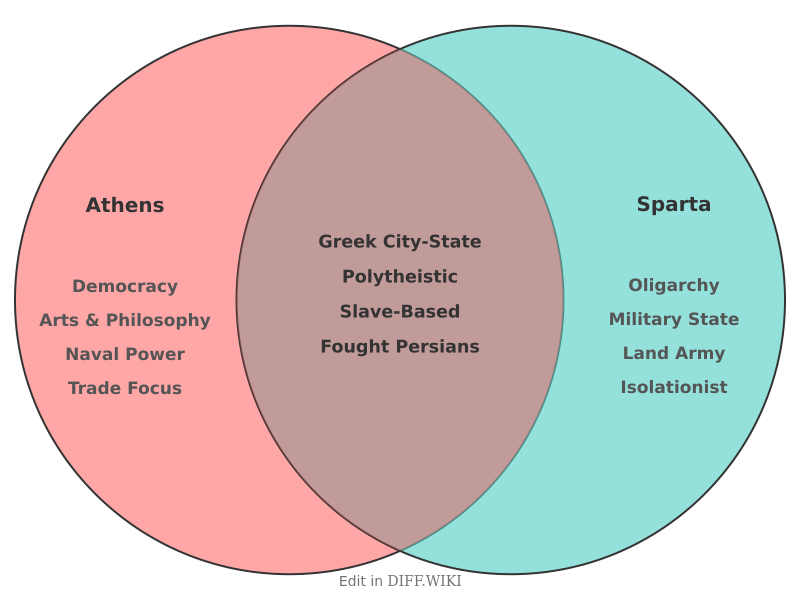
At the heart of the Athens-Sparta rivalry was a fundamental disagreement about the purpose of the state and the role of the individual within it. Athens came to represent democracy, maritime empire, commerce, and artistic expression. Sparta represented oligarchy, land-based military might, austerity, and unwavering discipline.
To begin, let's get a broad overview of this clash of civilizations. The following documentary clip sets the stage by contrasting the core character of each polis on the eve of their great conflict.
Athens vs Sparta: The War That Broke Ancient Greece | History Of Warfare | Odyssey
The documentary 'Athens vs Sparta' provides an excellent summary of the deep-seated differences between the two city-states, framing them as a clash of opposing systems.
Please watch from 06:53 to 10:00. Pay close attention to the key dichotomies presented: democracy vs. oligarchy, sea vs. land, and artistic brilliance vs. austere military focus.
As the video highlights, these weren't just different policy choices; they were reflections of profoundly different ideologies. Athens, as Pericles claimed, was a state held together by a "love of its freedom," while Sparta was a society organized entirely around military necessity and the subjugation of the individual to the state.
2. The Meaning of "Equality"
To truly grasp the ideological divide, we need to dig deeper than the simple labels of "democracy" and "oligarchy." A crucial question to ask is: what did each state mean by the word "equal"? The answer reveals the philosophical bedrock of their political systems.
The scholar Melissa Lane provides a brilliant framework for understanding this. She distinguishes between two ancient Greek concepts of equality, which map almost perfectly onto the Athenian and Spartan worldviews.
Ancient Greek Ideas of Equality Under the Law
The following text, from a lecture by Professor Melissa Lane, introduces the philosophical distinction between two types of equality. This is a more analytical part of our lesson, but it's key to understanding the 'why' behind their political systems.
Please read the following three parts of the text: Start at the beginning and read to the end of the first page to understand the difference between Eunomia (good order, an aristocratic ideal) and Isonomia (equal order, a democratic ideal). Continue reading on page 3, focusing on the section under the heading 'The Meaning of Equality: ‘equality of what?’'. This introduces the critical distinction between 'geometrical' and 'arithmetical' equality. Finally, read the section on page 4 that begins 'Aristotle identified the different ways that oligarchic and democratic partisans thought about equality...'. This part directly connects these abstract ideas to Athens and Sparta.
Let's break down those critical concepts:
-
Eunomia vs. Isonomia: Sparta championed Eunomia—a "good legal order." Their goal was a perfectly stable, hierarchical, and lawful society. The laws were good because they maintained this rigid order. Athens, on the other hand, championed Isonomia—an "equal legal order." For them, the law's goodness came from its application to all citizens equally, as a product of collective human effort.
-
Geometrical vs. Arithmetical Equality: This is the core of the distinction.
- Sparta (Geometrical Equality): The Spartan system was based on an idea of "equality of ratios" or worth. Full citizens called themselves Homoioi ("peers" or "similars") because they were deemed of similar worth—proven through the brutal agoge training system. Political rights belonged to this exclusive group. It's an equality based on weighing people's value, not counting their heads.
- Athens (Arithmetical Equality): The Athenian system was based on "sameness in number." One free male citizen equaled one vote. Your wealth or background didn't change the mathematical fact that you counted as one. It's an equality based on counting heads.
You could almost think of these as two different algorithms for distributing political power. Sparta's was a weighted system where you first had to meet a high threshold of "worth" to be counted at all. Athens' was a simple, unweighted count of every eligible member.
3. The Citizen's Job Description
These opposing ideologies resulted in two vastly different "job descriptions" for the role of a citizen.
The Athenian Citizen: The Engaged Amateur
- Primary Role: To be an active, versatile participant in public life. The ideal was a man who could fight in the phalanx, vote in the Assembly, judge in the courts, and appreciate a philosophical debate or a new tragedy at the theater.
- Key Responsibilities: As we saw in the last lesson, the Athenian citizen was expected to attend the Ekklesia (Assembly) to debate and vote on everything from war to public works. He was expected to be ready to serve by lot in the Boule (Council of 500) or on the massive juries of the Dikasteria.
- Rights and Freedoms: The Athenian citizen enjoyed significant freedom of speech (parrhesia), the right to challenge leaders, and the liberty to pursue his own business and private life as he saw fit, as long as he fulfilled his civic duties.
The Spartan Citizen: The Professional Soldier
- Primary Role: To be a soldier and a master. The Spartan state existed for one purpose: to maintain military dominance and control its vast population of enslaved helots. The citizen's entire life was dedicated to this goal.
- Key Responsibilities: The Spartiate's job was war. From age 7, he was in the state's hands. As an adult, his life was spent training, enforcing control over the helots (partly through the secret police, the Krypteia), and being ready for battle. Even political participation in the Apella was minimal—citizens could only vote 'yes' or 'no' on proposals from the Gerousia by shouting.
- Rights and Freedoms: An Athenian would have seen the Spartan's life as one of total servitude to the state. Spartans were forbidden from engaging in commerce or agriculture. Their lives were rigidly controlled, from diet to marriage. Their "freedom" was freedom from the need to labor, a freedom bought by the enslavement of others, which enabled them to dedicate their lives to being the ultimate warriors.
Test your understanding!
An Athenian and a Spartan citizen are shipwrecked on a deserted island. After sorting out their immediate survival, they get into a debate about what makes a "good man" and a "good citizen." Based on what you've learned, what would each of them argue?
Show answer
-
The Athenian would likely argue: A good man is well-rounded. He should be able to speak persuasively, think critically, appreciate beauty, and defend his city when called upon. A good citizen is one who actively participates—he doesn't shy away from the Assembly or jury duty. He uses his freedom responsibly to contribute to the city's greatness and holds his leaders accountable. A state that doesn't trust its citizens with power is a tyranny.
-
The Spartan would likely counter: A good man is disciplined, brave, and obedient to the law. He puts the needs of the group before his own desires. A good citizen is a good soldier, period. He endures hardship without complaint and is always ready for battle. All this Athenian chatter is a sign of weakness and disorder. A state that allows too much individual freedom will inevitably collapse into chaos. Strength comes from order, not from endless debate.
Conclusion
We have seen that the differences between Athens and Sparta were not merely cosmetic. They stemmed from fundamentally opposed ideologies about the nature of humanity, society, and the state.
Key Takeaways:
- Ideological Divide: Athens was built on the ideology of freedom, participation, and individual expression (Isonomia). Sparta was built on the ideology of order, discipline, and collective security (Eunomia).
- Concepts of Equality: Athenian democracy was rooted in arithmetical equality (one citizen, one vote). Spartan oligarchy was rooted in geometrical equality (political rights for a small group of "peers" deemed to be of equal worth).
- Role of the Citizen: The Athenian citizen was an active political participant and a well-rounded individual. The Spartan citizen was a full-time professional soldier whose life was entirely subordinated to the state's military needs.
Preview of the Next Lesson:
These political and ideological differences naturally spilled over into every other aspect of life. In our next and final lesson of this module, we will broaden our focus to contrast the military focus of Spartan culture with the burgeoning commercial and artistic culture of Athens. We'll see how their different worldviews shaped what they built, what they valued, and how they lived their daily lives.