Hello! Welcome to the final lesson of our module, "Sparta and Athens: A Tale of Two Cities."
In our last lesson, we dug into the political and philosophical divide between Athens and Sparta. We saw how Athens championed isonomia ("equal legal order") through its democratic institutions, valuing broad citizen participation. In contrast, Sparta embodied eunomia ("good legal order"), prioritizing stability and military discipline within its oligarchic structure.
Today, we'll see how these fundamental ideologies shaped every facet of their societies. Our learning outcome is to contrast the military focus of Spartan culture with the burgeoning commercial and artistic culture of Athens. We'll move from the assembly and the council chamber into the streets, marketplaces, and barracks to understand how these two rival city-states lived, what they valued, and what they left behind. This contrast is the essential backdrop for the great conflicts that will dominate the rest of our course.
1. Sparta: A Culture Forged for War
Everything in Spartan society was subordinate to one goal: creating the perfect soldier to maintain dominance over the Peloponnese and control the massive enslaved population of helots. This single-minded focus produced a unique, and often misunderstood, culture.
You could think of the Spartan and Athenian societies as running on two different operating systems. Sparta's was a highly optimized, single-purpose OS designed exclusively for military readiness. Every process and resource was dedicated to this core function. Athens, as we'll see, was more like a general-purpose, extensible OS with a vibrant ecosystem of "apps" for commerce, philosophy, and the arts.
The Spartan Way of Life: Austerity and Discipline
This military focus led to a culture that prized austerity, discipline, and conformity. While we've discussed the agoge training system, let's look at its broader cultural consequences.
To understand this, let's begin by reading an article that directly addresses the Spartan societal model and its stark differences from Athens.
The rivalry between ancient Athens and Sparta is infamous ...
This article from National Geographic, 'The rivalry between ancient Athens and Sparta is infamous ...', provides an excellent overview of Spartan values and how they were perceived by other Greeks, particularly Athenians.
Please read the first three sections of the article: 'A warrior society,' 'The secretive city, hostile to outsiders,' and 'The austere Spartan life.' Focus on these key points: Why Spartans were freed from daily work and what they dedicated themselves to. The policy of xenelasia (hostility to outsiders) and its purpose. The quote from the historian Thucydides about Sparta's lack of impressive buildings.
As the article highlights, Sparta’s culture was a direct product of its military ideology:
- Architectural Austerity: Thucydides' observation is crucial. Sparta invested in its people—or rather, in turning its male citizens into weapons—not in stone and marble. The virtue of the citizen-soldier was the monument. This stands in stark contrast to the grand building programs of Athens.
- Isolationism (Xenelasia): By forbidding foreigners to live in Sparta and Spartans to travel, they created a closed system. This was designed to prevent the "malware" of new, potentially subversive ideas from corrupting their perfectly ordered society.
- Laconic Speech: The famous Spartan terseness wasn't just a quirk. It reflected a culture that valued action over words, efficiency over embellishment. They saw the long, winding debates of Athenian democracy as a sign of weakness and inefficiency.
The "Spartan Mirage"
It's important to recognize that much of our image of Sparta is what one scholar called the "mirage spartiate" (the Spartan mirage). Since Spartans wrote almost nothing down, we see them through the eyes of others—mostly Athenians who were either hostile critics or wistful admirers of their discipline.
There is evidence that in the earlier Archaic period (around the 7th century BC), Sparta was actually a center for arts and culture, producing fine pottery and poetry. The extreme, austere version of Sparta we know from the Classical period was a conscious, deliberate choice—a society that hardened itself in response to internal and external pressures.
There's more to Sparta than martial valour and austerity
This essay from Aeon, 'There's more to Sparta than martial valour and austerity,' adds an important layer of nuance to our understanding, questioning the popular image of Sparta.
Please read the section that begins 'From 700 BCE onwards...' to see what Archaic Sparta was like. Then, read the following section 'The problem with painting a ‘true’ picture of classical Sparta is our sources' to understand the challenge historians face.
2. Athens: A Culture of Commerce and Creativity
If Sparta was a closed fortress, Athens was an open port, bustling with trade, new ideas, and artistic energy. Its culture was a reflection of its democratic ideology, maritime power, and commercial success.
The following video provides a wonderful visual tour of Athens, showing how its wealth and democratic spirit fueled an unparalleled cultural blossoming.
Ancient Athens: The Rise Of The Most Influential Society In History | Metropolis
The documentary 'Ancient Athens: The Rise Of The Most Influential Society In History' explores the city's golden age. It connects the city's commercial power, democratic ideals, and artistic achievements.
This is a rich documentary, and I encourage you to watch it in full if you have time. For now, let's focus on a few key segments: Watch from 08:21 to 13:33 to explore the Agora, the heart of Athenian commercial, social, and political life. Watch from 19:33 to 26:05 to understand Athens as a center of trade and its extensive connections across the ancient world. Finally, watch from 03:19 to 07:47 to see the sheer ambition of the Parthenon, a symbol of Athenian wealth, power, and devotion to the arts.
The video vividly illustrates the interconnected nature of Athenian society:
- A Commercial Powerhouse: Unlike the inward-looking, land-based Spartans, Athens looked to the sea. The port of Piraeus was the engine of its economy. Trade brought not only wealth but also people and ideas from across the Mediterranean, making Athens a cosmopolitan hub. Its powerful navy of citizen-rowed triremes existed to protect these vital sea lanes, directly linking military might to commercial prosperity.
- An Artistic and Intellectual Explosion: The tribute from its empire and the profits from trade funded the spectacular building projects on the Acropolis, like the Parthenon. But culture wasn't just top-down. The Agora was a space where merchants, politicians, and philosophers like Socrates could mingle and debate. The theater was a democratic institution where playwrights like Aristophanes and Euripides could critique society and even mock Sparta, as you'll see.
- Culture as a Weapon and a Statement: Athenians used their culture to express their identity. They staged plays mocking Spartan austerity and "Laconomania" (the trend of some wealthy Athenians to admire and imitate Spartan ways). Their art and architecture were a statement to the world about the glory and success of their democratic system.
Test your understanding!
Imagine an Athenian merchant and a Spartan warrior are arguing about what makes a city "great." What physical evidence would each point to in their home city to support their claim?
Show answer
-
The Athenian merchant would point to the Acropolis with the Parthenon, showcasing the city's wealth, artistic genius, and piety. He would then lead the Spartan to the bustling port of Piraeus, with ships arriving from Egypt and the Black Sea, as proof of Athens' power and influence in the world. Finally, he'd point to the Agora and the Theater of Dionysus as evidence of a vibrant civic and intellectual life where citizens freely exchange ideas and art.
-
The Spartan warrior would dismiss the buildings and ships as frivolous distractions. He would point not to a place, but to a group of men: a phalanx of Spartiates training in perfect unison. For him, the city's greatness isn't in its objects but in the discipline, courage, and physical perfection of its citizens. He would argue that this living wall of men is a far greater achievement and a more reliable defense than any stone fortress or fleet of trading vessels.
3. A Tale of Two Cities, Visualized
The differences between these two cultures are so profound that they have inspired artists for centuries. Look at the following image, which attempts to capture the essence of both societies.
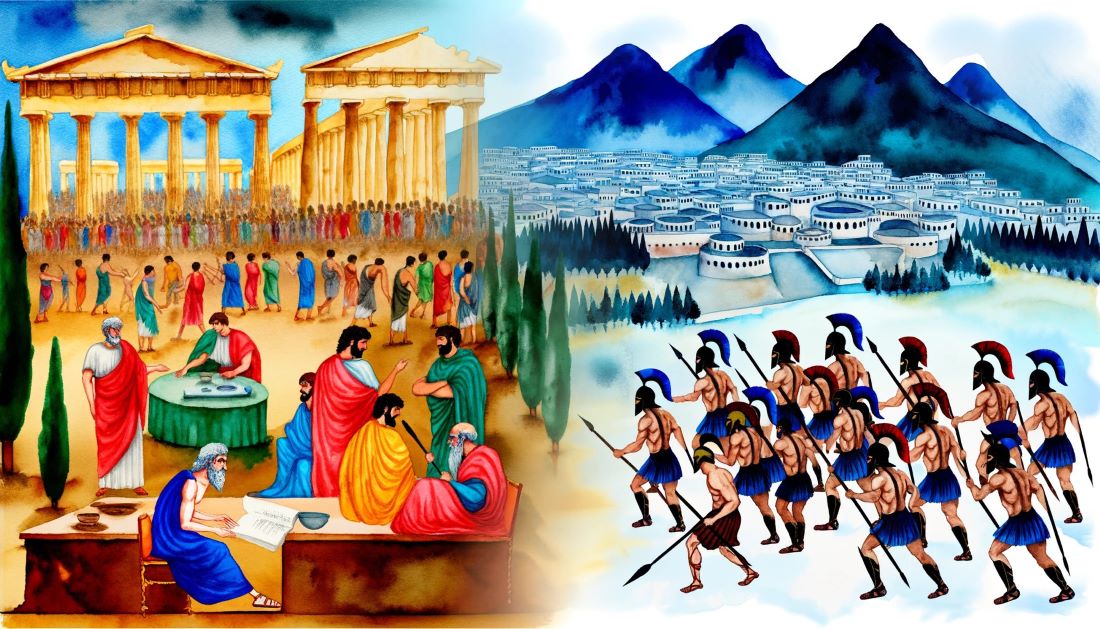
On the left, you see the Athenian ideal: citizens gathered among magnificent public buildings, engaged in conversation and commerce. It's a city of light, openness, and activity. On the right, you see the Spartan ideal: an ordered, disciplined line of warriors, one with the stark and formidable landscape. It's a city of strength, austerity, and singular purpose.
Conclusion
Today we have seen how the political and social ideologies of Athens and Sparta created two profoundly different cultural worlds. This wasn't just a matter of taste; it was a fundamental disagreement about what a society should be.
Key Takeaways:
- Sparta's culture was a tool of its military state. Austerity, discipline, isolationism, and laconic expression were all designed to support a society of professional soldiers. Greatness was measured in the virtue and readiness of its citizens, not in monuments.
- Athens' culture was an expression of its democratic and commercial life. Art, architecture, philosophy, and theater flourished, funded by trade and empire. Greatness was demonstrated through magnificent public works, vibrant civic discourse, and intellectual inquiry.
- Their military structures reflected their cultures. Sparta focused on a land-based, professional hoplite army. Athens built its power on a large navy of citizen-rowers, which both protected its trade and empowered its democracy.
Preview of the Next Lesson:
For decades, Athens and Sparta circled each other as suspicious rivals, the "land-power" and the "sea-power." Their clash seemed inevitable. But before they would turn on each other in the devastating Peloponnesian War, they would first have to face a common enemy that threatened to extinguish Greek freedom entirely.
In our next module, we will begin the story of the Persian Wars, starting with the rise of the mighty Achaemenid Empire and its first fateful collision with the Greek world. We will see how these two rival cities, for a time, stood together against a monumental threat.