Hello! Welcome to the fourth lesson in our module, "Sparta and Athens: A Tale of Two Cities."
In our last lesson, we traced the incredible journey of Athens from an aristocracy on the brink of civil war to the brink of a new political reality. We saw how Solon laid the foundations by tackling economic injustice and how Cleisthenes, in an act of political genius, completely redesigned the state's architecture to break the power of old factions. You can think of their work as creating the blueprint and building the scaffolding for democracy.
Today, we're going to examine the machine they built in full operation. Our goal is to explain the key institutions of Athenian democracy, such as the Assembly and the Council of 500. We will look at how these bodies functioned during the height of Athens' power in the 5th century BC, exploring who held power, how decisions were made, and how justice was administered. We're moving from the architectural design to the functional specifications of each component in this unique system of government.
1. The Core Principles: Direct Democracy and The Lottery
Before we dive into the specific institutions, it's crucial to grasp two core principles that made Athenian democracy radically different from modern representative systems.
First, it was a direct democracy. The guiding principle was ho boulomenos—"anyone who wishes." This meant that eligible citizens didn't just elect representatives to make decisions for them; they made the decisions themselves by attending, speaking, and voting in the Assembly.
Second, most public officials were not elected but were chosen by lottery, a process called sortition. From the Athenian perspective, elections favored the wealthy, the well-spoken, and the popular. A random lottery, on the other hand, was seen as more purely democratic—it gave every eligible citizen an equal chance to serve and prevented the formation of a permanent, professional political class that might use their position for personal gain.
To get a quick and clear overview of these ideas, please watch this short animated video.
What did democracy really mean in Athens? - Melissa Schwartzberg
The TED-Ed video 'What did democracy really mean in Athens?' provides a fantastic, concise introduction to the concepts of direct democracy, the Assembly, the Council, and the use of the lottery.
Please watch the video from 00:32 to 01:57. It efficiently explains the fundamental differences between Athenian and modern democracy and introduces the main institutions we'll be discussing.
2. The Organs of Government: A Visual Overview
Athenian democracy was a complex system with several interlocking parts. The following flowchart gives a high-level view of the four main pillars of the government, which we will explore in detail.
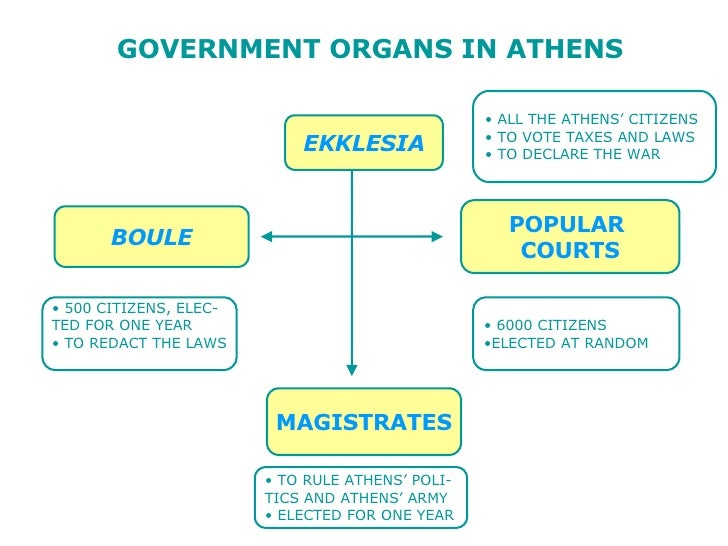
3. The Assembly (Ekklesia): The Sovereign People
The Ekklesia, or Assembly, was the heart and soul of the democracy. It was the sovereign body, holding ultimate authority in the state.
- Who: Any of the 30,000-40,000 adult male citizens were eligible to attend. In practice, usually around 6,000—the number required for a quorum on major decisions—would gather for each meeting.
- Where & When: Meetings were held about 40 times a year on a hill called the Pnyx, which offered a panoramic view of the city.
- What: The Assembly had vast powers. It made decisions on war and peace, debated and approved laws, voted on public spending, received foreign ambassadors, and could even banish a citizen for ten years through ostracism. Decisions were made by a simple show of hands.

To understand the scope of the Assembly's power, please read the following short text.
The article 'Ancient Greek Democracy' from History.com provides a very clear description of the Assembly's role and functions.
Please read the section titled 'The Ekklesia.' It clearly outlines the membership, meeting frequency, and supreme powers of this governing body.
4. The Council of 500 (Boule): The Government's Engine
While the Assembly was the ultimate authority, a crowd of 6,000 people can't effectively manage the day-to-day business of a state. This was the job of the Boule, or Council of 500. It acted as the full-time government and the crucial steering committee for the Assembly.
- Who: 500 citizens, 50 from each of Cleisthenes' ten tribes. Members were chosen by lottery, served for one year, and could only serve twice in their lifetime.
- What: The Boule's main function was probouleutic: it prepared the agenda for every meeting of the Assembly. No issue could be debated in the Assembly without first being considered by the Council. It also supervised financial matters, oversaw public officials, and met with foreign envoys.
The video you will watch next explains a fascinating feature of the Boule: the Prytaneis. This was a rotating executive committee, where the 50 members from one tribe would serve as the "presidents" of Athens for a tenth of the year. They lived and ate together at public expense and were on call 24/7 to handle any state emergencies. This constant rotation of power is a testament to the Athenian commitment to preventing any single group from dominating the government.
Let's return to the 'The Constitution of Athens' video by Historia Civilis. It gives a detailed and clear explanation of how the later, more powerful Boule functioned, including the ingenious system of the Prytaneis.
Please watch from 12:44 to 15:07. Focus on how the Council was structured and, specifically, the function of the Prytaneis as a daily executive body.
5. Magistrates and Courts: Execution and Justice
The final pieces of the democratic machine were the magistrates who executed the decisions and the courts that upheld the laws.
Magistrates: Getting the Job Done
Hundreds of officials, or magistrates, were needed to run the city. Most of these positions—from market inspectors to road commissioners—were filled by boards of ten (one from each tribe), chosen by lottery for a one-year term. The powerful Archons, who once ruled the city, saw their roles become largely judicial and ceremonial.
However, the Athenians were pragmatic. For jobs that required specialized skills, they used elections, not the lottery. The most important of these elected officials were the ten Strategoi, or generals. Because military leadership was too important to be left to chance, the people elected generals they believed were the most competent. Figures like Pericles were re-elected as Strategos year after year, allowing them to exert significant political influence through their military authority and their powers of persuasion in the Assembly.
The Popular Courts (Dikasteria)
The judicial system was another radical expression of popular power.
- Who: Juries were massive, typically comprising 501, 1001, or even more citizens, chosen by lot daily from a pool of 6,000 volunteers.
- What: These juries held almost unlimited power. There were no judges to interpret the law and no police force. Citizens brought cases, acted as prosecutors and defenders, and the jury delivered a verdict and sentence by majority vote.
To ensure that the poor could afford to take time off work to participate, Athens introduced pay for civic service, a key reform championed by Pericles. Jurors, councilmen, and most other officials received a modest daily wage. This single reform was perhaps the most critical in turning Athens into a true "radical democracy," where participation was not just a right but a practical possibility for all.
The webpage 'Athenian Democracy' from the University of Vermont offers a deep dive into the 'radical democracy' of Pericles' time, including the crucial introduction of pay for service.
Please read the following sections: start at the paragraph beginning 'Under Pericles, what is referred to as radical democracy took shape...' and continue through the descriptions of the Council of 500 (Boule) and the Assembly. This will reinforce what we've learned and add crucial details about pay for service and court procedures.
Test your understanding!
Imagine Athens decides it needs to build a new fleet of 20 triremes (warships) due to rising tensions with a rival city-state. Based on what you've learned, trace the likely path of this decision through the Athenian government. Which institutions would be involved, and what role would each play?
Show answer
- The Boule (Council of 500): The initial proposal would likely be formulated here. The Council would debate the necessity of the ships, the cost, and the logistics. They would then draft a preliminary bill (probouleuma) to put on the agenda for the Assembly.
- The Ekklesia (Assembly): The proposal would be presented to the citizen assembly. The Strategoi (generals) would almost certainly be invited to speak, arguing for the military necessity of the new fleet. Other prominent citizens might speak for or against the motion. The citizens would then vote (by show of hands) to approve or reject the proposal.
- The Magistrates: If the Assembly approved the measure, the Boule would oversee its execution. They would work with various financial magistrates (like the poletai) to contract the work and the treasurers to release the funds. The Strategoi or a specialized board might supervise the actual construction of the ships to ensure they met military specifications.
Conclusion
You now have a functional overview of the Athenian democratic system. It was a government of amateurs, run by ordinary citizens who were expected to participate directly in every aspect of the state, from legislation to administration to justice.
Key Takeaways:
- Athenian democracy was direct, with ultimate power residing in the Assembly (Ekklesia), where all citizens could vote.
- The Council of 500 (Boule) acted as the state's administrative engine, setting the agenda for the Assembly and handling daily governance.
- Sortition (lottery) was the default method for choosing officials, promoting fairness and rotation of power. Elections were reserved for roles requiring special expertise, most notably the Strategoi (generals).
- The Popular Courts (Dikasteria) gave citizens immense judicial power, acting as both judge and jury.
- Pay for public service was a critical innovation that enabled poor citizens to actively participate in the democratic process.
Preview of the Next Lesson:
We have now explored the political structures of both Sparta and Athens in detail. In the next lesson, we will finally bring them face-to-face. We will compare the political ideologies and the role of the citizen in Athens and Sparta, and contrast their profoundly different approaches to life, war, and society.