Hello! In our last session, we honed our skills in using multivariable integration to calculate the moment of inertia for continuous bodies like cones and spheres. We saw that by slicing a body into infinitesimal elements and summing their contributions, we could solve problems that would be intractable otherwise.
Today, we will apply this powerful integration principle to a new domain within rigid body dynamics: analyzing forces and torques that are distributed over a surface. Specifically, we'll focus on friction. While you're familiar with friction as a single force vector, many real-world scenarios, such as in clutches or bearings, involve friction acting over an entire contact area. Our goal is to formulate and solve the integral expressions needed to find the net force and torque resulting from this position-dependent friction. This skill is crucial for tackling a variety of advanced mechanics problems.
1. The Classic Case: Frictional Torque on a Rotating Disc
Let's begin with the most direct application of this concept: calculating the torque generated by friction between two rotating surfaces. This is the principle behind clutches, disc brakes, and collar bearings.
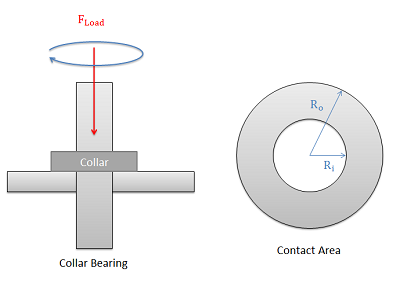
Imagine a flat, circular disc being pressed against a stationary surface with a total normal force and rotating. Kinetic friction will oppose this motion, creating a resistive torque.
The key challenge is that while the frictional force per unit area might be uniform, the torque it generates is not. A frictional force element acting at a radius from the center contributes a torque . Elements farther from the center have a larger lever arm and thus contribute more to the total torque. To find the total torque, we must integrate these contributions over the entire contact area.
The following resource provides a clear, step-by-step derivation for this exact scenario. It starts by considering a hollow circular contact area, which is the general case.
6.6: Disc Friction - Engineering LibreTexts
This text from Engineering LibreTexts provides a detailed, calculus-based derivation of the frictional torque on a rotating disc.
Please read the section titled Hollow Circular Contact Area. Start from the beginning of the section, paying close attention to the derivation. Focus on these key steps: How the total load force F_{load} is related to a uniform pressure p. How the elemental area dA is expressed for a thin ring of radius r and thickness dr. How the integral for the total moment (torque) M is set up and evaluated.
As you've read, the fundamental steps are:
- Pressure: Assume the total normal force is spread uniformly over the contact area , giving a constant pressure .
- Elemental Area: Consider an infinitesimally thin ring (an annulus) at radius with thickness . Its area is .
- Elemental Normal Force: The normal force on this ring is .
- Elemental Frictional Force: The kinetic friction on this ring is .
- Elemental Torque: The torque from this ring's friction is .
- Total Torque: Integrate from the inner radius to the outer radius .
Substituting and integrating gives the final result shown in the reading:
Special Case: Solid Disc
A common scenario involves a solid disc, like a simple end bearing or the sander shown in the image. This is a special case of our general formula where the inner radius .
For a solid disc of radius , we set and . The formula simplifies nicely:
This result is derived from scratch in the following short video, which provides an excellent visual recap of the integration process for the solid disc.
Calculate Torque Transfer Between Rotating Friction Discs
This video from INTEGRAL PHYSICS walks through the derivation of frictional torque for a solid disc. It's a great visual reinforcement of the steps we just outlined.
Please watch the full video from start to finish. Notice how the logic perfectly mirrors our derivation: starting with the total force, distributing it as pressure, defining an elemental ring, and integrating the torque contributions.
2. A More Complex Case: Friction's Balancing Act
The disc friction problem is relatively straightforward because the direction of the kinetic friction force is always tangential, opposing the rotation. Now, let's consider a more subtle problem where the direction of the static friction force can vary with position to maintain equilibrium. This kind of thinking is essential for solving olympiad-level problems.
Consider a thin, uniform bar of mass and length lying on a floor with a coefficient of static friction . What is the minimum horizontal force required to make the bar start moving?
A naive guess might be that you just need to overcome the maximum total static friction, . However, the answer is significantly less than this. Why?
The reason is torque. When you apply a force at one end of the bar, you're not only trying to translate it but also to rotate it. To prevent rotation, the static friction forces along the bar must arrange themselves to create a counter-torque. This means that not all friction can be pointing backward to oppose your push; some of it must point forward to create the necessary balancing torque.
The following problem from a physics olympiad handout explores this exact idea.
This handout by Kevin Zhou contains challenging mechanics problems. We'll focus on a problem that beautifully illustrates how distributed friction must balance both force and torque.
Please find Problem 12 in the document. Read part (a) and its solution to understand the concept of the "contact force". Then, carefully read part (b), which presents the bar problem. Pay close attention to the figure and the accompanying explanation in the solution for part (b). Focus on: The argument for why the friction force must point in different directions along the bar. How the problem is set up by defining a point where the friction direction flips. The two simultaneous equations for force balance and torque balance.
This problem reveals a deeper level of analysis. At the moment the bar is about to slip, the static friction is at its maximum value everywhere, but its direction is position-dependent.
- Force Balance: The applied force must equal the net friction force, which is the integral of the backward-pointing friction minus the integral of the forward-pointing friction.
- Torque Balance: The torque from the applied force must be balanced by the torque from the distributed friction forces.
As the solution shows, by solving the force and torque balance equations (which are themselves integrals over the distributed friction), you find that the minimum applied force is , which is less than half the naive guess! This demonstrates that correctly formulating integrals for distributed forces is key to solving such advanced problems.
3. Generalizing the Skill: An Irodov-style Problem
The technique of integrating a position-dependent force to find its net effect is not limited to friction. It's a general tool for rigid body dynamics. Let's look at an example similar to a problem from I.E. Irodov, which involves integrating a centrifugal force.
Consider a rod of length pinned at one end to the center of a rotating disc, with its other end touching the disc, as shown in the video. As the disc rotates with angular velocity , the rod rotates with it. In the rotating frame of reference, every element of the rod experiences an outward centrifugal force. This force depends on the element's distance from the axis of rotation, so it is position-dependent.
To find the total centrifugal force and its torque about the pivot, one must integrate along the length of the rod.
Rotational Mechanics | Rod Rotating With Disc | Similar to Irodov Problem 1.270 | Two Methods
This video solves a complex rotational mechanics problem. We will focus on "Method 1", which uses a rotating frame and requires integrating a position-dependent centrifugal force—a technique identical to what we've learned for friction.
Please watch the section explaining Method 1, from the start of Method 1 to the derivation of the centrifugal torque. Concentrate on these steps: Finding Net Centrifugal Force: See how an integral is set up to sum the force dF_cf = (dm)ω²r over the length of the rod. Finding Torque by Integration: Observe how the torque due to this distributed force is also calculated via an integral, dτ = r_perp dF_cf.
This example powerfully illustrates that the skill you've developed today is a general-purpose tool. The process of identifying an elemental force dF that depends on position and then integrating dF to get the total force and dτ = r_perp dF to get the total torque is fundamental to advanced mechanics.
Conclusion
In this lesson, we have extended your calculus skills to handle distributed forces in rigid body dynamics. You are now equipped to move beyond simple point forces and analyze more realistic scenarios where forces like friction are spread over a surface.
Key takeaways from today include:
- The Integration Strategy: To find the net force or torque from a distributed load, you must integrate the infinitesimal contributions from each part of the body. The general process is to define an element, find the force on it, find the torque from it, and sum (integrate) over the whole body.
- Disc Friction: For a rotating disc, the frictional torque is found by integrating over the contact area, leading to the formula for a solid disc.
- Force and Torque Balance: In more complex static problems, the distribution of friction is determined by the need to balance both external forces and external torques simultaneously. This can lead to non-intuitive friction patterns, as seen in the bar problem.
- General Applicability: The method of integrating position-dependent forces is a versatile tool, applicable not just to friction but to other effects like centrifugal or hydrostatic forces, which you will encounter later.
In our next lesson, we will continue our exploration of friction by tackling problems involving rolling with slipping. We'll see how kinetic friction provides the force and torque necessary to change a body's linear and angular velocities until the condition for pure rolling is achieved.