Welcome to our new lesson. In our previous session, we developed a powerful technique for handling distributed forces, learning to calculate net force and torque by integrating position-dependent friction over a body. This ability to move from point forces to distributed forces is a significant step in your journey toward mastering advanced mechanics.
Today, we will apply our understanding of friction to one of the most classic topics in rigid body dynamics: the motion of a rolling object. We will explore the crucial difference between "pure rolling" and "rolling with slipping." Our focus will be on the dynamics of the transition from slipping to pure rolling, driven by kinetic friction. You will learn to formulate and solve the equations of motion to determine precisely when an object stops slipping and begins to roll smoothly.
1. The Kinematics of Rolling: Pure vs. Slipping
Before diving into the dynamics, let's establish a clear picture of what rolling motion entails. Any rolling motion can be viewed as a combination of two simpler motions: pure translation of the center of mass (CM) and pure rotation about the center of mass.

The defining characteristic that separates pure rolling from slipping lies at the point of contact with the surface.
-
Pure Rolling: In pure rolling, the point of the object in contact with the surface is instantaneously at rest relative to the surface. This "no-slip" condition implies a specific relationship between the translational velocity of the center of mass, , and the angular velocity, :
where is the radius of the object. Because there is no relative motion at the contact point, the friction involved is static friction.
-
Rolling with Slipping: Slipping occurs when the no-slip condition is violated, i.e., . The point of contact is sliding along the surface. Consequently, the friction involved is kinetic friction, which always acts to oppose the relative motion.
Let's analyze the velocity of the contact point, P. Relative to the center of mass, point P has a velocity of (assuming is in the direction). The velocity of P relative to the ground is the vector sum of the CM's velocity and P's velocity relative to the CM:
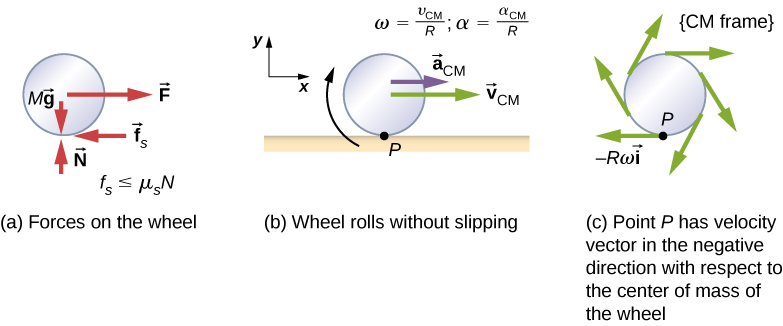
This leads to two main types of slipping:
- Forward Slipping (): The object translates faster than it rotates. The contact point P moves forward (). Kinetic friction opposes this, acting backward.
- Backward Slipping (): The object rotates faster than it translates. The contact point P moves backward (). Kinetic friction opposes this, acting forward.
Kinetic friction is the agent that drives the system toward pure rolling. It exerts a force that changes and a torque that changes until the condition is met.
2. The Transition to Pure Rolling
Let's now analyze the dynamics of this transition. Consider a common scenario: a solid sphere is given an initial horizontal velocity on a rough surface but has no initial angular velocity (). This is a case of forward slipping. Kinetic friction will act to slow down the translation and speed up the rotation until pure rolling begins.
The following resource provides a concise derivation for the time it takes to achieve pure rolling.
5.8: Rolling and Slipping Motion
This article from Physics LibreTexts explains the transition from slipping to rolling and derives the key equations for the time to pure rolling and the final rolling velocity.
Please read the first part of the article, starting from the introduction up to the final derived equations. As you read, focus on how the author sets up and solves two separate equations of motion: One for the linear motion of the center of mass, governed by the net force (which is just friction). One for the rotational motion about the center of mass, governed by the net torque (from friction).
Let's summarize the key steps from the derivation you just read.
-
Translational Motion: The only horizontal force is kinetic friction, , acting in the opposite direction to .
The translational velocity thus decreases linearly with time:
-
Rotational Motion: The friction force creates a torque about the center of mass, .
The angular velocity increases linearly from zero:
-
Condition for Pure Rolling: The transition is complete at a time when the no-slip condition is met: .
Solving for gives the general result:
And the final velocity when pure rolling begins is:
An important insight here is that the final velocity is independent of the coefficient of friction , although the time taken to reach it, , is not.
3. An Advanced Problem: When Pure Rolling is Not Guaranteed
The previous example was straightforward. In more complex problems, like those found in JEE Advanced or Irodov, external forces are often involved, and it's not always guaranteed that pure rolling will be achieved. The analysis requires careful application of Newton's laws and constraint relations.
Let's examine such a problem. A solid cylinder is pulled by a string attached to a hanging block. We need to analyze the motion and determine if and when pure rolling begins.
Advanced Rotational Dynamics Problem - SATHEE - IIT Kanpur
This problem from SATHEE IITK is an excellent example of a multi-body system involving slipping friction. The provided solution demonstrates the correct analytical approach.
First, read the Problem Statement to understand the setup. Then, skip the first two attempted solutions and go directly to "Solution 3: Correct Approach - Two-Phase Motion". Follow the logic of this section carefully. Notice how it sets up four equations for four unknowns (a_c, \alpha, T, a) assuming kinetic friction acts. After solving for the accelerations, the crucial step is to check if the condition for transitioning to pure rolling (a_c = R\alpha) can ever be satisfied. Finally, read the Conclusion, Final Answer, and Common Mistakes sections.
This problem delivers a critical lesson: you must not assume pure rolling from the start unless the problem states it. The correct method is to:
- Assume slipping occurs. This means kinetic friction () is acting. Determine its direction based on the likely relative motion at the contact point.
- Apply Newton's Laws. Write the force equation () and torque equation () for the rolling body, plus equations for any other connected bodies.
- Use Constraint Equations. Relate the accelerations of the different parts of the system (e.g., for the string unwinding from the top).
- Solve for the accelerations and .
- Check for Consistency. Compare with .
- If you can find a time where , then the system transitions to pure rolling.
- If the dynamics of the system lead to a situation where the condition can never be met (as in the SATHEE problem, where the constant accelerations satisfy ), then the object slips indefinitely.
The SATHEE problem's conclusion that "The cylinder will never achieve pure rolling" is a powerful result that stems directly from this rigorous analytical process.
Conclusion
In this lesson, we have dissected the mechanics of rolling motion, focusing on the transition from slipping to pure rolling. By applying Newton's laws for both translation and rotation, you can now analyze these systems dynamically, a skill essential for the advanced problems you aim to master.
Here are the key takeaways:
- Slipping vs. Pure Rolling: The core difference is the velocity of the contact point. It's zero in pure rolling (, static friction) and non-zero in slipping (, kinetic friction).
- Kinetic Friction as the Driver: Kinetic friction provides the necessary force and torque to change and , pushing the system towards the pure rolling state.
- The Analytical Method: The robust way to solve these problems is to assume slipping, apply Newton's second law for linear and angular motion, solve for the accelerations, and then use the condition to find the time of transition.
- Not a Guaranteed Outcome: As we saw in the advanced problem, pure rolling is not always achieved. A rigorous analysis might reveal that the object slips continuously.
In our next lesson, we will shift our focus to another key topic in rigid body dynamics: eccentric impacts. We will analyze collisions where the impulsive force is not applied at the center of mass, causing both a change in linear momentum and an instantaneous change in angular momentum. Your work today on separating translational and rotational dynamics will be excellent preparation for that.