Welcome to the next lesson in our journey through advanced mechanics. In our previous session, we analyzed the transition from slipping to pure rolling, mastering the application of Newton's laws for both translation and rotation under the influence of continuous frictional forces. This gave you a powerful framework for handling problems where both linear and angular motion evolve over time.
Today, we shift our focus to a different class of problems: those involving impulsive forces. These are large forces that act over a very short time, such as during a collision. For these events, we will use the impulse-momentum theorem, which is the integrated form of Newton's second law. Our specific goal is to solve problems involving eccentric impacts—collisions where the impulsive force does not pass through the center of mass, thus causing the rigid body to both translate and rotate. This lesson will equip you with the tools to analyze the instantaneous changes in motion that are characteristic of collisions.
1. The Principle of Angular Impulse and Momentum
When a force acts on a body, it changes its linear momentum. The impulse-momentum theorem for linear motion, which you know, states that the impulse is equal to the change in linear momentum :
Similarly, when a torque acts on a body, it changes its angular momentum. This gives rise to the angular impulse-momentum theorem. The angular impulse, , is equal to the change in angular momentum . For a rigid body rotating about its center of mass, this is:
An eccentric impact is one where the line of action of the impulsive force does not pass through the body's center of mass (CM). Because of this offset, the force creates a torque about the CM, delivering an angular impulse and causing a change in the body's angular velocity.

To formalize this, let's turn to a rigorous derivation from MIT OpenCourseWare.
This document provides a thorough treatment of angular momentum concepts. We will use it to formally define angular impulse.
Please read the section titled "19.5 Angular Impulse and Change in Angular Momentum", which you can find on page 11 of the PDF. Focus on the definitions of angular impulse and its direct relationship to the change in angular momentum, as shown in Equation (19.4.2). This is the rotational analogue to the linear impulse-momentum theorem you are familiar with.
The key takeaway is that for any impulsive event, we have a pair of powerful tools: one for linear motion and one for angular motion.
2. Conservation of Angular Momentum in Collisions
In many collision problems, especially those you'll encounter in JEE Advanced or Irodov, a body is hinged or pivoted at some point. When it's struck, the hinge exerts an unknown impulsive reaction force. This makes applying linear momentum conservation tricky, as there's an external impulse.
However, we can be clever. If we choose our axis of rotation to be the hinge itself, the torque due to the hinge's reaction force is zero (since the lever arm is zero). The impulsive force of the collision is an internal force between the colliding objects, so its torque will be part of a zero-sum pair if we consider the whole system. The only other external force, gravity, is a non-impulsive force; its impulse () over the infinitesimally short duration of the collision is negligible.
Therefore, for a system with a fixed pivot, the total angular momentum of the system about the pivot is conserved during a collision.
This principle is the most important tool for solving eccentric impact problems on hinged bodies. Let's see it in action with a classic example.
8 Angular momentum conservation theorem | Angular impulse | Rigid body dynamics | RBD | IIT advanced
The instructor in this video solves a typical problem from a competitive exam perspective, focusing on the correct application and reasoning. We'll watch the first problem he presents, which involves a perfectly inelastic collision.
Please watch the segment from this problem setup. The instructor analyzes a particle striking the end of a hinged rod and sticking to it. Pay close attention to his reasoning for applying angular momentum conservation about the hinge. He explains why linear momentum is not conserved, but angular momentum about the pivot is. Also, notice how he constructs the 'after' state, treating the particle and rod as a single new rigid body.
As you saw, the problem-solving steps were:
- Identify the system: The rod and the particle.
- Analyze forces: Recognize the external impulsive force at the hinge.
- Choose the pivot: Select the hinge as the point to calculate angular momentum.
- Apply Conservation of Angular Momentum: Set the system's total angular momentum before the collision equal to its total angular momentum after the collision ().
- Before: .
- After: .
- Solve for the unknown angular velocity .
3. General Eccentric Impact: Using the Coefficient of Restitution
What if the collision isn't perfectly inelastic? For general collisions, we need another piece of information: the coefficient of restitution, .
The coefficient of restitution relates the relative velocities of the two colliding bodies at the point of impact, along the line of impact, before and after the collision.
For a particle hitting a rigid body at some point P, the velocity of P is the sum of the translational velocity of the center of mass and the rotational velocity of P about the CM: . This full expression for the velocity at the impact point must be used in the restitution equation.
To solve a general eccentric impact problem, you typically need to solve a system of equations:
- Conservation of Linear Momentum (if the system is free of external impulses).
- Conservation of Angular Momentum about a suitable point (CM for a free body, the hinge for a pivoted body).
- Coefficient of Restitution Equation applied at the point of impact.
Let's examine a comprehensive problem that puts all these ideas together.
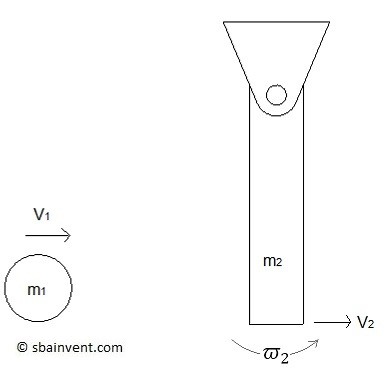
The following resource provides a detailed, step-by-step solution to a similar problem, which is an excellent model for the rigorous analysis required for top-tier physics problems.
We will now study a complete example from the same MIT document. This example is very detailed and shows the full application of the principles we've discussed.
Please read "Example 19.7 Collision Between Pivoted Rod and Object". It starts on page 21 of the PDF. Follow the solution step-by-step. First, understand the three identified states of the system: initial (before collision), 'a' (immediately after collision), and final (at the peak of the swing). Focus on the transition from the initial state to state 'a'. Carefully read the justification for conserving angular momentum about the pivot S. Follow the calculation of the angular momentum before and after the collision, leading to the expression for the angular speed \omega_a. Notice that the second part of the problem (from state 'a' to 'f') uses conservation of energy to find the initial velocity needed to reach a certain height. This is a common way to combine impulse-momentum with other principles. Finally, see how the condition for an elastic collision (e=1, meaning kinetic energy is conserved during the collision) is used to find the required mass ratio.
This example is a template for how to approach complex, multi-part dynamics problems. You must first analyze the instantaneous collision using impulse-momentum principles and then analyze the subsequent motion using work-energy or Newton's laws.
Conclusion
In this lesson, we've added the crucial tool of impulse-momentum analysis to your rigid body dynamics toolkit. You now have a framework for analyzing instantaneous events like collisions, which complements your ability to analyze motion under continuous forces.
Here are the key takeaways:
- Eccentric Impact: An impact whose line of force does not pass through the center of mass, causing both translational and rotational motion.
- Angular Impulse-Momentum Theorem: . This is the rotational equivalent of the linear impulse-momentum theorem.
- Conservation of Angular Momentum: In a collision, if the net external angular impulse about a point is zero, the system's angular momentum about that point is conserved. This is particularly powerful for hinged bodies when analyzing angular momentum about the hinge.
- Problem-Solving Strategy: For a general eccentric impact, you combine conservation of angular momentum, conservation of linear momentum (if applicable), and the coefficient of restitution equation to solve for the final state of motion.
With the conclusion of this lesson, we have reached a major milestone. You have explored the core topics of advanced rigid body mechanics using your calculus skills. Now, we will pivot to a new and fascinating area of classical physics: fluid mechanics. In our next lesson, we will start from the very basics, defining fundamental properties like density and pressure and exploring how pressure behaves in a static fluid with Pascal's law.