Welcome to the first lesson of our module on Fluid Statics! In the previous modules, we developed a powerful toolkit for analyzing the motion of rigid bodies, culminating in the study of complex scenarios like eccentric impacts. You've become adept at applying principles of momentum and energy to discrete objects. We will now transition from the world of rigid bodies to the continuous, flowing world of fluid mechanics. This is a field with immense practical importance and deep connections to calculus and mechanics, which I know you enjoy.
Today, we lay the groundwork for this new topic. We will start by defining what a fluid is and introduce the two most fundamental concepts for describing fluids at rest: density and pressure. Our main goal is to understand how pressure behaves in a static, incompressible fluid. You will learn to apply Pascal's law and derive the crucial formula for calculating pressure at any given depth. This will be our first step towards solving the challenging fluid dynamics problems you aim to master.
1. What is a Fluid? Pressure and Density
In mechanics, we dealt with solids, which maintain a fixed shape. A fluid, in contrast, is a substance that continuously deforms, or flows, when subjected to a shear stress, no matter how small. This category includes both liquids and gases.
To describe the state of a fluid, especially when it's at rest (in static equilibrium), we use macroscopic properties. The two most important ones for our initial study are density and pressure.
Fluid Mechanics L1 | Hydrostatic pressure, Pascal's law, Barometer & Manometer | 11 Physics JEE 2023
This video from Vedantu JEE English provides a great introduction to the basic properties of fluids from a perspective that's well-aligned with your goals.
Please watch the segment from the beginning, which defines what a fluid is and what we mean by an "ideal" fluid. Then, continue watching from the discussion on density and pressure. Pay close attention to these key points: Density (\rho): Defined as mass per unit volume (m/V). Remember the standard density of water: 1000 \, \text{kg/m}^3 or 1 \, \text{g/cm}^3. Pressure (P): Defined as the magnitude of the normal force per unit area (F_\perp/A). It's a scalar quantity, and its SI unit is the Pascal (Pa), where 1 \, \text{Pa} = 1 \, \text{N/m}^2. The force exerted by fluid pressure always acts perpendicular to any surface it contacts.
The resource below, from a JEE preparation site, also provides a concise summary of these foundational ideas. It's a good text-based reference to complement the video.
Fluid Statics -Study Material for IIT JEE
This reading covers the basic definitions of a fluid and pressure.
Read the initial section on "Fluid" to see how it's defined in contrast to a solid. Then, read the section on "Fluid Pressure", focusing on the definition p = F⊥/dA and the derivation of pressure at the bottom of a simple fluid column.
2. Pressure Variation with Depth: The Hydrostatic Equation
Why does pressure increase as you dive deeper into a lake? The intuitive answer is that you have more weight of the fluid above you. Your mechanics background tells you that this weight is a force (), and this force distributed over an area creates pressure. Let's formalize this using calculus.
We can analyze an infinitesimal fluid element and apply Newton's second law (in this case, for static equilibrium, ). This approach, which you've used for rigid bodies, works beautifully for continuous media as well.
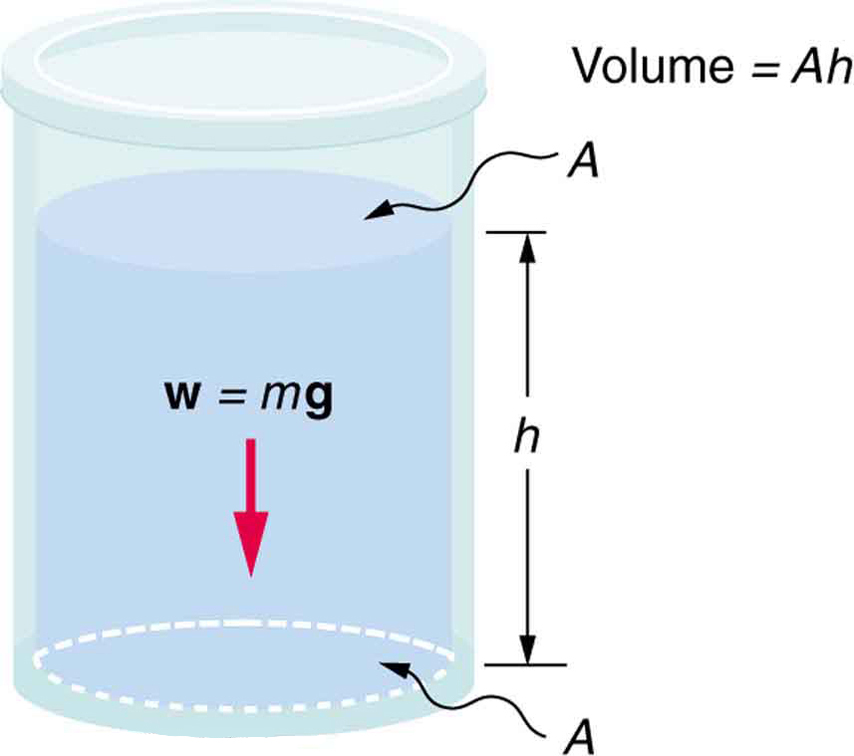
The following resource provides a rigorous derivation of the fundamental equation governing pressure in a static fluid. Given your comfort with calculus, you will find the approach of setting up and solving a differential equation quite natural.
Fluid Statics & the Hydrostatic Equation – Introduction to Aerospace ...
This text from Embry-Riddle Aeronautical University provides a detailed, step-by-step derivation of the hydrostatic equation.
Begin by reading the section "Aerostatic/Hydrostatic Pressure Field". Follow the logic of balancing pressure forces and body forces (gravity) on an infinitesimal cubic fluid element. The use of partial derivatives and the gradient operator (\nabla) should feel familiar from your vector calculus studies. The key result is the general vector equation for pressure variation. Next, read "Effects of Gravity Alone". See how the general equation simplifies when gravity is the only body force. This leads to the crucial ordinary differential equation: \frac{dp}{dz} = -\rho g This is the hydrostatic equation. The negative sign indicates that pressure decreases as the vertical coordinate z (height) increases. Finally, read the subsection "Isodensity Fluid". This section integrates the hydrostatic equation for an incompressible fluid (where density \rho is constant), leading to the formula you'll use most often: p_2 - p_1 = -\rho g (z_2 - z_1) This is often written as p = p_0 + \rho g h, where h is the depth measured downwards from the surface where pressure is p_0.
This derivation also reveals two critical rules for static fluids:
- Pressure increases linearly with depth.
- Pressure is the same at all points on the same horizontal level within a continuous body of the same fluid.
For a visual walkthrough of these derivations, the following video is an excellent supplement.
Fluid Mechanics: Pascal’s Law, Hydrostatic Pressure Variations, Manometry (2 of 34)
This video offers a very clear lecture-style derivation of the same principles.
Watch the segment from the derivation. The instructor first proves that pressure does not vary on horizontal planes (\partial p / \partial x = 0, \partial p / \partial y = 0) and then derives the vertical pressure gradient (dp/dz = -\gamma, where \gamma = \rho g). This provides a fantastic visual reinforcement of the text you just read.
Let's see this principle in action with a problem of the type you'd see in a competitive exam.
Fluid Mechanics L1 | Hydrostatic pressure, Pascal's law, Barometer & Manometer | 11 Physics JEE 2023
The same instructor from the earlier video now solves two problems applying the pressure-depth formula.
First, watch the solution to the submarine problem. This is a great example from a past JEE paper that shows how to apply the formula P = P_{atm} + \rho g h to find percentage change. Next, watch the solution to the lake depth problem. This problem requires you to set up equations for pressure at two different depths and solve for an unknown, which is a common problem-solving pattern.
3. Pascal's Law and its Applications
A direct consequence of the hydrostatic equations for an incompressible fluid is Pascal's Law. It has two important aspects:
- The pressure at a point in a fluid at rest is isotropic, meaning it is the same in all directions. The calculus-based proof using a fluid wedge that you saw in the LINK reading formally establishes this.
- Any change in pressure applied to an enclosed, incompressible fluid is transmitted undiminished to every portion of the fluid and the walls of the container.
This second point has a remarkable application: the hydraulic lift. By applying a small force to a small area, we can generate a very large force on a large area, because the pressure change is transmitted equally throughout the fluid.

The principle is simple:
Since , we have:
Since , it follows that . This is how a person can lift a car.
Fluid Mechanics L1 | Hydrostatic pressure, Pascal's law, Barometer & Manometer | 11 Physics JEE 2023
The Vedantu video provides a fun and intuitive explanation of Pascal's Law.
Watch the segment on Pascal's Law, from the toothpaste analogy to the explanation of the hydraulic lift. The instructor does a great job of explaining how a small force can balance a large one.
Conclusion
This lesson marked our entry into fluid mechanics. We've established the foundational concepts of fluid statics, moving from basic definitions to the powerful equations that govern pressure in a fluid at rest.
Here are the key takeaways from today's session:
- A fluid is a substance that flows under shear stress. We describe its static state using density () and pressure ().
- Pressure in a static fluid under gravity varies only with vertical depth. This relationship is captured by the hydrostatic equation: .
- For an incompressible fluid, the pressure at a depth below a surface with pressure is given by .
- Pascal's Law states that a pressure change in an enclosed, incompressible fluid is transmitted equally everywhere. This is the principle behind the force-multiplying action of hydraulic systems.
In our next lesson, we will build upon this foundation. We will investigate what happens to the pressure distribution when the fluid is no longer at rest but is inside a container that is accelerating uniformly. This will extend the force-balance analysis we performed today to non-inertial reference frames.