In our last lesson, we laid the foundation of fluid statics by analyzing fluids at rest in an inertial frame. By balancing the forces on a small fluid element, we derived the fundamental hydrostatic equation, , which describes how pressure increases with depth due to gravity.
Today, we take a logical and exciting step forward by asking: what happens to the pressure distribution if the fluid is in a container that is accelerating? Although the fluid is at rest relative to its container, the container itself is in a non-inertial reference frame. Your background in mechanics has already equipped you with the tools for such scenarios—namely, the concept of pseudo-forces. We will apply this idea to our fluid element, leading us to the elegant concept of an "effective gravity" that governs the fluid's behavior. Our goal is to formulate the pressure gradient equation that applies to any uniformly accelerated fluid.
1. The Equivalence Principle and Effective Gravity
Before diving into the equations, let's build the physical intuition. The key insight comes from what Albert Einstein called his "happiest thought"—the Equivalence Principle. It states that, locally, the effects of gravity are indistinguishable from the effects of acceleration. A fluid doesn't "know" whether the force it feels is from a planet's gravitational pull or from being accelerated in a rocket. It simply responds to the net force. This powerful idea allows us to treat an accelerating frame as if it has a modified or "effective" gravitational field.
The following article eloquently explains this principle and sets the stage for our analysis.
Pressure in Accelerating Fluids: The Equivalence Principle in Action | Bohrium
This article from Bohrium provides a wonderful conceptual introduction, framing the problem in terms of Einstein's Equivalence Principle.
First, read the section The Elevator and the Astronaut. This will introduce the core idea of how acceleration creates an "artificial gravity." Next, focus on the section Tilting the World. It uses the familiar example of coffee in a cup to explain how horizontal acceleration combines with gravity to create a new, tilted "effective gravity" vector. This is the central concept for this lesson.
2. Formulating the General Pressure Gradient Equation
Let's now formalize this idea using the force-balance method from our last lesson. Recall the infinitesimal fluid element subject to pressure and body forces.
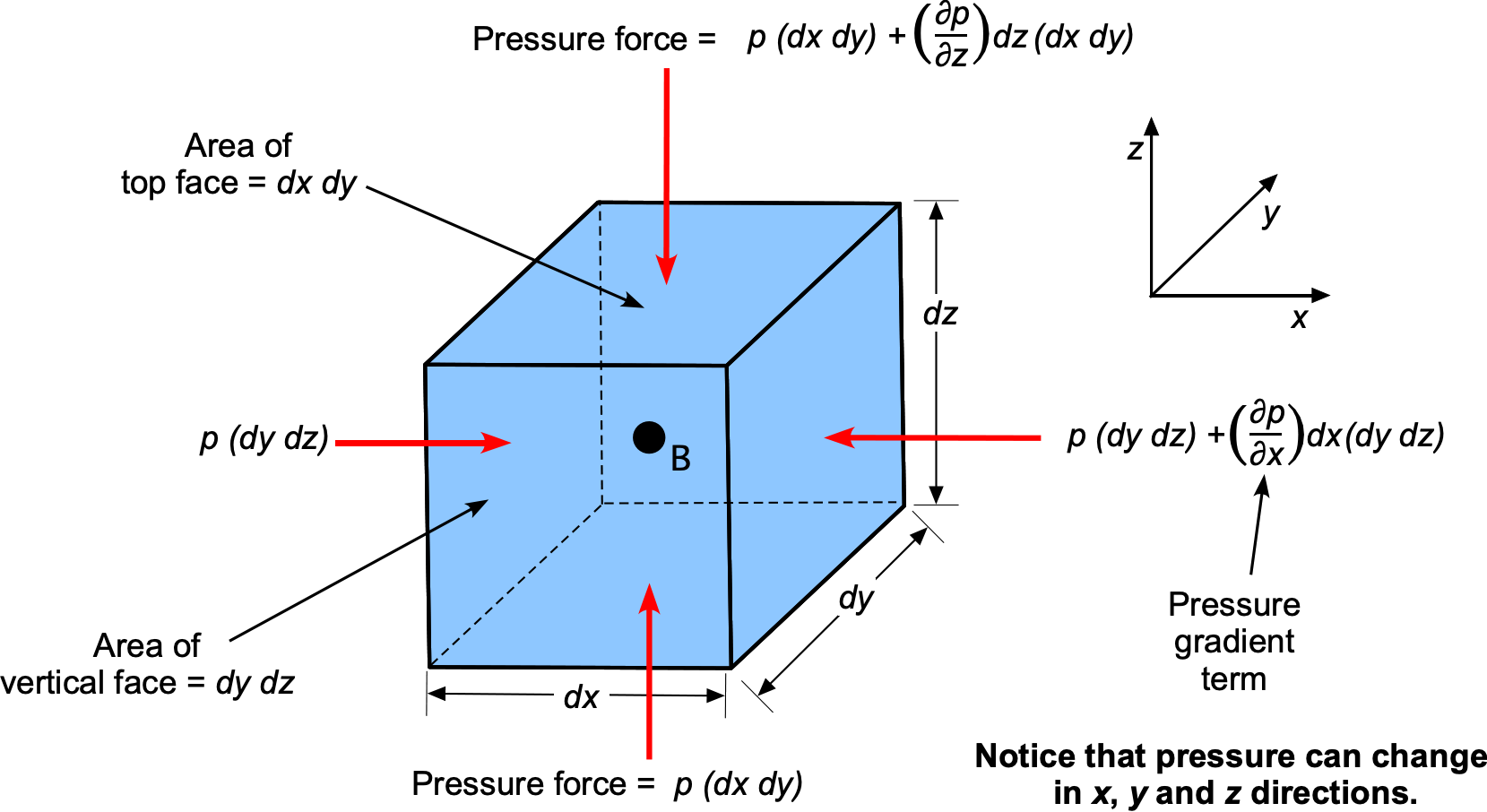
In an inertial frame, Newton's second law for this fluid element of mass is . The forces are the net pressure force, , and the gravitational force, . Combining these gives:
Dividing by the volume element , we get the fundamental equation for pressure in an accelerating fluid:
This equation is remarkably powerful. It tells us that the pressure gradient, , is no longer directed purely vertically (against ), but is now aligned with the vector . We can define the effective gravity vector as . With this, our equation looks just like the static case, but with a modified gravity:
This confirms the intuition from the Equivalence Principle. All the rules of hydrostatics apply, as long as we use the effective gravity.
The following resource provides a concise derivation of the component equations that result from this vector relationship.
Fluid Statics & the Hydrostatic Equation – Introduction to Aerospace ...
This section from the Embry-Riddle textbook formally derives the pressure gradient components for a linearly accelerating fluid.
Please read the short subsection Linear Acceleration. It applies the concept of inertial forces (pseudo-forces) to arrive at the key results: \frac{\partial p}{\partial x} = -\rho a_x and \frac{\partial p}{\partial y} = -\rho a_y. Note that the vertical pressure gradient, \frac{\partial p}{\partial z} = -\rho g, remains unchanged if there is no vertical acceleration.
3. Application: Fluid in a Horizontally Accelerating Tank
Let's analyze the most common scenario: a tank of liquid accelerating horizontally with . Let's define our coordinate system with the y-axis pointing vertically upwards.

From our general equation, , where , the pressure gradient components are:
- (Pressure decreases in the direction of acceleration)
- (The standard hydrostatic variation with depth)
- (Assuming 2D motion)
The effective gravity is . A crucial rule of fluid statics is that a free surface is always a surface of constant pressure (an isobar), and is therefore always perpendicular to the direction of gravity. In this case, the free surface must be perpendicular to .
From the geometry, the slope of the free surface is . Since the surface is perpendicular to , the angle is given by:
The following videos provide an excellent walkthrough of this derivation and demonstrate how to calculate the pressure at any point in the fluid.
Class 11 Physics | Fluid Statics | #19 Pressure Distribution in an Accelerated Frame |For JEE & NEET
This video from Physics Galaxy is perfectly suited for your goal of preparing for competitive exams. It clearly explains the concept of effective gravity and shows multiple methods to solve for pressure.
Watch the entire segment from the beginning. Pay close attention to these key points: Angle of Inclination: The derivation of \tan \theta = a_y / g (note the video uses a_y for horizontal acceleration). Method 1 (Effective Gravity): Calculating pressure using the depth h measured along the direction of \vec{g}_{\text{eff}}. The pressure is P = P_{atm} + \rho g_{\text{eff}} h. Method 2 (Component-wise): Calculating pressure by summing the changes due to vertical depth and horizontal position separately. This is a very versatile technique.
For another clear perspective on the same derivation, you can watch this video. It derives the surface angle by explicitly balancing the pressure terms.
Physics - Ch 33A Test Your Knowledge: Fluid Statics (5 of 43) Open Tank & Horizontal Acceleration
This video by Michel van Biezen offers an alternative but equivalent way to think about the problem.
Watch the segment from the explanation. The instructor explains how the pressure created by the horizontal acceleration (P_x = \rho a x) must be balanced by the hydrostatic pressure from the liquid being pushed up (P_y = \rho g y). Setting them equal at the free surface directly leads to the slope y/x = a/g, which is \tan \theta.
4. Application: Fluid in a Vertically Accelerating Tank
The case of vertical acceleration is a straightforward application of the same principle. Consider an elevator accelerating upwards with .
The effective gravity is .
Since is purely vertical, the free surface remains horizontal. The pressure gradient is simply:
Integrating this, the pressure at a depth is:
If the acceleration is downwards, the sign flips, and the pressure increases less rapidly: . If the container is in free fall (), the pressure is constant everywhere—the fluid becomes "weightless."
This "elevator problem" is well-covered in the Bohrium article you looked at earlier.
Pressure in Accelerating Fluids: The Equivalence Principle in Action | Bohrium
This section revisits the elevator analogy to explain the effect of vertical acceleration.
Read the section Stacking Up the Pressure. It formalizes the idea that an upward acceleration adds to gravity, creating a steeper pressure gradient.
Conclusion
In this lesson, we have extended our analysis of fluid statics to non-inertial frames. By leveraging your existing knowledge of pseudo-forces from mechanics, we introduced the concept of an effective gravitational field, which provides a unified and intuitive framework for solving these problems.
Here are the key takeaways:
- In a uniformly accelerating reference frame with acceleration , a fluid behaves as if it is in a modified gravitational field .
- The pressure gradient equation becomes . This is the master equation for this topic.
- Surfaces of constant pressure (isobars) are always perpendicular to . Consequently, the free surface of a liquid will tilt.
- For horizontal acceleration , the surface tilts at an angle where . For vertical acceleration , the effective gravity becomes , and the pressure at depth is .
In our next lesson, we will investigate another fascinating case of accelerated motion: a fluid in a uniformly rotating container. This will introduce a position-dependent centripetal acceleration, leading to a parabolic free surface and providing another powerful application of the principles we've developed today.