Hello! In our last lesson, we explored the fascinating behavior of a fluid in uniform rotation, discovering how centripetal acceleration sculpts the free surface into a perfect paraboloid. We derived the pressure distribution using both force balance and the pressure gradient equation. This wrapped up our study of pressure in non-inertial frames.
Today, we turn our attention to a problem of immense practical importance in engineering: determining the total force a static fluid exerts on a curved surface. While we know pressure always acts normal to a surface, this changing direction makes direct summation tricky. In this lesson, we will develop a powerful and intuitive method to tackle this challenge. You will learn to calculate the horizontal and vertical components of the hydrostatic force separately, a technique that elegantly simplifies the problem from a complex vector integration into two manageable scalar calculations. This skill is foundational for analyzing structures like dams, tanks, and ship hulls.
1. The Challenge of Curved Surfaces
When a fluid acts on a flat surface, all the differential pressure forces are parallel. To find the total force, we simply integrate the pressure over the area. However, for a curved surface, the direction of the force vector changes at every point.
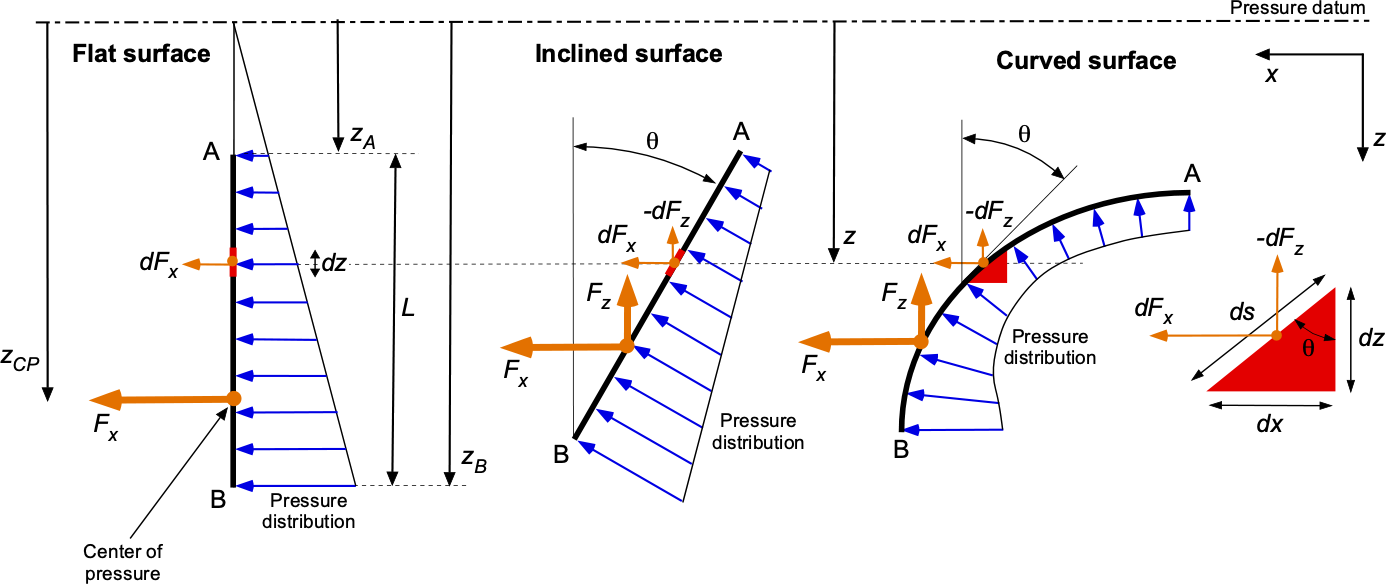
The total force is the vector integral of the differential pressure forces over the surface area :
where is the gage pressure and is the differential area vector pointing into the surface. While performing this vector integration directly is possible, it often involves cumbersome calculus. The more elegant and physically intuitive approach is to decompose the force into its horizontal and vertical components, , and calculate each component separately.
2. The Horizontal Force Component: The Projection Method
The key insight for the horizontal force comes from considering the equilibrium of a "virtual" body of fluid.
Imagine isolating the volume of fluid that is bounded by the curved surface of interest and its vertical projection onto a plane. For this fluid volume to be in static equilibrium, the net horizontal force on it must be zero. The only horizontal forces acting on this volume are the force from the curved surface and the force from the rest of the fluid on the flat, projected plane. These two forces must be equal and opposite.
By Newton's third law, the horizontal force the surface exerts on the fluid () is the opposite of the force the fluid exerts on the surface (). Therefore, must be equal in magnitude to the force on the projected plane.
This leads to a simple, powerful rule:
The horizontal component of the hydrostatic force on a curved surface is equal in magnitude and line of action to the hydrostatic force that would be exerted on the vertical projection of that surface.
We already know how to calculate the force on a flat vertical surface:
where is the area of the vertical projection and is the depth of the centroid of that projected area from the free surface.
The following resource provides an excellent explanation of this method using a free-body diagram of the fluid volume.
This document from Ankara University's course materials clearly lays out the logic for decomposing the force into horizontal and vertical components.
Read the initial section, from the beginning up to the first example. Pay close attention to Figure 3.30 and the accompanying text, which explains how the horizontal force on the fluid is balanced. This leads directly to the conclusion summarized in rule number 1.
3. The Vertical Force Component: The Weight Method
A similar equilibrium analysis for the vertical forces on our virtual fluid volume yields the principle for the vertical force component:
The vertical component of the hydrostatic force on a curved surface is equal to the weight of the entire column of fluid directly above that surface, extending up to the free surface.
The intuition is straightforward: the upward vertical force exerted by the surface must be strong enough to support the weight of all the fluid sitting on it. The magnitude of this force is:
where is the volume of the fluid column directly above the curved surface. Calculating this volume is where your skills in integration will be valuable for complex geometries.
A Note on Surfaces with Fluid Below
What happens if the fluid is below the curved surface, like on the underside of a boat hull or a gate hinged at the bottom? The principle remains the same, but the force direction changes. The vertical force is now directed downward and is equal to the weight of the imaginary fluid that would fill the volume above the surface up to the level of the free surface. This is effectively a buoyancy concept. The vertical force is equal to the weight of the fluid displaced by the curved feature.
4. Application: Solving a Problem
Let's see this method in action. The following video solves a classic problem involving a quarter-circular gate. This is a typical exam-style question that requires a firm grasp of the component method.
Solved Exam Problem: Hydrostatic Forces on a Curved Gate
This video from the "Fluid Matters" channel provides a step-by-step solution for the forces on a curved gate. The use of a free-body diagram for the adjacent water volume is a crucial problem-solving technique.
Watch the video from the beginning up to the end of Part A. Focus on these key steps: Conceptualization: Notice the initial discussion on how the pressure distribution gives an intuitive sense of the force directions (General Physics). Free-Body Diagram: The most critical step is drawing the FBD of the water adjacent to the gate (FBD setup). This allows you to use equilibrium principles. Horizontal Force: Observe how F_H is calculated simply by finding the force on the projected vertical surface AC (calculating FH). Vertical Force: Pay close attention to how F_V is found. Because the fluid is below the gate, the vertical force on the gate is upward. The video finds this force by applying static equilibrium to the water volume (calculating FV). The upward force F_V balances the downward weight of the water volume and the downward pressure force on the top surface of the water volume. Note the careful distinction between the force of the gate on the water (downward) and the force of the water on the gate (upward).
5. Connecting to Your Goals: JEE Advanced Problems
The component method is the standard approach for solving problems in competitive exams like the JEE. The next video tackles two such problems. The second problem is particularly relevant as it involves finding forces on a quarter-cylinder plate to calculate tension in a cable, requiring torque analysis.
[JEE Adv] Force on Curved Surfaces Due to Fluids | SBT 57 and 75
This video from "JeePhyX" demonstrates the application of these principles in a problem-solving context relevant to your goals.
Focus on the second problem presented, starting from the beginning of the question. Observe how the solution unfolds: An FBD of the fluid is used to establish that F_H is the force on the vertical wall and F_V is the weight of the fluid volume. The video quickly calculates these components. It then makes an important point about the line of action for circular surfaces, which we will study in the next lesson, and uses it to balance torques. This gives you a taste of what's to come.
6. The Fundamental Approach: Direct Integration
Given your strength in calculus, it's valuable to see how the component method derives directly from integrating the elemental forces. This solidifies the link between the physics and the mathematics.

Consider a small segment of the curve with length and width (into the page). The pressure at depth is . The force on this area element is . We can resolve this force into components using the angle that the normal to the surface makes with the vertical.
-
Horizontal Component: .
From the geometry, the change in vertical height over the segment is . Substituting this in, we get:
Integrating from the top of the surface () to the bottom () gives , which is exactly the force on the projected vertical plane of height and width . -
Vertical Component: .
From geometry, the change in horizontal distance is . Substituting this gives:
Integrating this, , is precisely the calculation for the weight of the fluid volume above the curve.
This formal derivation confirms that our intuitive component method is mathematically rigorous.
Conclusion
In this lesson, we have developed a robust and intuitive method for calculating the hydrostatic force on a submerged curved surface. Instead of tackling a difficult vector integral, we decompose the problem into two simpler parts.
Key Takeaways:
- The total hydrostatic force on a curved surface is found by calculating its horizontal and vertical components separately.
- The horizontal component () is equal to the force on the vertical projection of the surface. It is calculated as .
- The vertical component () is equal to the weight of the fluid column directly above the surface, up to the free surface. It is calculated as .
- For surfaces with fluid below them, the vertical force acts downward and is equal to the weight of the imaginary fluid that would occupy the space above the surface.
You now have the tools to analyze the forces on a wide variety of submerged objects. In our next lesson, we will complete this topic by learning how to combine these components to find the magnitude and direction of the resultant force. More importantly, we will determine the resultant's line of action, or the center of pressure, which is crucial for analyzing torques and the stability of structures like gates and dams.