Welcome back! In our previous lesson, we explored variable mass systems, deriving a generalized form of Newton's second law to handle scenarios like rocket propulsion and falling chains. We saw how a solid grasp of calculus allows us to tackle mechanics problems that go beyond the introductory level.
Today, we'll continue this theme of applying advanced calculus to mechanics by turning our attention back to rotational dynamics. You're already familiar with calculating the moment of inertia, , for simple objects. However, problems in sources like Irodov and JEE Advanced often demand the calculation of for more complex, continuous bodies like cones and hemispheres. This lesson will equip you with the necessary techniques, leveraging the triple integration skills you developed earlier in this course. Our goal is to calculate the moment of inertia for these shapes, solidifying your ability to translate a physical problem into a solvable multivariable integral.
1. The General Integral for Moment of Inertia
Recall that the moment of inertia is the rotational analogue of mass, representing an object's resistance to angular acceleration. For a system of discrete particles, it is defined as . For a continuous body, this sum becomes an integral over the entire body:
Here, is an infinitesimal mass element, and is its perpendicular distance from the axis of rotation.
To solve this integral, we need to express in terms of spatial coordinates. If the object has a volume and a uniform mass density , then a small volume element has a mass . This transforms our equation into a triple integral over the volume of the body:
The key is to correctly identify and for a given axis and coordinate system. The resource below provides the explicit formulas for the moment of inertia about the Cartesian axes.
[PDF] 24. Simply connected regions; triple integrals - The Swiss Bay
These notes from an MIT course discuss various applications of triple integrals in mechanics. The relevant part for us is the formal definition of moment of inertia using these integrals.
Please read the section that begins with this paragraph. Focus on how the perpendicular distance squared (d^2) is expressed for the z-axis, x-axis, and y-axis, leading to the integral definitions for I_z, I_x, and I_y.
As you've just read, if we are calculating the moment of inertia about the z-axis, the perpendicular distance squared for a point is . The integral becomes:
While this is the general form, evaluating it in Cartesian coordinates is often cumbersome. The art lies in choosing a coordinate system (cylindrical or spherical) and a method of slicing that simplifies the integral.
2. Case Study 1: The Solid Cone
Let's find the moment of inertia of a solid cone of mass , height , and base radius about its central axis of symmetry. We'll explore two powerful methods to solve this.
Method 1: Slicing into Elemental Disks
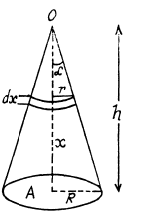
This is an intuitive method frequently used in physics. We can think of the cone as a stack of infinitesimally thin disks. We know the moment of inertia of a solid disk of mass and radius about its central axis is . Our strategy is:
- Consider an elemental disk at a height from the base, with thickness .
- Express its radius and mass as a function of .
- Write the moment of inertia of this elemental disk.
- Integrate from the base () to the vertex ().
The following video provides an excellent step-by-step walkthrough of this exact process. Note that the presenter measures distance from the vertex (x) instead of the base (z), but the principle is identical.
Class 11 Physics | Rigid Body Dynamics | #8 Moment of Inertia of a Solid Cone | For JEE & NEET
This Physics Galaxy video masterfully demonstrates the slicing method to find the moment of inertia of a solid cone. It is a perfect illustration of the physical approach to setting up the integral.
Please watch the entire derivation from the beginning to the result. Pay close attention to these four key steps: Finding r(x): How similar triangles are used to relate the disk's radius to its position. Finding dm: How the mass of the elemental disk is found using the cone's overall density. Finding dI: Setting up the moment of inertia for the single elemental disk. Integrating dI: Summing the moments of inertia of all disks to get the total moment of inertia.
By following this method, you arrive at the final result:
Method 2: Direct Triple Integration (Cylindrical Coordinates)
Now, let's solve the same problem using the formal triple integral. Given the cone's cylindrical symmetry, cylindrical coordinates are the natural choice.
- The volume element is .
- The squared perpendicular distance to the z-axis is simply .
- The density is .
The integral becomes:
The main challenge is defining the integration limits.
- sweeps the full circle: .
- The height goes from base to vertex: .
- For a given height , the radius is constrained by the cone's wall. The line forming the cone's side is . So, for a given , goes from 0 to .
Setting up the integral:
Let's evaluate it step-by-step:
- Integrate with respect to r:
- Integrate with respect to z:
Let , then . The limits change from and .
- Integrate with respect to :
Combining everything and substituting :
Both methods yield the same correct result. The slicing method is often faster if you remember the component formula (), while the triple integral is more fundamental and universally applicable.
3. Case Study 2: The Solid Sphere
Next, let's find the moment of inertia of a solid sphere of mass and radius about an axis passing through its center.
Method 1: Slicing into Disks (for a Hemisphere)
While we can apply this to a full sphere, it's illustrative to first consider a solid hemisphere of radius rotating about its axis of symmetry. We can slice it into disks of thickness at a height from the base.

From the geometry, the radius of a disk at height is given by . The mass of this elemental disk is .
The moment of inertia of this disk is .
To find the total moment of inertia for the hemisphere, we integrate from to :
Substituting the density of a hemisphere, , we get:
Method 2: Exploiting Symmetry (for a Full Sphere)
Calculating the triple integral for a sphere in Cartesian coordinates is a nightmare. Using spherical coordinates is better, but there's an even more elegant approach that relies on the sphere's perfect symmetry. This method is a hallmark of clever physics problem-solving.
The following MIT OpenCourseWare video demonstrates this beautiful technique.
29.5 Deep Dive - Moment of Inertia of a Sphere
This video calculates the moment of inertia of a sphere using a powerful symmetry argument, which greatly simplifies the calculation. This is a must-know technique for advanced problem solving.
Watch the entire video from start to finish. The core logic unfolds in these parts: Using Symmetry: Understand why, for a sphere, I_x = I_y = I_z. Summing the Integrals: See how adding I_x, I_y, and I_z produces a much simpler term, 2(x^2+y^2+z^2) = 2r_{sphere}^2. Integrating over Shells: Observe how the problem is reduced to a simple 1D integral by considering the sphere as a set of concentric spherical shells. The Final Result: The derivation concludes with the famous formula.
The key insight is that . Since , we have . This integral is simple in spherical coordinates, as it only depends on the radial coordinate. As shown in the video, this leads to the classic result:
Notice that the moment of inertia for the hemisphere about its axis of symmetry has the same form as the sphere's. This makes sense: the mass distribution relative to that axis is identical in form.
Conclusion
Today, we've deepened your ability to solve complex problems in rotational dynamics by mastering the calculation of moment of inertia for continuous bodies. We've seen that what might seem like a daunting triple integral can be tamed by choosing the right approach.
Here are the essential takeaways:
- The fundamental formula for moment of inertia is , which can be written as a triple integral .
- Method 1 (Slicing): For bodies with a high degree of symmetry, slicing the object into simpler shapes with known moments of inertia (like disks) is an efficient and intuitive strategy.
- Method 2 (Direct Integration): For any shape, you can set up the full triple integral. The key to success is choosing the coordinate system (cylindrical, spherical) that best matches the geometry of the body to simplify the limits of integration.
- Symmetry is your most powerful tool. As seen with the sphere, exploiting symmetry can transform a complicated set of integrals into a single, simple one.
You are now well-equipped to calculate the moment of inertia for a wide variety of objects that appear in advanced physics problems.
In our next lesson, we will continue applying integration to rigid body dynamics. We will move from analyzing mass distribution to analyzing force distribution, specifically learning how to formulate integral expressions for the net force and torque exerted by position-dependent friction on a body.