Hello! Welcome back to our course on advanced calculus applications in mechanics.
In our last lesson, we built a solid foundation for analyzing three-dimensional objects by learning to set up and evaluate triple integrals for mass and center of mass. The key insight was expressing an infinitesimal mass element, , in terms of a volume element, , using the object's density.
Today, we will apply this powerful framework to a central concept in rotational dynamics: the moment of inertia. You're likely familiar with the moment of inertia as the rotational analogue of mass, representing a body's resistance to angular acceleration. We'll move beyond simple formulas for specific shapes and learn how to formulate the general integral expression for the moment of inertia of any continuous body. This will allow you to derive these formulas from first principles, a crucial skill for tackling the advanced problems in sources like Irodov and H.C. Verma.
1. From Sums to Integrals: The Concept of Moment of Inertia
In introductory mechanics, the moment of inertia, , for a collection of discrete point masses is defined as the sum:
where is the mass of the -th particle and is its perpendicular distance from the axis of rotation.
For a continuous rigid body, we can think of it as an infinite collection of infinitesimal point masses, . The sum then transforms into an integral over the entire body:
This is our master formula. Here, is the perpendicular distance of the mass element from the axis of rotation. The main challenge, and the focus of this lesson, is learning how to express and in a form that we can actually integrate.
To see how this integral naturally arises from fundamental principles, the following video provides a great conceptual overview and links it to rotational kinetic energy.
AP Physics C - Moment of Inertia
This video from APlusPhysics provides a concise introduction to the concept of rotational inertia and its mathematical origin.
Please watch the first few minutes, focusing on two key parts: The introduction, which defines moment of inertia and contrasts it with translational inertia (mass). The derivation, which shows how the expression I = \sum mr^2 naturally emerges when deriving the formula for rotational kinetic energy, K_{rot} = \frac{1}{2}I\omega^2.
2. Deconstructing the Master Formula
The expression can be confusing at first because we are integrating with respect to mass. The key is to transform this into an integral with respect to spatial variables (like , , or , , ) that we can set limits for.
We achieve this by relating the mass element to a geometric element (, , or ) using a density function:
- For 1D objects (like a rod): , where is the linear mass density (mass per unit length).
- For 2D objects (like a plate): , where is the areal mass density (mass per unit area).
- For 3D objects (like a sphere): , where is the volumetric mass density (mass per unit volume).
This substitution turns our abstract integral into a concrete single, double, or triple integral, just like those we solved in the previous lesson.
Finding Moment of Inertia (Rotational Inertia?) $I$ Using ...
This Stack Exchange discussion directly addresses the common confusion about integrating with respect to mass.
Read the beginning of the top answer by user Justin L., specifically the first paragraph, which explains the idea of changing the integration variable. Then, look at the start of the second answer by Tobias Kienzler, which provides the formal relationship between dm and the volume element dV (denoted as d^3 \mathbf r).
The general expression for moment of inertia about the z-axis for a 3D object is therefore:
Notice that , the squared perpendicular distance to the z-axis, is . This is a crucial detail. The in the formula is not a coordinate in a particular system, but a physical distance that you must express using the coordinates you choose.
Let's now put this into practice by deriving the moment of inertia for a few standard shapes.
3. Application 1: Slender Rod (1D)
Let's find the moment of inertia of a uniform slender rod of mass and length rotating about an axis through one of its ends.
- Axis and Coordinates: Place the rod along the x-axis, with the axis of rotation at the origin (). The rod extends from to .
- Mass Element : We consider a small segment of the rod of length at a position . The linear density is uniform, so . The mass of the segment is .
- Distance : The perpendicular distance of our mass element from the axis of rotation (at ) is simply . So, .
- Formulate and Solve the Integral: Since and are constants, we can pull them out:
The following video provides an excellent, detailed walkthrough of this derivation.
Moment of Inertia For Slender Rod - Formula Derivation Via Integration Physics With Calculus
This video from The Organic Chemistry Tutor clearly derives the moment of inertia for a slender rod.
First, watch the general setup, which explains how to define the differential mass element dm in terms of the differential length dx. Then, see how this is applied to find the inertia for a rod rotating about its end (the case where their variable h=0) in this segment.
4. Application 2: Solid Cylinder (Method of Shells)
Let's find the moment of inertia of a uniform solid cylinder of mass , radius , and length about its central axis.
Here, instead of a full triple integral, it's more intuitive to use the "method of cylindrical shells". We imagine the solid cylinder is built from an infinite number of nested, hollow, thin cylinders (shells).
- Axis and Element: The axis is the central axis of the cylinder. Our element is a thin cylindrical shell of radius , thickness , and length .
- Mass Element : The volume of this shell is its surface area times its thickness: . The total volume is , so the uniform density is . The mass of our shell is .
- Distance : Every part of this thin shell is at the same distance, , from the axis of rotation.
- Formulate and Solve the Integral: We sum the moments of inertia of all shells from to .
This common result is derived clearly in the APlusPhysics video.
AP Physics C - Moment of Inertia
This part of the APlusPhysics video shows the derivation for the moment of inertia of a solid cylinder.
Watch the derivation from this segment. Notice how dm is defined for a thin cylindrical shell and how constants are managed during the integration.
5. Application 3: Solid Sphere (Full Triple Integral)
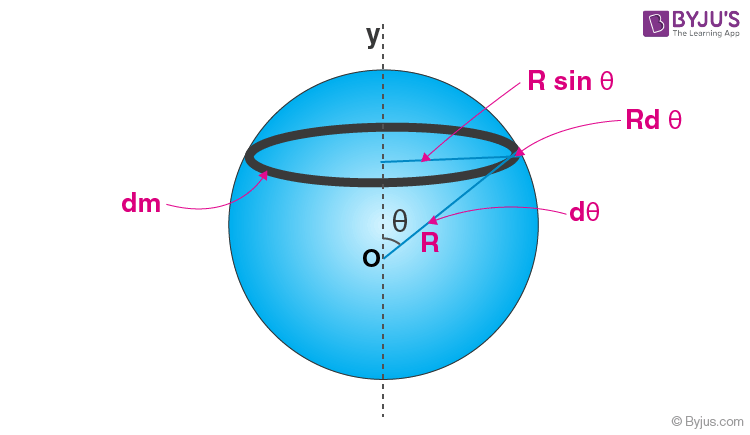
Finally, let's tackle a true 3D problem that uses the skills from our last lesson: finding the moment of inertia of a uniform solid sphere of mass and radius about an axis through its center.
- Axis and Coordinates: Let the axis of rotation be the z-axis. Given the spherical symmetry, spherical coordinates are the natural choice.
- Mass Element : The sphere's volume is , so its density is . The mass element is .
- Distance : This is the most important step. For a point at , what is its perpendicular distance to the z-axis? This is the radius in the xy-plane, which is . Therefore, .
-
Formulate and Solve the Integral: We integrate over the volume of the sphere.
Let's group the terms and integrate.
Evaluating each integral separately:
- . Using u-substitution with , this evaluates to .
Putting it all together:
Now, substitute back the density :
This confirms the well-known result, derived directly from the fundamental integral definition.
Conclusion
In this lesson, you've learned how to translate the physical concept of moment of inertia into a solvable mathematical expression. This is a foundational skill for advanced mechanics.
Here are the key takeaways:
- The moment of inertia of a continuous body is given by the integral .
- The core task is to express the mass element and the perpendicular distance in a suitable coordinate system.
- For 3D objects, , which turns the problem into a triple integral that builds directly on your skills from the previous lesson.
- The term is the perpendicular distance to the axis of rotation and must be carefully determined. For rotation about the z-axis, , which becomes in cylindrical coordinates and in spherical coordinates.
In our next lesson, we will explore two powerful tools that allow us to simplify moment of inertia calculations dramatically: the parallel axis theorem and the perpendicular axis theorem. These theorems will enable us to find the moment of inertia about different axes without having to re-calculate the integral every time.