Hello! Let's dive into the next topic in our exploration of advanced mechanics.
In our last lesson, we established the fundamental method for calculating the moment of inertia by integrating . While this integration method is powerful, it can be cumbersome to apply from scratch every time you want to consider a new axis of rotation. Today, we will learn about two remarkable shortcuts that can save you a tremendous amount of effort: the parallel axis theorem and the perpendicular axis theorem. These theorems allow you to find the moment of inertia about a new axis by leveraging a known moment of inertia, often one that you've already calculated (like those for the rod, cylinder, and sphere from our last lesson). Mastering these theorems is essential for efficiently solving the complex rotational dynamics problems found in sources like JEE Advanced and Irodov.
1. The Parallel Axis Theorem
Imagine you have calculated the moment of inertia of a rigid body about an axis passing through its center of mass (). What if you need to find the moment of inertia about a different axis, one that is parallel to the first? Must you perform a whole new integration? The parallel axis theorem provides a definitive "no".
The theorem states that the moment of inertia about any axis is equal to the moment of inertia about a parallel axis passing through the center of mass, , plus the total mass of the body multiplied by the square of the perpendicular distance between the two axes.
Mathematically, this is expressed as:
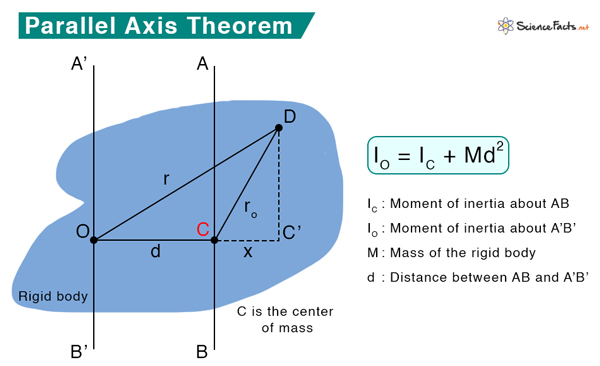
This theorem is universally applicable to any rigid body, whether it's 2D or 3D. The only condition is that the two axes must be parallel, and one of them must pass through the center of mass.
The Proof
For a student who appreciates the "why" behind the physics, the proof of this theorem is both elegant and insightful. It relies on the definition of the center of mass and basic vector properties. The following reading from a lecture by Prof. Ramamurti Shankar at Yale provides a clear and rigorous derivation.
PHYS 200 - Lecture 10 - Rotations, Part II: Parallel Axis Theorem
This lecture transcript provides a detailed, step-by-step proof of the Parallel Axis Theorem.
Please read the section titled "Proof of the Parallel Axis Theorem". Focus on the vector-based derivation starting from the main derivation. The key step is realizing why the cross-term in the expansion, which involves \sum m_i \mathbf{r}_i, vanishes due to the definition of the center of mass.
Application 1: The Slender Rod Revisited
Let's see the theorem in action with an example we know well. In the previous lesson, we used integration to find that the moment of inertia of a uniform rod of length about its center is , and about its end is . Let's use the parallel axis theorem to derive from .
The axis through the end is parallel to the axis through the center. The distance between them is half the length of the rod, . Applying the theorem:
This perfectly matches our result from integration, but with far less work! The following video from MIT OpenCourseWare walks through this exact application.
This video by Prof. Walter Lewin provides a concise explanation and demonstration of the Parallel Axis Theorem.
Watch the entire short video. Pay attention to how the theorem is stated (the formula), applied to the rod example (rod application), and then confirmed by direct integration (the check).
For more practice, The Organic Chemistry Tutor video provides several clear examples, starting with discrete point masses and then applying the theorem to the rod. It's a great resource for building fluency.
Parallel Axis Theorem & Moment of Inertia - Physics Practice Problems
This video provides several practice problems for the parallel axis theorem.
Watch the segment from the theorem's introduction to see how it's used with point masses. Then, watch the derivation for the rod from this segment for another perspective on the application we just covered.
2. The Perpendicular Axis Theorem
The second powerful tool is the perpendicular axis theorem. This theorem is a special case that applies only to planar objects (or laminas), i.e., 2D objects or 3D objects with negligible thickness.
The theorem states that for a planar object, the moment of inertia about an axis perpendicular to its plane () is equal to the sum of the moments of inertia about two mutually perpendicular axes ( and ) that lie within the plane of the object and intersect the z-axis.
Mathematically:

The proof is remarkably straightforward, flowing directly from the definition of the moment of inertia.
Classical Mechanics LECTURE 23: MoI THEOREMS AND ...
This handout from the University of Oxford provides a concise statement and proof of the perpendicular axis theorem.
On page 5 of the PDF, find the section "Perpendicular axis theorem". Read the short text and follow the derivation provided. You'll see it's a simple application of Pythagoras's theorem within the moment of inertia integral.
Application: Moment of Inertia of a Disc about a Diameter
The classic application of this theorem is to find the moment of inertia of a uniform circular disc about one of its diameters. Direct integration for this is tricky. However, we know from the last lesson that the moment of inertia about the axis perpendicular to the disc and passing through its center is .
Let's set up our coordinate system with the disc in the xy-plane and the z-axis perpendicular to it through the center. The x and y axes are then two perpendicular diameters.
From the theorem, we have .
Due to the symmetry of the disc, the moment of inertia about any diameter must be the same. Therefore, . We can call this .
Substituting this into the theorem's equation:
Now we can solve for the moment of inertia about a diameter:
This elegant result is obtained with simple algebra, completely bypassing a complex integral.
3. Combining the Theorems: A Typical Problem
The true power of these theorems is revealed when you use them together to solve more complex problems. Consider this challenge:
Find the moment of inertia of a uniform circular disc of mass and radius about an axis tangent to its edge and lying in the plane of the disc.
Let's break this down step-by-step:
- Identify the target axis: An axis that is a tangent line, in the plane of the disc.
- Identify a known, related axis: We don't immediately know the moment of inertia about an axis through the center of mass that is parallel to this tangent. The parallel axis is a diameter.
- Step 1: Find the moment of inertia about a diameter. We just did this using the perpendicular axis theorem!
- We know .
- Using and symmetry (), we found .
- Step 2: Use the Parallel Axis Theorem. Now we can find the moment of inertia about the tangent. The tangent line is parallel to a diameter, and the distance between them is the radius of the disc, .
- Our "center of mass axis" in this context is the diameter, so in the formula corresponds to .
- Applying the theorem:
By combining the two theorems, we solved a non-trivial problem without any integration at all. This kind of multi-step reasoning is precisely what's needed for competitive exams.
Conclusion
Today, we've added two powerful, labor-saving devices to your mechanics toolkit. They allow you to build upon known results instead of starting from scratch with integration every time.
Here are the key takeaways:
- Parallel Axis Theorem: . It connects the moment of inertia about an axis through the center of mass to that of any parallel axis. It works for all rigid bodies.
- Perpendicular Axis Theorem: . It connects the out-of-plane moment of inertia to the in-plane ones. It works only for planar (2D) objects.
- The real skill lies in identifying which theorem to use and how to combine them to find the moment of inertia about a desired axis from a known one.
Having now solidified our methods for describing a body's rotational inertia, our next step is to refine our language for describing rotational motion. In the upcoming lesson, we will develop the kinematic framework of polar coordinates, which provides a much more natural and powerful way to analyze circular and central force motion.