Welcome to the final lesson in our module on advanced mathematical tools. In our last session, you did the heavy lifting of deriving the expressions for velocity and acceleration in polar coordinates. This was a purely kinematic exercise, but it armed us with the exact tools needed to analyze motion in systems with rotational symmetry.
Today, we will put those tools to work by applying them to a very important class of physical problems: motion under a central force. Your goal is to apply Newton's second law, , in this new coordinate system. By doing so, we will not only formulate the equations of motion but also derive one of the most fundamental principles in physics—the conservation of angular momentum—directly from these equations. This lesson bridges the mathematical formalism we've developed with profound physical insight, a key step toward your goal of mastering advanced mechanics.
1. What is a Central Force?
Before we dive into the mathematics, let's define our subject. A force is considered "central" if it satisfies two conditions:
- It is always directed along the line connecting the particle and a fixed point, which we take as the origin.
- Its magnitude depends only on the distance, , from the origin.
Mathematically, this means the force vector can be written in the elegant form:
where is some scalar function of the radial distance , and is the radial unit vector. Notice the most important feature: the force has no component in the transverse () direction.
This type of force is not a niche case; it describes some of the most fundamental interactions in the universe, including:
- Gravitational force: The force exerted by the sun on a planet.
- Electrostatic force: The force exerted by a proton on an electron in a hydrogen atom.
- Tension in a string: The force keeping a mass in circular motion, like in the diagram below.

2. Formulating Newton's Second Law in Polar Coordinates
We are now ready to combine Newton's law, , with the expressions for force and acceleration in polar coordinates. As a quick reminder from our previous lesson, the acceleration vector is:
Substituting the expressions for and into Newton's second law gives:
This single vector equation contains a wealth of information. Since the basis vectors and are orthogonal, we can equate the coefficients on each side independently. This powerful step separates the vector equation into two distinct scalar differential equations.
The following video by Jeffrey Chasnov provides a clear, step-by-step walkthrough of this formulation and its immediate consequences.
Central Force | Lecture 29 | Vector Calculus for Engineers
This video clearly sets up the central force problem and derives the two component equations from Newton's second law in polar coordinates.
First, watch the introduction to understand how a central force problem is defined from the start. Then, jump to the main derivation where Newton's law is applied and separated into its radial and angular components, from this segment.
As the video demonstrates, we arrive at two fundamental equations of motion:
-
Radial Equation:
This equation relates the radial motion () to the central force and the centripetal acceleration term (). -
Angular (or Transverse) Equation:
Because a central force has no transverse component, the right-hand side of this equation is zero. As we will see next, this simple fact leads directly to a major conservation law.
3. Derivation of Angular Momentum Conservation
Let's focus on the angular equation of motion. Since the mass is not zero, we have:
This expression may look complex, but it has a very special structure. It is, in fact, what you get if you take the time derivative of and divide by . Let's verify this using the product rule:
So, our angular equation of motion can be rewritten as:
Since is generally non-zero, this implies that the time derivative of the quantity inside the parenthesis must be zero:
This is the statement of a conservation law: the quantity does not change with time; it is a constant of the motion.
But what is this quantity? Let's connect it back to the definition of angular momentum, , where .
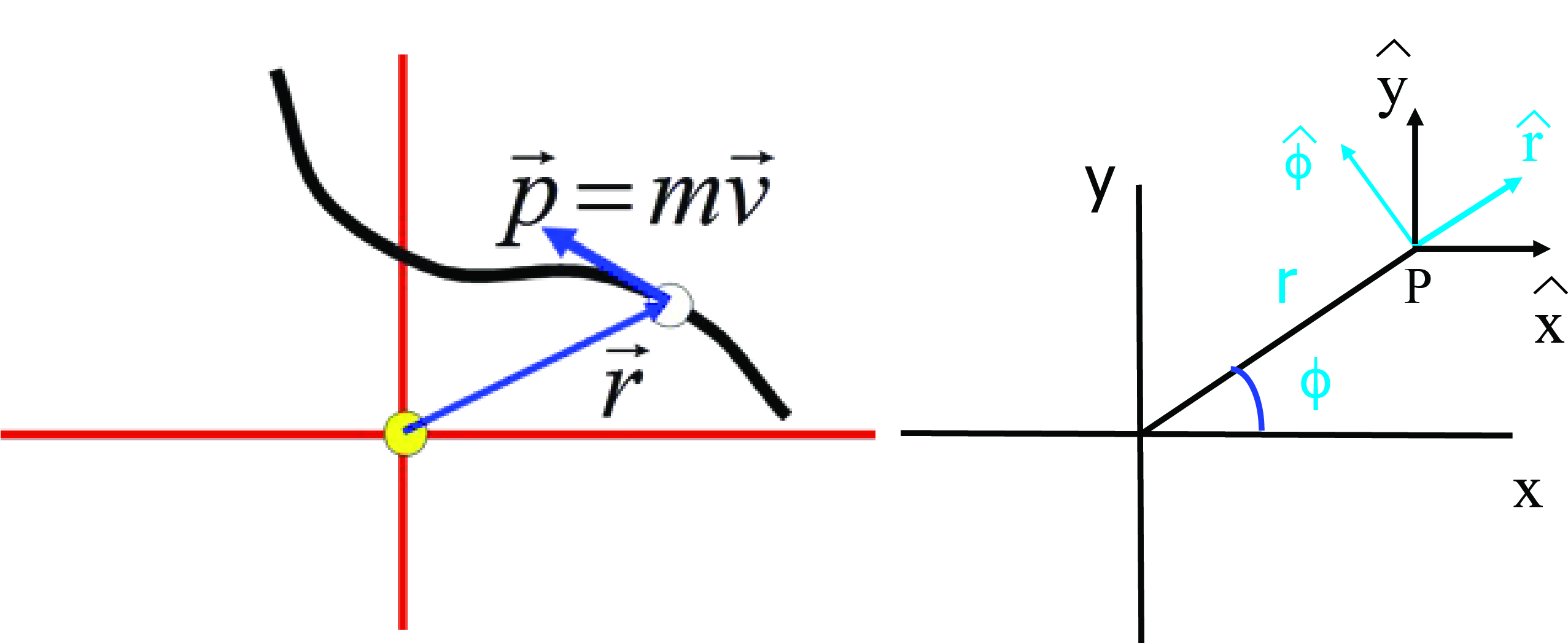
Using our polar expressions for and :
The cross product becomes:
Since the cross product of any vector with itself is zero (), the first term vanishes. If we define as the unit vector perpendicular to the plane of motion (), we are left with:
The magnitude of the angular momentum is therefore . This is precisely the quantity that our angular equation of motion told us is constant!
Thus, by applying Newton's laws in polar coordinates, we have rigorously proven that for any central force, angular momentum is conserved.
The following resources provide a formal summary of this derivation.
Central Force | Lecture 29 | Vector Calculus for Engineers
This part of the video from Jeffrey Chasnov shows how the angular equation simplifies to a conservation law and explicitly identifies the conserved quantity as angular momentum.
Watch how the angular equation is recognized as a conservation law from this segment. The summary from this point recaps the beauty and utility of this approach.
These lecture notes from the University of Cambridge provide a concise, text-based derivation that mirrors the one we've just completed.
In the document, find the section "4.2 Back to Central Forces". Read from the beginning of this section, to the end. Pay close attention to how equation (4.4) is split into its components and how the \hat{\theta} component is manipulated to show that l = r^2\dot{\theta} is the conserved angular momentum per unit mass.
4. Consequences of Angular Momentum Conservation
This conservation law is not just a mathematical curiosity; it has profound physical consequences.
-
Planar Motion: The angular momentum vector is constant in both magnitude and direction. By definition, is perpendicular to both and . If the direction of is fixed, it means that the position vector and velocity vector must always remain in a single, fixed plane perpendicular to . This is a remarkable simplification: any 3D problem involving a central force immediately reduces to a 2D problem.
-
Kepler's Second Law: The quantity , the rate at which the position vector sweeps out area, is given by . Since we found that is constant, it follows that is also constant. This is precisely Kepler's second law of planetary motion: a line joining a planet and the sun sweeps out equal areas during equal intervals of time.
Conclusion
In this lesson, we have reached a significant milestone. By combining the kinematics of polar coordinates with Newton's second law, we have seen how a complex vector equation of motion naturally decomposes into more manageable radial and angular components.
Your key takeaways are:
- For a central force , Newton's second law splits into two equations:
- Radial:
- Angular:
- The angular equation is a direct statement of the conservation of angular momentum, .
- A direct consequence of the conservation of the angular momentum vector is that all motion under a central force is confined to a fixed plane.
This concludes our first module on the advanced mathematical tools for physics. You have built a solid foundation in vector calculus applications, multivariable integration for physical quantities, and now, the analysis of motion in polar coordinates.
In our next module, "Advanced Applications in Mechanics," we will shift gears. You will apply these mathematical skills, alongside your existing mechanics knowledge, to solve a variety of challenging dynamics problems. We will begin by tackling kinematic problems where acceleration is not constant, but rather a function of time, position, or velocity—a common feature in the advanced problems you aim to master.