In our last lesson, we developed the concept of a line integral to sum up the effect of a vector field along a one-dimensional path. This allowed us to generalize the idea of work for variable forces and curved trajectories. We will now expand our integration capabilities from 1D paths to 2D surfaces.
Today's goal is to learn how to set up and evaluate double integrals, which are the natural tool for integrating over two-dimensional regions. You will apply this powerful mathematical technique to solve a classic problem in mechanics: finding the mass and center of mass of a flat plate, or lamina, with a density that can vary from point to point. This skill is a cornerstone for analyzing continuous bodies, a frequent topic in the advanced physics problems you aim to master.
1. Defining Mass with a Double Integral
Imagine a thin, flat sheet of metal. If its density were uniform, finding its mass would be simple: mass = density × area. But what if the density is not constant? What if one part of the sheet is thicker or made of a heavier material than another? We need a way to sum up the mass over the entire object.
This is precisely where the double integral comes in. We can think of the lamina as being composed of countless infinitesimally small rectangular patches.
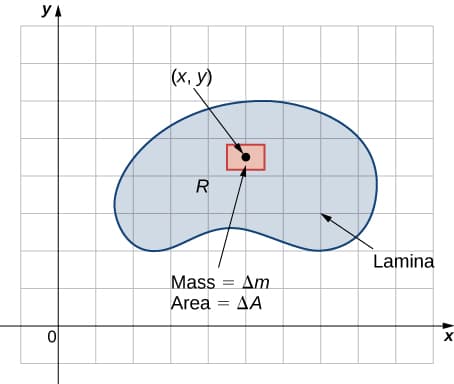
A planar lamina, denoted by the region 'R', is divided into tiny rectangular elements. Each element at position (x, y) has an area ΔA and a corresponding mass Δm.
If the area of a tiny patch at point is , and the density (mass per unit area) at that point is given by a function , then the mass of that tiny patch is . To find the total mass of the lamina, we must sum up the masses of all these infinitesimal patches over the entire region . This summation is the double integral:
Professor Leonard provides an excellent introduction to this idea.
Calculus 3 Lecture 14.4: Center of Mass (and Moments of Mass and Inertia) for Lamina in 2-D
This video introduces the concept of a lamina and explains how its mass can be calculated from a density function using a double integral.
Please watch the first three and a half minutes, from the beginning to the initial discussion of mass. Pay attention to how the double integral arises naturally from the idea of summing up mass over a 2D region.
2. Evaluating Double Integrals: Iterated Integrals
The expression is conceptually clear, but to compute it, we need a practical method. We do this by converting the double integral into an iterated integral, which is simply two nested single-variable integrals.
The key is to describe the 2D region of integration using bounds on and . For a region defined by and , the double integral becomes:
You evaluate this from the inside out: first, integrate with respect to (treating as a constant), and then integrate the resulting function of with respect to . The area element becomes .
For a deep dive into the mechanics of setting up these iterated integrals, the following text is very helpful.
[PDF] Calculus of Several Variables
This section from an IIT Madras textbook explains how to calculate double integrals over rectangular and more general regions by converting them into iterated integrals.
Please read the subsection "Calculating double integrals" starting on page 46. Focus on the definitions of regions that are regular in y-direction and x-direction. Then, study Example 2.6 and Example 2.11 to see how the limits of integration are determined from the bounding curves of the region.
3. Center of Mass Formulas
You'll recall from mechanics that for a system of discrete point masses, the center of mass is a weighted average of their positions. For a continuous body like a lamina, this summation becomes an integration.
The coordinates of the center of mass are given by:
where is the total mass we've already defined. and are the first moments of mass.
- Moment about the y-axis (): This measures the tendency of the lamina to rotate about the y-axis. The "lever arm" for any point is its x-coordinate.
- Moment about the x-axis (): This measures the tendency to rotate about the x-axis. The lever arm is the y-coordinate.
The logic behind these formulas is explained very intuitively in the next segment of Professor Leonard's video.
Calculus 3 Lecture 14.4: Center of Mass (and Moments of Mass and Inertia) for Lamina in 2-D
This part of the video explains the physical meaning of moments and derives the formulas for the center of mass coordinates. It's followed by a concise recap.
Watch from the introduction of moments to the full definition of the center of mass. The analogy to a wrench and a lever arm is particularly helpful for understanding why the moment about the y-axis involves x, and vice-versa. Then watch the recap from this point.
Now, let's see a complete example of calculating the mass, moments, and center of mass for a simple rectangular lamina in Cartesian coordinates.
Calculus 3 Lecture 14.4: Center of Mass (and Moments of Mass and Inertia) for Lamina in 2-D
This segment walks through a full example from start to finish.
Watch the worked example starting at this timestamp. Follow each of the five integral calculations: mass (M), moments (Mx, My), and finally the assembly into the center of mass coordinates (x̄, ȳ).
4. Integration in Polar Coordinates
Evaluating double integrals in Cartesian coordinates can become very difficult if the region is circular. For such cases, it is much easier to work in polar coordinates.
The transformation is:
The most critical change is the area element . In polar coordinates, an infinitesimal patch of area is not simply . Due to the geometry of polar grids, the area element becomes:
This extra factor of is essential and easy to forget, so be mindful of it.

An example problem showing a region of integration well-suited for polar coordinates. Note the conversion of the integrand and the r dr dθ area element.
The process is then to express the integrand and the bounds of the region in terms of and , and evaluate the new integral.
[PDF] Calculus of Several Variables
This section explains the change of variables to polar coordinates and derives the r dr dθ area element.
Please read the subsection "Calculating double integrals using polar coordinates" on pages 50-52. Pay close attention to the derivation of the area element ∆sij which leads to the factor of ρ (their notation for r) in the final integral form.
5. Center of Mass of a Semicircle
Let's tackle a classic mechanics problem: finding the center of mass of a uniform semicircle. This is a perfect demonstration of the power of polar coordinates. Attempting this in Cartesian coordinates is possible, but significantly more complex.
The video below demonstrates how to set up and solve the integrals for the center of mass of a semicircle using polar coordinates. This is a standard result that you will encounter frequently in physics problems.
This video from Physics Ninja calculates the center of mass of a uniform semi-circle, a classic problem that is best solved with polar coordinates.
Watch the setup and calculation from the beginning to the end of Method 1. Observe how symmetry is used to argue that \bar{x}=0 immediately, and then follow the detailed calculation of \bar{y} using polar integration.
For an alternative text-based explanation of a similar problem (a quarter-circle with non-uniform density), you can review Example 15.3.2 in the "Moment and Center of Mass" resource (LINK).
6. Test Your Understanding
Now it's your turn. Let's find the center of mass for a lamina that occupies the region in the first quadrant bounded by the circle and the x and y axes. Assume the density at any point is proportional to its distance from the origin, i.e., , where is a constant.
Your Task:
- Choose a coordinate system. Given the shape of the region and the density function, which system (Cartesian or polar) is more appropriate?
- Set up the integrals. Write down the three double integrals for the mass , the moment , and the moment . Remember to express the integrand and the area element
dAcorrectly in your chosen coordinate system. - Evaluate the integrals to find , , and .
- Calculate the center of mass .
Due to the symmetry of the region and the density function, what can you say about the relationship between and before you even calculate them?
Click here for the solution.
1. Coordinate System: The region is a quarter-circle and the density is simple in polar coordinates. Polar coordinates are the best choice.
2. Setting up the Integrals:
- Region: , .
- Density: .
- Area element: .
The integrals are:
- Mass:
- Moment :
- Moment :
3. Evaluating the Integrals:
- Mass:
- Moment :
- Moment : By symmetry ( vs over the same symmetric interval), we expect . Let's verify:
4. Center of Mass:
The center of mass is at . As expected from the symmetry of both the shape and the density function about the line , we found that .
Conclusion
Today, you have added a major tool, the double integral, to your mathematical arsenal. You've learned not just the mechanics of how to evaluate them, but also their direct physical application in solving for the mass and center of mass of continuous two-dimensional bodies.
Here are the key takeaways:
- The mass of a lamina with density is found by the double integral .
- The center of mass is a weighted average of position, calculated using the moments of mass: and .
- The moments are also double integrals: and .
- Choosing the right coordinate system is crucial. For regions or integrands with circular symmetry, polar coordinates are almost always superior, but you must remember to use the area element .
We have now progressed from integrating over 1D lines to 2D areas. The logical next step is to move into the third dimension. In our next lesson, we will introduce triple integrals, which will allow us to find the mass and center of mass of 3D solid objects using Cartesian, cylindrical, and spherical coordinate systems.